length
16,455 words
a few pages a day
~8 min
finished in
9 days
full read
1h 9m
At Folio's default of ten pages a day, you finish Henry VIII and His Court 6th edition in about 9 days — roughly 8 minutes of reading each morning.
The opening
the first pages of Henry VIII and His Court 6th edition, free
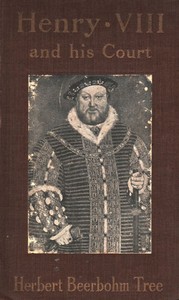
Holbein has drawn the character and written the history of Henry on the canvas of his great picture. Masterful, cruel, crafty, merciless, courageous, sensual, through-seeing, humorous, mean, matter of fact, worldly-wise, and of indomitable will, Henry the Eighth is perhaps the most outstanding figure in English history. The reason is not far to seek. The genial adventurer with sporting tendencies and large-hearted proclivities is always popular with the mob, and "Bluff King Hal," as he was called, was of the eternal type adored by the people. He had a certain outward and inward affinity with Nero. Like Nero, he was corpulent; like Nero, he was red-haired; like Nero, he sang and poetised; like Nero, he was a lover of horsemanship, a master of the arts and the slave of his passions. If his private vices were great, his public virtues were no less considerable. He had the ineffable quality called charm, and the appearance of good-nature which captivated all who came within the orbit of his radiant personality. He was the "beau garçon," endearing himself to all women by his compelling and conquering manhood. Henry was every inch a man, but he was no gentleman. He chucked even Justice under the chin, and Justice winked her blind eye.
It is extraordinary that in spite of his brutality, both Katharine and Anne Boleyn spoke of him as a model of kindness. This cannot be accounted for alone by that divinity which doth hedge a king.
There is, above all, in the face of Henry, as depicted by Holbein, that look of impenetrable mystery which was the background of his character. Many royal men have this strange quality; with some it is inborn, with others it is assumed. Of Henry, Cavendish,[1] a contemporary, records the following saying: "Three may keep counsel, if two be away; and if I thought my cap knew my counsel, I would throw it in the fire and burn it." Referring to this passage, Brewer says, "Never had the King spoke a truer word or described himself more accurately. Few would have thought that, under so careless and splendid an exterior--the very ideal of bluff, open-hearted good humour and frankness--there lay a watchful and secret mind that marked what was going on without seeming to mark it; kept its own counsel until it was time to strike, and then struck as suddenly and remorselessly as a beast of prey. It was strange to witness so much subtlety combined with so much strength."
There was something baffling and terrifying in the mysterious bonhomie of the King. In spite of Cæsar's dictum, it is the fat enemy who is to be feared; a thin villain is more easily seen through.
His Ancestry
Henry's antecedents were far from glorious. The Tudors were a Welsh family of somewhat humble stock. Henry VII.'s great-grandfather was butler or steward to the Bishop of Bangor, whose son, Owen Tudor, coming to London, obtained a clerkship of the Wardrobe to Henry V.'s Queen, Catherine of France. Within a few years of Henry's death, the widowed Queen and her clerk of the wardrobe were secretly living together as man and wife. The two sons of this morganatic match, Edmund and Jasper, were favoured by their half brother, Henry VI. Edmund, the elder, was knighted, and then made Earl of Richmond. In 1453 he was formally declared legitimate, and enrolled a member of the King's Council. Two years later he married the Lady Margaret Beaufort, a descendant of Edward III. It was this union between Edmund Tudor and Margaret Beaufort which gave Henry VII. his claim by descent to the English throne.
Keep going from exactly here — Folio remembers your place and serves the next portion tomorrow.
continue reading Henry VIII and His Court 6th editionAbout this free edition
Henry VIII and His Court 6th edition by Herbert Beerbohm, Sir Tree (1852-1917) is free to read in full. Folio serves it in daily portions you can actually finish, tracks your streak and reading position across devices, and reads every page aloud with a built-in narrator. The text comes from Project Gutenberg.
More like Henry VIII and His Court 6th edition

The Autobiography of Benjamin Franklin
Benjamin Franklin
Narrative of the Life of Frederick Douglass
Folio
Narrative of the Life of Frederick Douglass
Frederick Douglass
My Bondage and My Freedom
Folio
My Bondage and My Freedom
Frederick Douglass
The Story of My Life
Folio
The Story of My Life
Helen Keller

Up from Slavery
Booker T. Washington
Incidents in the Life of a Slave Girl
Folio
Incidents in the Life of a Slave Girl
Harriet Jacobs
Twelve Years a Slave
Solomon Northup
The Narrative of Sojourner Truth
Folio
The Narrative of Sojourner Truth
Sojourner Truth