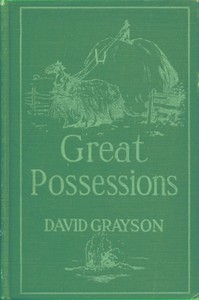
Great Possessions
free to read
length
39,382 words
a few pages a day
~8 min
finished in
21 days
full read
2h 44m
At Folio's default of ten pages a day, you finish Great Possessions in about 21 days — roughly 8 minutes of reading each morning.
The opening
the first pages of Great Possessions, free
“Sweet as Eden is the air And Eden-sweet the ray. No Paradise is lost for them Who foot by branching root and stem, And lightly with the woodland share The change of night and day.”
For these many years, since I have lived here in the country, I have had it in my mind to write something about the odour and taste of this well-flavoured earth. The fact is, both the sense of smell and the sense of taste; have been shabbily treated in the amiable rivalry of the senses. Sight and hearing have been the swift and nimble brothers, and sight especially, the tricky Jacob of the family, is keen upon the business of seizing the entire inheritance, while smell, like hairy Esau, comes late to the blessing, hungry from the hills, and willing to trade its inheritance for a mess of pottage.
I have always had a kind of errant love for the improvident and adventurous Esaus of the Earth. I think they smell a wilder fragrance than I do, and taste sweeter things, and I have thought, therefore, of beginning a kind of fragrant autobiography, a chronicle of all the good odours and flavours that ever I have had in my life.
As I grow older, a curious feeling comes often to me in the spring, as it comes this spring more poignantly than ever before, a sense of the temporariness of all things, the swiftness of life, the sadness of a beauty that vanishes so soon, and I long to lay hold upon it as it passes by all the handles that I can. I would not only see it and hear it, but I would smell it and taste it and touch it, and all with a new kind of intensity and eagerness.
Harriet says I get more pleasure out of the smell of my supper than I get out of the supper itself.
“I never need to ring for you,” says she, “but only open the kitchen door. In a few minutes I’ll see you straighten up, lift your head, sniff a little, and come straight for the house.”
“The odour of your suppers, Harriet,” I said, “after a day in the fields, would lure a man out of purgatory.”
My father before me had a singularly keen nose. I remember well when I was a boy and drove with him in the wild North Country, often through miles of unbroken forest, how he would sometimes break a long silence, lift his head with sudden awareness, and say to me:
“David, I smell open fields.”
In a few minutes we were sure to come to a settler’s cabin, a log barn, or a clearing. Among the free odours of the forest he had caught, afar off, the common odours of the work of man.
When we were tramping or surveying in that country, I have seen him stop suddenly, draw in a long breath, and remark:
“Marshes,” or, “A stream yonder.”
Part of this strange keenness of sense, often noted by those who knew that sturdy old cavalryman, may have been based, as so many of our talents are, upon a defect. My father gave all the sweet sounds of the world, the voices of his sons, the songs of his daughters, to help free the Southern slaves. He was deaf.
It is well known that when one sense is defective the others fly to the rescue, and my father’s singular development of the sense of smell may have been due in part to this defect, though I believe it to have been, to a far larger degree, a native gift. Me had a downright good nose. All his life long he enjoyed with more than ordinary keenness the odour of flowers, and would often pick a sprig of wild rose and carry it along with him in his hand, sniffing at it from time to time, and he loved the lilac, as I do after him. To ill odours he was not less sensitive, and was impatient of rats in the barn, and could smell them, among other odours, the moment the door was opened. He always had a peculiar sensitiveness to the presence of animals, as of dogs, cats, muskrats, cattle, horses, and the like, and would speak of them long before he had seen them or could know that they were about.
Keep going from exactly here — Folio remembers your place and serves the next portion tomorrow.
continue reading Great PossessionsAbout this free edition
Great Possessions by David Grayson (1870-1946) is free to read in full. Folio serves it in daily portions you can actually finish, tracks your streak and reading position across devices, and reads every page aloud with a built-in narrator. The text comes from Project Gutenberg.
More like Great Possessions
Adventures in Contentment
Folio
Adventures in Contentment
David Grayson
Adventures in Friendship
Folio
Adventures in Friendship
David Grayson
The Friendly Road: New Adventures in Contentment
Folio
The Friendly Road: New Adventures in Contentment
David Grayson
The Autobiography of Benjamin Franklin
Benjamin Franklin
Narrative of the Life of Frederick Douglass
Folio
Narrative of the Life of Frederick Douglass
Frederick Douglass
My Bondage and My Freedom
Folio
My Bondage and My Freedom
Frederick Douglass
The Story of My Life
Folio
The Story of My Life
Helen Keller

Up from Slavery
Booker T. Washington