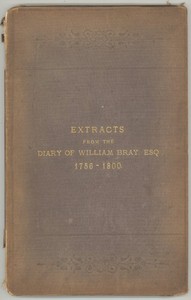
Extracts from the Diary of William Bray
free to read
length
11,922 words
a few pages a day
~8 min
finished in
7 days
full read
50 min
At Folio's default of ten pages a day, you finish Extracts from the Diary of William Bray in about 7 days — roughly 8 minutes of reading each morning.
The opening
the first pages of Extracts from the Diary of William Bray, free
These extracts are printed for the gratification of Mr. Bray’s descendants; who will see in them a remarkable instance of a life of sociability and amusement, combined with great and successful industry.
More extracts would have only shewn the same activity and pursuits.
MEMOIR.
MR. BRAY was born at Shere, on the 15th of November, 1736. He was the youngest of the three sons who survived their father Edward Bray, Esq. George the eldest, who was in the Church, and the second son Edward, who was in the Army, both died unmarried; and, on the death of George the survivor, in 1803, Mr. Bray succeeded to the possession of the Manors of Shere and Gumshall, which had belonged to his ancestors from the reign of Henry the Eighth. When ten years old he was placed at Rugby, where he remained until he was articled to Mr. Martyr, an Attorney of Guildford. In 1761, he was appointed a Clerk of the Board of Green Cloth, at St. James’s, through the patronage of Sir John Evelyn. His attendance at the Board did not prevent his practising as an Attorney, and it introduced him to many clients. In 1777, he published a ‘Tour in Derbyshire and Yorkshire,’ and a second edition of it in 1783. In 1797, he was chosen one of the Council, and a few years afterwards Treasurer, of the Society of Antiquaries, many of his communications to which are printed in the ‘Archæologia.’ In 1801, on the death of the Revd. Mr. Manning, who had been engaged for some years in compiling the ‘History of Surrey,’ Mr. Bray undertook to complete the work. The first volume was published in 1804, the second in 1809, and the third in 1814. His next and last literary undertaking was the editing of the ‘Evelyn Memoirs,’ which he completed in 1817. {6} Although in his 80th year, he transcribed in his own handwriting nearly the whole of Mr. Evelyn’s Journal.
He died from weakness, and without any disorder, on the 21st of December, 1832, having entered his 97th year on the 15th of the preceding month.
His habits before marriage did not promise either an industrious or a very long life. He spent almost every night at cards, and many of his mornings in other amusements. After his marriage he became more attentive to his professional business; but he continued for many years to live more like a bachelor than a married man, spending most of his evenings in the society of his numerous friends, or at a coffee-house. He was very hospitable both in bed and board, but in the plainest way. His surplus income was laid out in purchases at Shere and in planting, and he left no personal property except his life insurances. The family estate devolved on his death to his grandson Edward, who lived at Shere, and died in 1866, at the age of 72.
EXTRACTS.
1756, Jan. 1st.—Called on Miss Stevens {7a} this morning. With Mr. Boughton and Shotter to Mr. Shrubb’s at Shalford, to spend the evening. We played at loo, came home a little after 11.
Keep going from exactly here — Folio remembers your place and serves the next portion tomorrow.
continue reading Extracts from the Diary of William BrayAbout this free edition
Extracts from the Diary of William Bray by William Bray (1736-1832) is free to read in full. Folio serves it in daily portions you can actually finish, tracks your streak and reading position across devices, and reads every page aloud with a built-in narrator. The text comes from Project Gutenberg.
More like Extracts from the Diary of William Bray
The Autobiography of Benjamin Franklin
Benjamin Franklin
Narrative of the Life of Frederick Douglass
Folio
Narrative of the Life of Frederick Douglass
Frederick Douglass
My Bondage and My Freedom
Folio
My Bondage and My Freedom
Frederick Douglass
The Story of My Life
Folio
The Story of My Life
Helen Keller
Up from Slavery
Booker T. Washington
Incidents in the Life of a Slave Girl
Folio
Incidents in the Life of a Slave Girl
Harriet Jacobs
Twelve Years a Slave
Solomon Northup
The Narrative of Sojourner Truth
Folio
The Narrative of Sojourner Truth
Sojourner Truth