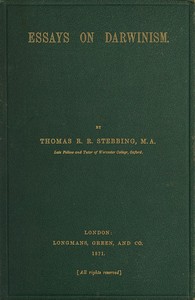
length
48,754 words
a few pages a day
~8 min
finished in
26 days
full read
3h 23m
At Folio's default of ten pages a day, you finish Essays on Darwinism in about 26 days — roughly 8 minutes of reading each morning.
The opening
the first pages of Essays on Darwinism, free
The opinions of Mr. Darwin have now been for many years before the world. His own book on ‘The Origin of Species by means of Natural Selection,’ unfolds and supports them with admirable clearness of argument. Far from being an abstruse and tedious work, it carries the reader on with unflagging interest to the close. Observations and experiments, some the most simple, some the most elaborate, notes on natural history, as well from every quarter of the globe as from almost every province of nature, are brought to bear upon the subject without confusion of thought or embarrassment of style. The language flows easily in its calm, temperate, unegotistical course. There is no disguising of objections, no seeking of opponents. There is an evident searching after truth. Of its form or of its shadow the author’s mind as evidently retains a bright clear vision, and what he sees he tries to make others see as clearly as he sees it himself. The suspicion and dislike which are aroused in some minds by the very name of Darwinism cannot be retained by those who read Mr. Darwin’s own description of his theory and the grounds which slowly led him to adopt it. Few readers can be dull enough to feel no charm at finding the most unlooked-for results deduced from the simplest illustrations, from old familiar facts, from every-day occurrences, or at finding what seem examples of the most special and varied contrivance reconciled to the simplicity of a single general law. Many readers will be inclined to whisper to themselves at many passages, ‘we never thought of that before,’ ‘we never looked at the matter in that light,’ ‘how curious if after all it should be true,’ ‘it looks less wicked and silly than we used to think it.’ Whether the theory itself be right or wrong, the general effect of the book which describes it can only be to quicken the minds of its readers, to enlarge for them the circle of ideas, to open up before them new lines of thought and enquiry, to let them see the whole face of nature teeming with mysteries and revelations, an inexhaustible vintage for the human reason to gather in.
Such being the character of Mr. Darwin’s own Work, the handful of Essays and Letters contained in the present volume, supporting the same views by almost the same arguments, may seem a superfluous contribution to the literature of the question. And so it would be if all who condemn and ridicule Darwinism would be at the pains to study Mr. Darwin’s Work. But opinions passed upon it and allusions made to it in common conversation and in popular lectures often testify to nothing except supreme ignorance of its general merits. To judge by such hearsay, one might believe that Mr. Darwin had lived all his life shut up in a dove-cote, and never seen or examined any other living creature than a pigeon. Another estimate will dismiss the whole subject, scathed with indignant laughter, by simply explaining, that, according to this fatuous theory, man is descended from a monkey. Naturally no well-minded persons will consent to be pithecoid in origin, whether they know what pithecoid means or not; still less can a theory be accepted as moral and good, according to which, as some will tell you, the giraffe lengthened its neck by a series of stretchings, and the elephant acquired a trunk by continually pulling its own nose. A disinterested advocate will perhaps be allowed to deprecate these burlesque and ignorant representations, and to strip from what is merely vulgar prejudice the guise of magnanimity and fine feeling. The range of topics embraced in the present volume, however feebly handled, and however inaccurate that handling may in some points prove to be, should at least teach those who are willing to learn, that the whole subject is a great one, and worthy of attention, claiming earnest thought and varied learning to decide upon it in all its bearings; it cannot be disposed of by caricaturing; it cannot be settled in deference to any religious prepossession; it must be examined with open eyes, and with the full candour of mind which great subjects demand, and which great subjects nobly repay.
Some of the following papers treat of matters on which no man of scientific education can be supposed at the present day to retain even a vestige of doubt. But thousands of persons, whom in ordinary courtesy we must call well-educated, although they know nothing of science, hold opinions on the Flood and the age of the world as irreconcileable with the best-approved scientific conclusions as they are with the Darwinian Theory. In appealing to the judgment of such persons, as well as in considering the measure of his own powers, the present writer has thought it expedient to confine himself, for the most part, to the clearest and simplest arguments, leaving on one side the subtle and intricate.
Keep going from exactly here — Folio remembers your place and serves the next portion tomorrow.
continue reading Essays on DarwinismAbout this free edition
Essays on Darwinism by Thomas Roscoe Rede Stebbing (1835-1926) is free to read in full. Folio serves it in daily portions you can actually finish, tracks your streak and reading position across devices, and reads every page aloud with a built-in narrator. The text comes from Project Gutenberg.
More like Essays on Darwinism
Darwinism. The Noachian Flood
Thomas Roscoe Rede Stebbing
Meditations
Folio
Meditations
Marcus Aurelius
The Enchiridion
Epictetus

Thus Spake Zarathustra
Friedrich Nietzsche
Beyond Good and Evil
Folio
Beyond Good and Evil
Friedrich Nietzsche
The Genealogy of Morals
Folio
The Genealogy of Morals
Friedrich Nietzsche
The Republic
Folio
The Republic
Plato
Apology
Folio
Apology
Plato