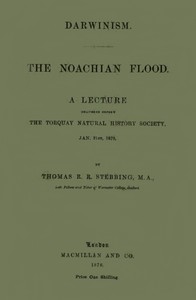
length
7,388 words
a few pages a day
~8 min
finished in
4 days
full read
31 min
At Folio's default of ten pages a day, you finish Darwinism. The Noachian Flood in about 4 days — roughly 8 minutes of reading each morning.
The opening
the first pages of Darwinism. The Noachian Flood, free
DARWINISM implies almost throughout that no universal Deluge has drowned our globe, either within the last ten thousand years, or even within a period indefinitely longer. Let us speak with due respect of the contrary belief. It seems to rest upon the testimony of a Volume the most precious in the world. It was taken for granted till a few years back as much in science as in religion. For a while, the arguments that began to be raised against it were met by counter-arguments so plausible, and the objectors differed so widely among themselves, that unscientific opinion had a kind of right and prudence in adhering to that which had been taught for centuries, and was still taught without deviation in nursery, and school, and pulpit.
We should have asserted a better right and shown a higher prudence, had we waited, in a matter which concerned science full as much as it concerned religion, till, by learning facts and weighing arguments, we had become able to form an opinion no longer unscientific, or, at the very least, to appreciate the difficulties involved in the ancient belief.
We are forced to take a controversy of this kind as it stands; otherwise, there is a simple principle which ought to make all controversy on the subject needless. All authors endowed with common sense, let alone divine inspiration, use language which their intended readers may be expected to understand, and language appropriate to the scope and design of their writings. Unless, therefore, we suppose that the Old Testament writers proposed to teach natural science to the Hebrew nation, we ought to expect from them what we actually find: as to natural phenomena, past and present, they use the language not of far-advanced knowledge and minute particular research, but simply the language current in their own day and nation.
But, setting aside the general principle, in the present instance there is a second possibility of quashing the controversy, if it can be shown or made probable that the author, whose narrative is in question, never meant to imply that which for thousands of years has been held to be his meaning.
The whole point at issue is the universality of the Noachian Deluge, and the narrative has been thought to be uncompromising in its declarations that all the earth, to the very mountain-tops, was indeed enveloped in water, and, excepting the handful rescued in the ark, that all men and cattle and creeping things and fowls of the air were inexorably destroyed. But to this view of the narrative there is more than one objection upon the very surface of the narrative itself. And, by way of preface, let it be remarked how vague and indefinite is the use in ordinary language of such terms as ‘all’ and ‘every’ and ‘universal.’ For instance, if a popular lady gives a kettledrum, we say, ‘all the world was at it,’ although 500 persons could not have been squeezed into the rooms without being suffocated; or we say, ‘so and so is a thing which every school-boy knows,’ when we only mean that a good many lads of a particular age, in a particular rank of life, and belonging to one particular country, have most probably been taught it. And again we say, ‘smoking is universal with the Dutch,’ without implying that every baby in Holland has a pipe instead of a rattle. You are not to suppose that this is a view of language invented for the occasion, frivolously explaining grave and sacred composition by the trivialities of common speech. On the contrary, it is precisely to the unquestioned prevalence of such phraseology, in all but the most exact scientific writing, that the late Dr. M‘Caul appealed, and appealed successfully, against more than one of the objections to the authority of the Pentateuch, which were raised some time ago by the well-known and ingenious arithmetician who presides over the see of Natal. When we read that ‘there went out a decree from Cæsar Augustus that all the world should be taxed: and all went to be taxed, every one into his own city,’ are we to infer either that the clever practical Roman decreed the taxation of barbarians over whom he had not the faintest shadow of control, or that every Israelite, without exception, found and visited his ancestral home in Palestine—merchants from Gades and Ophir and Tarshish, slaves and prisoners, sucking children, bed-ridden old men, dying sufferers? We shall not, if we are wise, shut up either Cæsar Augustus or the Evangelist St. Luke to so preposterous a meaning.
Keep going from exactly here — Folio remembers your place and serves the next portion tomorrow.
continue reading Darwinism. The Noachian FloodAbout this free edition
Darwinism. The Noachian Flood by Thomas Roscoe Rede Stebbing (1835-1926) is free to read in full. Folio serves it in daily portions you can actually finish, tracks your streak and reading position across devices, and reads every page aloud with a built-in narrator. The text comes from Project Gutenberg.
More like Darwinism. The Noachian Flood
Essays on Darwinism
Thomas Roscoe Rede Stebbing
Meditations
Folio
Meditations
Marcus Aurelius
The Enchiridion
Epictetus

Thus Spake Zarathustra
Friedrich Nietzsche
Beyond Good and Evil
Folio
Beyond Good and Evil
Friedrich Nietzsche
The Genealogy of Morals
Folio
The Genealogy of Morals
Friedrich Nietzsche
The Republic
Folio
The Republic
Plato
Apology
Folio
Apology
Plato