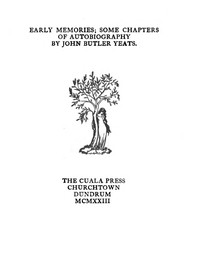
length
24,385 words
a few pages a day
~8 min
finished in
13 days
full read
1h 42m
At Folio's default of ten pages a day, you finish Early memories; some chapters of autobiography in about 13 days — roughly 8 minutes of reading each morning.
The opening
the first pages of Early memories; some chapters of autobiography, free
My father died in New York on February 2nd, 1922, at the end of his eighty second year. He died after a few hours illness brought on, as it seemed, by a long walk in the cold of a New York winter. He awoke in the middle of the night to find his friends Mrs Foster and Mr John Quinn sitting beside his bed and after a few words of pleasure at the sight said to Mrs Foster 'Remember you have promised me a sitting in the morning.' These were his last words for he dropped off to sleep and died in his sleep. He had gone to America some ten or twelve years before to be near my eldest sister who had an exhibition of embroidery there, and though she left after a few months he stayed on. 'At last' he said 'I have found a place where people do not eat too much at dinner to talk afterwards'. As he grew infirm his family & his friends constantly begged him to return, but, though he promised as constantly and would even fix the day of sailing, he would always ask for a few weeks more. He lived in a little French hotel in 29th Street where there is a café and night after night sat there, sketch book in hand, surrounded by his friends, painters and writers for the most part, who came to hear his conversation. He seemed to work as hard as in his early days, and drew with pen or pencil innumerable portraits with vigour, and subtlety. He painted a certain number in oils, & worked for several years at a large portrait of himself, commissioned by Mr John Quinn. I have not seen this portrait, but expect to find that he had worked too long upon it and, as often happened in his middle life when, in a vacillation prolonged through many months it may be, he would scrape out every morning what he had painted the day before, that the form is blurred, the composition confused, and the colour muddy. Yet in his letters he constantly spoke of this picture as his masterpiece, insisted again and again, as I had heard him insist when I was a boy, that he had found what he had been seeking all his life. This growing skill had been his chief argument against return to Ireland, for the portrait that displayed it must not be endangered by a change of light. The most natural among the fine minds that I have known he had been preoccupied all his life with the immediate present and what he thought his growing skill, but began towards its end, as I suppose we all do, to compare the present to the remote past. When I noticed how often his letters referred to long dead relations and friends, 'those lost people' as he called them in one letter, I persuaded him to begin his autobiography. He wrote, though with difficulty and a little against the grain, the biographical fragment in this book. When his account of friends and relations had come to an end the difficulty increased, and finding it more amusing to put the present into letters, or conversation, he put off the next chapter from day to day. Everything that happened, the death or marriage of an acquaintance, the discovery of a new friend, stirred his imagination; and his letters, now that his conversation can be heard no more, are indeed the fullest expression of a wisdom where there is always beauty. Yet this biographical fragment has its measure of wisdom and beauty, and I am pleased to think that when my son has reached his eighteenth birthday he will be able to say 'Though my grandfather was born a hundred years ago, and I have never seen his face, I know him from his book and think of him with affection'.
W. B. Yeats.
June, 1923.
EARLY MEMORIES SOME CHAPTERS OF AUTOBIOGRAPHY BY JOHN BUTLER YEATS.
Why I became an artist is a question which every artist must sometimes put to himself. It was my father who made me an artist, though his intention was that I should become a barrister, and I did become a barrister, but soon left it to follow my destiny and be an artist. Had I remained a barrister, in all probability both my sons would have taken to the law and would not now be one a poet and the other a painter.
When I was a little child, like other children I took to drawing, and my father being very appreciative of his children admired what I drew. In those days there was a heavy tax on paper as a defence against cheap journalism, & the radical movements which it was bound to foster, and my mother, being, as are most mothers, careful of expenditure, and not very sympathetic toward my artistic strivings, was always reluctant to give me paper on which I could draw. However, my father was an Irish gentleman of the old school and not at all thrifty; from him I could always get as much paper as I wanted. At that time there were no illustrated magazines and only one illustrated paper which I saw very occasionally at a friend's house. The only newspaper which came into my father's house was the London 'Times' and it had a picture of a clock. It was I think a rough wood-block. There is no child who will not really subscribe to Aristotle's doctrine that art is imitation, and in this case the imitation was roughly rendered so that it might be described as imitation with selection.
I was the eldest of the family and my brothers were much younger, for which reason my childhood was without companionship. Ah, the loneliness of such a childhood and the blessedness of it! Whether inside the house or out in the grounds I was always by myself, therefore I early learned to sustain myself by revery and dream. Years afterwards I suffered a good deal from the reproofs of my elders, for my habit of absentmindedness. Of course I was absentminded and am so still. In those childhood days I discovered the world of fantasy, and I still spend all my spare moments in that land of endearing enchantment.
Keep going from exactly here — Folio remembers your place and serves the next portion tomorrow.
continue reading Early memories; some chapters of autobiographyAbout this free edition
Early memories; some chapters of autobiography by John Butler Yeats (1839-1922) is free to read in full. Folio serves it in daily portions you can actually finish, tracks your streak and reading position across devices, and reads every page aloud with a built-in narrator. The text comes from Project Gutenberg.
More like Early memories; some chapters of autobiography
The Autobiography of Benjamin Franklin
Benjamin Franklin
Narrative of the Life of Frederick Douglass
Folio
Narrative of the Life of Frederick Douglass
Frederick Douglass
My Bondage and My Freedom
Folio
My Bondage and My Freedom
Frederick Douglass
The Story of My Life
Folio
The Story of My Life
Helen Keller
Up from Slavery
Booker T. Washington
Incidents in the Life of a Slave Girl
Folio
Incidents in the Life of a Slave Girl
Harriet Jacobs
Twelve Years a Slave
Solomon Northup
The Narrative of Sojourner Truth
Folio
The Narrative of Sojourner Truth
Sojourner Truth