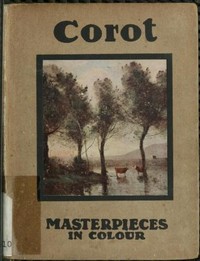
length
9,468 words
a few pages a day
~8 min
finished in
5 days
full read
39 min
At Folio's default of ten pages a day, you finish Corot in about 5 days — roughly 8 minutes of reading each morning.
The opening
the first pages of Corot, free
The work of Jean Baptiste Camille Corot has been steadily rising in the estimation of the instructed ever since he won his first notable successes in 1840. During the greater part of the artist's life-time the rise was very gradual, and he would have been astonished indeed if he could have known how rapid it was to be after his death. It is by no means only a rise in the selling prices of such of his works as come into the market--a Corot has something more than a collector's value; but figures are in their way eloquent, and when we find a work ("Le Lac de Garde") for which the painter was glad to get 800 francs selling for 231,000 francs within thirty years of his death, the rapid growth in the fame of the painter is materially evidenced.
There are fashions in art as in everything else: for reasons which the dealers could often disclose if they would, this or that artist's work is suddenly boomed, and for a time commands absurdly big prices in the auction rooms, only to find its proper level again when it is no longer to anybody's interest to maintain an artificial valuation. But it is difficult to believe that the passing of years will do anything to diminish the fame of Corot, or lessen the prices which connoisseurs are willing to pay for the possession of his work. Rather will both increase, there is reason to think, as under the winnowing of Time's wings the chaff is separated from the grain, and many a painter hailed as a master to-day is scorned if not forgotten. For whatever may happen, it is impossible to believe that the work of Corot will ever become old-fashioned. There is in it something that does not belong to one time, but to all times; not to one place, but to all places. It is elemental and universal, and instinct with a vitality and youth that unnumbered to-morrows can have no power to destroy.
Even those critics who most strongly opposed the canons Corot professed--and there were many of them--were often unable to condemn a heresy in which faith was so justified by works: coming to curse, like Balaam, they remained to bless. A far more trying ordeal the artist had to undergo in the intemperate rhapsodies of enthusiastic admirers. But neither censure or praise, the scepticism of his own people, or the indifference of the picture-buying public, could tempt him to deviate from the path that for him was the right one. "Vive la conscience, vive la simplicité!" he used to say. His creed was in the words, and he lived up to it.
He claimed for the artist an entire independence. "You must interpret nature with entire simplicity, and according to your personal sentiment, altogether detaching yourself from what you know of the old masters or of contemporaries. Only in this way will you do work of real feeling. I know gifted people who will not avail themselves of their power. Such people seem to me like a billiard-player, whose adversary is constantly giving him good openings, but who makes no use of them. I think that if I were playing with that man, I would say, 'Very well, then, I will give you no more.' If I were to sit in judgment, I would punish the miserable creatures who squander their natural gifts, and I would turn their hearts to cork." Again he says--"Follow your convictions. It is better not to exist than to be the echo of other painters. As the wise man says, if one follows, one is behind." And again--"Art should be an individual expression of the verities, an ardour that concedes nothing."
[Illustration: PLATE II.--L'ETANG.
"Beauty in art is truth bathed in the impression, the emotion that is received from nature.... Seek truth and exactitude, but with the envelope of sentiment which you felt at first. If you have been sincere in your emotion you will be able to pass it on to others." So said Corot to a pupil, and "L'Etang" would in itself be sufficient to prove that he knew how to practise what he preached. It is a variant on a simple motive that he was never weary of, and that he knew how to invest with new beauties every time it came to him.]
It is on the face of it rather a hopeless task to attempt to trace the artistic pedigree of a painter who, at all costs, will be individual with "an ardour that concedes nothing"; and it would not help much towards an understanding of him. At the same time, it would be a mistake to suppose that Corot was quite so independent of the influences around as, perhaps, he imagined himself to be. "Artists," says Shelley in a notable utterance, "cannot escape from subjection to a common influence which arises out of an infinite combination of circumstances belonging to the times in which they live, though each is in a degree the author of the very influence by which his being is thus pervaded."
Keep going from exactly here — Folio remembers your place and serves the next portion tomorrow.
continue reading CorotAbout this free edition
Corot by Sidney Allnutt (1874-1931) is free to read in full. Folio serves it in daily portions you can actually finish, tracks your streak and reading position across devices, and reads every page aloud with a built-in narrator. The text comes from Project Gutenberg.
More like Corot

The Autobiography of Benjamin Franklin
Benjamin Franklin
Narrative of the Life of Frederick Douglass
Folio
Narrative of the Life of Frederick Douglass
Frederick Douglass
My Bondage and My Freedom
Folio
My Bondage and My Freedom
Frederick Douglass
The Story of My Life
Folio
The Story of My Life
Helen Keller

Up from Slavery
Booker T. Washington
Incidents in the Life of a Slave Girl
Folio
Incidents in the Life of a Slave Girl
Harriet Jacobs
Twelve Years a Slave
Solomon Northup
The Narrative of Sojourner Truth
Folio
The Narrative of Sojourner Truth
Sojourner Truth