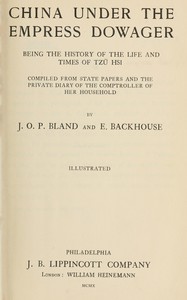
China under the Empress Dowager
free to read
length
181,264 words
a few pages a day
~8 min
finished in
96 days
full read
12h 35m
At Folio's default of ten pages a day, you finish China under the Empress Dowager in about 96 days — roughly 8 minutes of reading each morning.
The opening
the first pages of China under the Empress Dowager, free
(1) Tung Hua Men, the East Gate Glorious. This is the usual entrance to the Forbidden City for officials attending audience when the Court is there resident. (It was here that was suspended in a basket the head of the foreigner captured by the Boxers on 20th June.)
(2) Huang Chi Tien, or Throne Hall of Imperial Supremacy. In this Hall the Empress Dowager, after the return of the Court from exile, was accustomed to receive her officials in audience on the rare occasions when she lived in the Forbidden City. It was here that her remains lay for nearly a year awaiting the day of burial.
(3) Ning Shou Kung, or Palace of Peaceful Longevity. Here the Old Buddha resided during the siege; here she buried her treasure. She returned hither after the days of exile and lived in it pending the restoration of the Lake Palace, desecrated by the foreign occupation.
(4) Chien Ching Kung, or Palace of Heavenly Purity. The Hall in which China’s Emperors were accustomed to give audience to the Grand Council. After the Boxer rising, in accordance with the new ceremonial laid down by the Peace Protocol, the Diplomatic Body were received here. In this Hall the Emperor Kuang Hsü discussed and decided with K’ang Yu-wei the reform programme of 1898, and it was here that his body lay awaiting sepulture between November 1898 and February 1909.
(5) Shen Wu Men, or Gate of Divine Military Genius. Through this, the Northern gate of the City, the Old Buddha fled in the dawn of the 15th August, 1900.
(6) The Rock-garden in which Her Majesty used to walk during the days of the siege of the Legations and from which she witnessed the burning of the Hanlin Academy.
(7) Yang Hsin Tien, or Throne Hall of Mental Growth. In this Palace the Emperor T’ung-Chih resided during the whole of his reign.
(8) Hsi Hua Men, or West Gate Glorious. One of the main entrances to the Forbidden City.
(9) Tai Ho Tien, Throne Hall of Exalted Peace. Used only on occasions of High ceremony, such as the accession of a new Emperor, an Imperial birthday celebration, or the New Year ceremonies.
(10) Shou Huang Tien, or Throne Hall of Imperial Longevity. In this building the reigning sovereign unrolls on the day of the New Year the portraits of deceased Emperors, and pays sacrifice to them.
(11) Hsi Yüan Men, Western Park Gate. It is through this that the Grand Council and other high officials pass to audience when the sovereign is in residence at the Lake Palace.
(12) At this gate the Emperor was wont to await, humbly kneeling, the arrival of the Old Buddha on her way to or from the Summer Palace.
(13) The Altar of Silkworms, at which the Empress Consort must sacrifice once a year, and where the Old Buddha sacrificed on occasion.
(14) A Lama Temple where the Old Buddha frequently worshipped.
(15) Ta Hsi Tien. The Temple of the Great Western Heaven. A famous Buddhist shrine built in the reign of the Emperor Kang Hsi.
(16) The Old Catholic Church built within the Palace precincts by permission of the Emperor Kang-Hsi. It was converted by the Empress Dowager into a Museum in which was kept the collection of stuffed birds made by the missionary Père David. Eye-witnesses of the siege of the French Cathedral in 1900 have stated that the Empress and several of the ladies of the Court ascended to the roof of this building to watch the attack on the Christians; but it is not likely that they exposed themselves for any great length of time in what must have been a dangerous position.
Keep going from exactly here — Folio remembers your place and serves the next portion tomorrow.
continue reading China under the Empress DowagerAbout this free edition
China under the Empress Dowager by J. O. P. Bland (1863-1945) is free to read in full. Folio serves it in daily portions you can actually finish, tracks your streak and reading position across devices, and reads every page aloud with a built-in narrator. The text comes from Project Gutenberg.
More like China under the Empress Dowager
The Autobiography of Benjamin Franklin
Benjamin Franklin
Narrative of the Life of Frederick Douglass
Folio
Narrative of the Life of Frederick Douglass
Frederick Douglass
My Bondage and My Freedom
Folio
My Bondage and My Freedom
Frederick Douglass
The Story of My Life
Folio
The Story of My Life
Helen Keller
Up from Slavery
Booker T. Washington
Incidents in the Life of a Slave Girl
Folio
Incidents in the Life of a Slave Girl
Harriet Jacobs
Twelve Years a Slave
Solomon Northup
The Narrative of Sojourner Truth
Folio
The Narrative of Sojourner Truth
Sojourner Truth