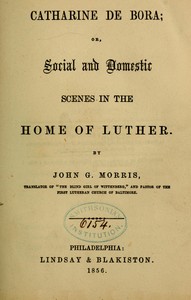
Catharine de Bora
free to read
length
23,300 words
a few pages a day
~8 min
finished in
13 days
full read
1h 37m
At Folio's default of ten pages a day, you finish Catharine de Bora in about 13 days — roughly 8 minutes of reading each morning.
The opening
the first pages of Catharine de Bora, free
There are many interesting and characteristic incidents in the domestic life of Luther which are not found in biographies of the great Reformer. The character of his wife has not been portrayed in full, and who does not wish to become better acquainted with a woman who mingled many a drop of balsam in those numerous cups of sorrow which her celebrated husband was compelled to drink?
This little book is the result of extensive research, and exhibits facts attested by the most reliable authorities, many of which will be new to those of my readers who have not investigated this particular subject.
J. G. M.
Baltimore, June, 1856.
LUTHER AT HOME.
CHAPTER I.
Clerical Celibacy—Luther-Bernhardi’s Marriage—Treatment of Catharine de Bora—the Convent—Wealthy Nuns—Convent Life—the Escape—Treatment of the Nuns—Florentine de Oberweimer—Leonard Koppe—Luther’s Defence.
The celibacy of the clergy was one of the strongest pillars on which the proud edifice of Romish power rested. It was a stupendous partition-wall which separated the clergy from all other interests, and thus consolidated the wide-spread authority of the Pope. It cut off the secular clergy, as well as the monks, from all domestic ties. They forgot father, mother, and friends. Political obligations to their sovereign and country were disregarded, but the cord which bound them to the interests of Rome was only the more tightly drawn.
Superior purity was the presumed ground of the system, but a total surrender of all rights, and complete submission to the will of the Pope, were its legitimate results. He was regarded as the only parent of the clergy—the only sovereign to whom they owed allegiance—the only protector in whom they were to confide, and, as dutiful sons, obedient subjects, and grateful beneficiaries, they were obliged to exert themselves to the utmost to maintain his authority and extend his dominion. Clerical celibacy was regarded not only as a duty, but as the highest attainment in moral perfection. The system was introduced with caution and maintained with sleepless vigilance and zeal. There were some who saw its errors and disadvantages, and desired its abolition, but their remonstrances were unheeded and their clamors silenced.
That, however, which was considered impossible by the whole Christian world, was accomplished by a single man, who himself had been a monk, and whose first duty as such was a vow of celibacy! That man was Martin Luther, Augustinian Monk, Doctor of Theology at the University of Wittenberg, who, by his heroic conduct in relation to this subject, has only added to the other inappreciable services he has rendered the Church. It was he who was bold enough to abandon the monastic order, and, in spite of the principles of the Church as they prevailed in that age, to enter the married state. This adventurous step led to the deliverance of a large portion of the clergy from the chain of Papal power. From having been the slavish satellites of a foreign master in Italy, they became patriotic subjects and useful men at home.
Several years before, two friends of Luther, who were his noble assistants in the work of the Reformation, Melanchthon and Carlstadt, had written treatises against clerical celibacy. Their books on this subject were equally as unexpected, and created as much excitement among the clergy, as Luther’s Theses against Indulgences had done six years before.
Luther was not the first priest of those days who practically rejected celibacy. As early as 1521, one of his friends and fellow-laborers, Bernhardi, superintendent of the churches at Kemberg, had the boldness to marry. He was the first ecclesiastic in Saxony who took this step, and his wedding-day was long regarded as the Pastors’ Emancipation Day; but Caspar Aquila, a priest residing near Augsburg, was married as early as 1516, Jacob Knabe in 1518, and Nicolas Brunner in 1519.
Luther was free from all participation in Bernhardi’s marriage, for at that time he was a prisoner in Wartburg Castle, and the first intelligence came so unexpectedly, that whilst he admired the courage of his friend, he was very apprehensive it would occasion him and his cause many severe trials. Not long after, Bernhardi’s metropolitan, the Cardinal Archbishop Albert, of Mainz and Magdeburg, demanded of the Elector of Saxony, Frederick the Wise, to send Bernhardi to Halle, to answer for his presumptuous act. Frederick did not yield to the demand of the Archbishop, and the latter professed to be satisfied with an anonymous defence of Bernhardi.
Keep going from exactly here — Folio remembers your place and serves the next portion tomorrow.
continue reading Catharine de BoraAbout this free edition
Catharine de Bora by John G. Morris (1803-1895) is free to read in full. Folio serves it in daily portions you can actually finish, tracks your streak and reading position across devices, and reads every page aloud with a built-in narrator. The text comes from Project Gutenberg.
More like Catharine de Bora

The Autobiography of Benjamin Franklin
Benjamin Franklin
Narrative of the Life of Frederick Douglass
Folio
Narrative of the Life of Frederick Douglass
Frederick Douglass
My Bondage and My Freedom
Folio
My Bondage and My Freedom
Frederick Douglass
The Story of My Life
Folio
The Story of My Life
Helen Keller

Up from Slavery
Booker T. Washington
Incidents in the Life of a Slave Girl
Folio
Incidents in the Life of a Slave Girl
Harriet Jacobs
Twelve Years a Slave
Solomon Northup
The Narrative of Sojourner Truth
Folio
The Narrative of Sojourner Truth
Sojourner Truth