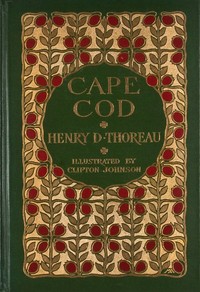
length
78,225 words
a few pages a day
~8 min
finished in
42 days
full read
5h 26m
At Folio's default of ten pages a day, you finish Cape Cod in about 42 days — roughly 8 minutes of reading each morning.
The opening
the first pages of Cape Cod, free
The Clam-Digger (Photogravure) Cohasset—The little cove at Whitehead promontory An old windmill A street in Sandwich The old Higgins tavern at Orleans A Nauset lane Nauset Bay A scarecrow Millennium Grove camp-meeting grounds A Cape Cod citizen Wreckage under the sand-bluff Herring River at Wellfleet A characteristic gable with many windows A Wellfleet oysterman Wellfleet Hunting for a leak Truro—Starting on a voyage Unloading the day’s catch A Truro footpath Truro meeting-house on the hill A herd of cows Pond Village Dragging a dory up on the beach An old wrecker at home The Highland Light Towing along shore A cranberry meadow The sand dunes drifting in upon the trees The white breakers on the Atlantic side In Provincetown harbor Provincetown—A bit of the village from the wharf The day of rest A Provincetown fishing-vessel
INTRODUCTION
Of the group of notables who in the middle of the last century made the little Massachusetts town of Concord their home, and who thus conferred on it a literary fame both unique and enduring, Thoreau is the only one who was Concord born. His neighbor, Emerson, had sought the place in mature life for rural retirement, and after it became his chosen retreat, Hawthorne, Alcott, and the others followed; but Thoreau, the most peculiar genius of them all, was native to the soil.
In 1837, at the age of twenty, he graduated from Harvard, and for three years taught school in his home town. Then he applied himself to the business in which his father was engaged,—the manufacture of lead pencils. He believed he could make a better pencil than any at that time in use; but when he succeeded and his friends congratulated him that he had now opened his way to fortune he responded that he would never make another pencil. “Why should I?” said he. “I would not do again what I have done once.”
So he turned his attention to miscellaneous studies and to nature. When he wanted money he earned it by some piece of manual labor agreeable to him, as building a boat or a fence, planting, or surveying. He never married, very rarely went to church, did not vote, refused to pay a tax to the State, ate no flesh, drank no wine, used no tobacco; and for a long time he was simply an oddity in the estimation of his fellow-townsmen. But when they at length came to understand him better they recognized his genuineness and sincerity and his originality, and they revered and admired him. He was entirely independent of the conventional, and his courage to live as he saw fit and to defend and uphold what he believed to be right never failed him. Indeed, so devoted was he to principle and his own ideals that he seems never to have allowed himself one indifferent or careless moment.
He was a man of the strongest local attachments, and seldom wandered beyond his native township. A trip abroad did not tempt him in the least. It would mean in his estimation just so much time lost for enjoying his own village, and he says: “At best, Paris could only be a school in which to learn to live here—a stepping-stone to Concord.”
He had a very pronounced antipathy to the average prosperous city man, and in speaking of persons of this class remarks: “They do a little business commonly each day in order to pay their board, and then they congregate in sitting-rooms, and feebly fabulate and paddle in the social slush, and go unashamed to their beds and take on a new layer of sloth.”
The men he loved were those of a more primitive sort, unartificial, with the daring to cut loose from the trammels of fashion and inherited custom. Especially he liked the companionship of men who were in close contact with nature. A half-wild Irishman, or some rude farmer, or fisherman, or hunter, gave him real delight; and for this reason, Cape Cod appealed to him strongly. It was then a very isolated portion of the State, and its dwellers were just the sort of independent, self-reliant folk to attract him. In his account of his rambles there the human element has large place, and he lingers fondly over the characteristics of his chance acquaintances and notes every salient remark. They, in turn, no doubt found him interesting, too, though the purposes of the wanderer were a good deal of a mystery to them, and they were inclined to think he was a pedler.
Keep going from exactly here — Folio remembers your place and serves the next portion tomorrow.
continue reading Cape CodAbout this free edition
Cape Cod by Henry David Thoreau (1817-1862) is free to read in full. Folio serves it in daily portions you can actually finish, tracks your streak and reading position across devices, and reads every page aloud with a built-in narrator. The text comes from Project Gutenberg.
More like Cape Cod
Walden
Henry David Thoreau
On the Duty of Civil Disobedience
Folio
On the Duty of Civil Disobedience
Henry David Thoreau
A Week on the Concord and Merrimack Rivers
Henry David Thoreau
The Service
Folio
The Service
Henry David Thoreau
Wild Apples
Folio
Wild Apples
Henry David Thoreau
Paradise (to be) Regained
Folio
Paradise (to be) Regained
Henry David Thoreau
A Plea for Captain John Brown
Folio
A Plea for Captain John Brown
Henry David Thoreau
Meditations
Folio
Meditations
Marcus Aurelius