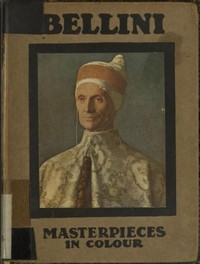
length
8,508 words
a few pages a day
~8 min
finished in
5 days
full read
35 min
At Folio's default of ten pages a day, you finish Bellini in about 5 days — roughly 8 minutes of reading each morning.
The opening
the first pages of Bellini, free
From the standpoint of the biographer, it is to be regretted that more of the great Italian artists of the fifteenth century were not associated with the Church. In the days of the most interesting activity of painters and sculptors, the capacity to write was rarely met beyond the monasteries and few people took the trouble to record any impression of notable men in the early years of their career. We are apt to forget that, for one artist whose name is preserved to us to-day, there are a score of men whose work has perished, whose very names are forgotten. In middle life, or in old age, when commissions from Popes or Emperors had attracted the attention of the world at large to the best men of the time, there might be some chronicler found to make passing but invaluable reference to those of his contemporaries whose names were common in men's mouths, but such notes were made in very haphazard fashion, they were not necessarily accurate, and might be founded upon personal observation or rumour, or even upon the prejudice that was inevitable when Italy was a congerie of opposing states. Latter-day historians grope painfully and conscientiously after the scanty records of great painters, searching the voluminous writings of men who have little to say, and very little authority for saying anything about the great personalities of the art world of their time. It is not surprising, under these circumstances, that despite much search the record of many lives that must have been fascinating cannot be found. We learn more of the man from his work than we can hope to learn from any written record and, as the taste for studying pictures grows, so all the internal evidence of a man's thought and ways of life accumulates and the message that underlies canvas and stands revealed in colour and line to the trained eye, is translated for the benefit of a curious generation. We learn to know what manner of man the painter was from the models he chose, the portraits he painted, the qualities and nature of his landscape, the expression of his joy in light and air, his feeling for flowers and birds. By a process of synthetical reasoning we come to see, though it be as in a glass, darkly, the picture that every man paints, from the years of his activity to the last year of his sojourn among mortals--that is the portrait of himself. Doubtless we are often misled, because as each critic, artist or layman, finds in the picture a reflection of what he takes there, it remains difficult to arrive at definite conclusions upon which all men can agree about any painter. Happily the effort pleases our own generation, and as there are many great men who flourished in the fifteenth century and have left their pictures to be their sole monument, there is no lack of work. Naturally in this curious and inquisitive age there are some who would rather discover a well authenticated story about an artist's life than an unexpected masterpiece from his hand, but then the appeal of letters is always more widespread than that of paint. It is always pleasant to endeavour to supply a want, but it is only fair to remember that in writing about people whose life story was not preserved by their contemporaries, the path is strewn with pitfalls.
[Illustration: PLATE II.--THE DOGE LOREDANO
This picture, which is of bust length and life size, is one of the ten examples of Giovanni Bellini in the National Gallery, and is perhaps the most important example of the artist as a portrait painter. The Doge wears his state robes and cap of office, and the picture is signed on a cartellino.]
In dealing with the Italians from the days of Cimabue to Clovio, it has been the custom to depend very largely upon the works of Giorgio Vasari, and to rely for later and more accurate information upon the volumes written by Crowe and Cavalcaselle, passing from them to Morelli and Berenson. Vasari, to whom the students of Italian art, down to the middle of the sixteenth century, are so deeply indebted, was born in 1512, and lived for more than sixty years. He was a painter and architect, related to Luca Signorelli, and engaged for a great part of his life upon work in Arezzo. He was a great copyist, a painstaking writer, and never did critic wield a milder pen if he chanced to be writing of Florentine art, or a more prejudiced one if he dealt with things of Venice. He was first a patriot and then a critic. One night, he tells us, a friend of Monsignore Giovio expressed a wish to add to his library a treatise on men who had distinguished themselves in the arts of design, from the time of Cimabue down to the year of the conversation. Vasari undertook the work and founded it, he says, upon notes and memoranda which he had made from the time when he was a boy. The compilation was finished about the year 1547, it was written at a time when the painter was very busy with commissions. He did his best in a certain prejudiced fashion, and the result for all its defects is very valuable. Naturally enough Vasari had not too large a share of the gifts required for his task, nor had he the necessary facts before him for writing really reliable history. Much that he wrote was accepted faute de mieux, but modern researches have necessitated a revision of very many estimates that Vasari formed for us, together with a considerable portion of his facts, and we have learned to understand something of the source and direction of his prejudices.
Keep going from exactly here — Folio remembers your place and serves the next portion tomorrow.
continue reading BelliniAbout this free edition
Bellini by George Hay (1876-) is free to read in full. Folio serves it in daily portions you can actually finish, tracks your streak and reading position across devices, and reads every page aloud with a built-in narrator. The text comes from Project Gutenberg.
More like Bellini
Carlo Dolci
George Hay

The Autobiography of Benjamin Franklin
Benjamin Franklin
Narrative of the Life of Frederick Douglass
Folio
Narrative of the Life of Frederick Douglass
Frederick Douglass
My Bondage and My Freedom
Folio
My Bondage and My Freedom
Frederick Douglass
The Story of My Life
Folio
The Story of My Life
Helen Keller

Up from Slavery
Booker T. Washington
Incidents in the Life of a Slave Girl
Folio
Incidents in the Life of a Slave Girl
Harriet Jacobs
Twelve Years a Slave
Solomon Northup