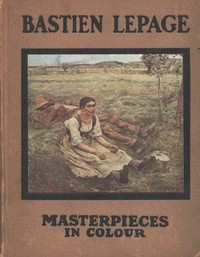
length
9,905 words
a few pages a day
~8 min
finished in
6 days
full read
41 min
At Folio's default of ten pages a day, you finish Bastien Lepage in about 6 days — roughly 8 minutes of reading each morning.
The opening
the first pages of Bastien Lepage, free
There are certain beings who bear the stamp of the divine seal and are preordained to receive the highest favours within the gift of glory; they are fated to pass through life like those brilliant meteors which are seen to flash across the heavens and disappear in the same instant. Bastien-Lepage was one of these meteors. But while the others leave behind them only a luminous trail that swiftly vanishes, this rare artist, snatched so prematurely from the field of art, traced his passage in a furrow of dazzling splendour, the radiance of which has not even yet begun to fade.
Bastien-Lepage was a painter in the noblest acceptation of the term; it may even be asserted that he would have exercised considerable influence upon the art of his epoch if Destiny had not stupidly mown down the sturdy flower of his genius in the very hour of its brightest blossoming. Born into this world with a solid tenacity of purpose which seems to be a special gift of the soil of Lorraine to her sons and daughters, he had a clear-cut and unalterable conception of what painting should be. His mind was receptive only of simple ideas, his eye perceived only visions that were tangible, such as were unobscured by any shadow or any artifice. He was the apostle of clearness, both in conception and in execution. Every time that he tried experimentally to turn aside from his chosen path, he ceased to be himself, he fell below his own standards. What interested him most of all, in the life of this world which he observed so eagerly, as though he had a presentiment of his early end, was nature's most precise and most uncompromising manifestation, both in line and in relief; namely, the peasant and the environment which frames him. Having deliberately chosen such models, Bastien-Lepage could not pretend to be the painter of the Beautiful, nor did he ever become so. He did not even adorn his subjects with that special sort of idealism with which Millet embellished even his most uncouth rustic types, a slightly melancholy idealism obtained by a sombre toning down of colour, which Bastien-Lepage held in horror. His peasants stand out boldly, in the crude glare of flamboyant noontide, under a summer sun that refuses to leave hidden any part of their ugliness or their defects. He painted them as he saw them, with the searching rays striking them full in the face; and his brush was a stranger to any compromise, intolerant of even the slightest betterment, in the course of the literal transference of his model to his canvas. It made no difference how handsome or how homely a given subject might be, Bastien-Lepage would always render him precisely as nature, in a grudging or indulgent mood, had made him,--that is to say, truly and sincerely, with a precision that would be almost photographic, if the minuteness of his technique were not ennobled by the high quality of his art. With such gifts, Bastien-Lepage was foreordained to be a marvellous interpreter of rural life, and such he was in the highest degree; in like manner, he could not fail to become a portrait painter of the first order, and it was in this capacity also that he enrolled himself among the most interesting and vigorous artists of our epoch.
[Illustration:
PLATE II.--PORTRAIT OF M. WALLON
(Museum of the Louvre)
Few artists have been able to endow their models with such an animated expression of life. All the keenness, intelligence and austerity of this prominent personage, known by the name of Father of the Constitution, are eloquently transferred to this page, with a sobriety of means that still further emphasizes its vigour.]
HIS YOUTH
Jules Bastien-Lepage was born at Damvillers, in the department of the Meuse, on the first of November, 1848. His parents were of the well-to-do farming class, occupied from one year's end to the other with the work of the fields. Consequently, all the early boyhood of the artist was passed in daily contact with the soil of Lorraine and with the sons of that soil. He knew them, one and all, in his native village; he grew up among them; he went to school side by side with the other little rustics of his own age: he understood the peasant class, with all their faults, their virtues, their habits of life; he learned to read in their faces, which were a sealed book to the outsider, the opinions and emotions which they had in common with him.
Keep going from exactly here — Folio remembers your place and serves the next portion tomorrow.
continue reading Bastien LepageAbout this free edition
Bastien Lepage by François Crastre is free to read in full. Folio serves it in daily portions you can actually finish, tracks your streak and reading position across devices, and reads every page aloud with a built-in narrator. The text comes from Project Gutenberg.
More like Bastien Lepage
Puvis de Chavannes
François Crastre
Rosa Bonheur
François Crastre
Veronese
François Crastre

The Autobiography of Benjamin Franklin
Benjamin Franklin
Narrative of the Life of Frederick Douglass
Folio
Narrative of the Life of Frederick Douglass
Frederick Douglass
My Bondage and My Freedom
Folio
My Bondage and My Freedom
Frederick Douglass
The Story of My Life
Folio
The Story of My Life
Helen Keller

Up from Slavery
Booker T. Washington