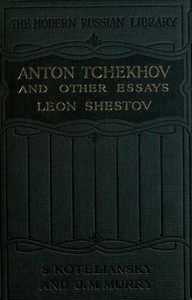
Anton Tchekhov, and Other Essays
free to read
length
51,123 words
a few pages a day
~8 min
finished in
27 days
full read
3h 33m
At Folio's default of ten pages a day, you finish Anton Tchekhov, and Other Essays in about 27 days — roughly 8 minutes of reading each morning.
The opening
the first pages of Anton Tchekhov, and Other Essays, free
It is not to be denied that Russian thought is chiefly manifested in the great Russian novelists. Tolstoi, Dostoevsky, and Tchekhov made explicit in their works conceptions of the world which yield nothing in definiteness to the philosophic schemes of the great dogmatists of old, and perhaps may be regarded as even superior to them in that by their nature they emphasise a relation of which the professional philosopher is too often careless--the intimate connection between philosophy and life. They attacked fearlessly and with a high devotion of which we English readers are slowly becoming sensible the fundamental problem of all philosophy worthy the name. They were preoccupied with the answer to the question: Is life worth living? And the great assumption which they made, at least in the beginning of the quest, was that to live life must mean to live it wholly. To live was not to pass by life on the other side, not suppress the deep or even the dark passions of body or soul, not to lull by some lying and narcotic phrase the urgent questions of the mind, not to deny life. To them life was the sum of all human potentialities. They accepted them all, loved them all, and strove to find a place for them all in a pattern in which none should be distorted. They failed, but not one of them fainted by the way, and there was not one of them but with his latest breath bravely held to his belief that there was a way and that the way might be found. Tolstoi went out alone to die, yet more manifestly than he had lived, a seeker after the secret; death overtook Dostoevsky in his supreme attempt to wrest a hope for mankind out of the abyss of the imagined future; and Tchekhov died when his most delicate fingers had been finally eager in lighting The Cherry Orchard with the tremulous glint of laughing tears, which may perhaps be the ultimate secret of the process which leaves us all bewildered and full of pity and wonder.
There were great men and great philosophers. It may be that this cruelly conscious world will henceforward recognise no man as great unless he has greatly sought: for to seek and not to think is the essence of philosophy. To have greatly sought, I say, should be the measure of man's greatness in the strange world of which there will be only a tense, sorrowful, disillusioned remnant when this grim ordeal is over. It should be so: and we, who are, according to our strength, faithful to humanity, must also strive according to our strength to make it so. We are not, and we shall not be, great men: but we have the elements of greatness. We have an impulse to honesty, to think honestly, to see honestly, and to speak the truth to ourselves in the lonely hours. It is only an impulse, which, in these barren, bitter, years, so quickly withers and dies. It is almost that we dare not be honest now. Our hearts are dead: we cannot wake the old wounds again. And yet if anything of this generation that suffered is to remain, if we are to hand any spark of the fire which once burned so brightly, if we are to be human still, then we must still be honest at whatever cost. We--and I speak of that generation which was hardly man when the war burst upon it, which was ardent and generous and dreamed dreams of devotion to an ideal of art or love or life--are maimed and broken for ever. Let us not deceive ourselves. The dead voices will never be silent in our ears to remind us of that which we once were, and that which we have lost. We shall die as we shall live, lonely and haunted by memories that will grow stranger, more beautiful, more terrible, and more tormenting as the years go on, and at the last we shall not know which was the dream--the years of plenty or the barren years that descended like a storm in the night and swept our youth away.
Yet something remains. Not those lying things that they who cannot feel how icy cold is sudden and senseless death to all-daring youth, din in our ears. We shall not be inspired by the memory of heroism. We shall be shattered by the thought of splendid and wonderful lives that were vilely cast away. What remains is that we should be honest as we shall be pitiful. We shall never again be drunk with hope: let us never be blind with fear. There can be in the lap of destiny now no worse thing which may befall us. We can afford to be honest now.
Keep going from exactly here — Folio remembers your place and serves the next portion tomorrow.
continue reading Anton Tchekhov, and Other EssaysAbout this free edition
Anton Tchekhov, and Other Essays by Lev Shestov (1866-1938) is free to read in full. Folio serves it in daily portions you can actually finish, tracks your streak and reading position across devices, and reads every page aloud with a built-in narrator. The text comes from Project Gutenberg.
More like Anton Tchekhov, and Other Essays
All Things are Possible
Lev Shestov
Meditations
Folio
Meditations
Marcus Aurelius
The Enchiridion
Epictetus
Thus Spake Zarathustra
Friedrich Nietzsche
Beyond Good and Evil
Folio
Beyond Good and Evil
Friedrich Nietzsche
The Genealogy of Morals
Folio
The Genealogy of Morals
Friedrich Nietzsche
The Republic
Folio
The Republic
Plato
Apology
Folio
Apology
Plato