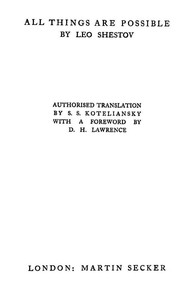
All Things are Possible
free to read
length
45,120 words
a few pages a day
~8 min
finished in
24 days
full read
3h 8m
At Folio's default of ten pages a day, you finish All Things are Possible in about 24 days — roughly 8 minutes of reading each morning.
The opening
the first pages of All Things are Possible, free
_In his paragraph on The Russian Spirit, Shestov gives us the real clue to Russian literature. European culture is a rootless thing in the Russians. With us, it is our very blood and bones, the very nerve and root of our psyche. We think in a certain fashion, we feel in a certain fashion, because our whole substance is of this fashion. Our speech and feeling are organically inevitable to us_.
_With the Russians it is different. They have only been inoculated with the virus of European culture and ethic. The virus works in them like a disease. And the inflammation and irritation comes forth as literature. The bubbling and fizzing is almost chemical, not organic. It is an organism seething as it accepts and masters the strange virus. What the Russian is struggling with, crying out against, is not life itself: it is only European culture which has been introduced, into his psyche, and which hurts him. The tragedy is not so much a real soul tragedy, as a surgical one. Russian art, Russian literature after all does not stand on the same footing as European or Greek or Egyptian art. It is not spontaneous utterance. It is not the flowering of a race. It is a surgical outcry, horrifying, or marvellous, lacerating at first; but when we get used to it, not really so profound, not really ultimate, a little extraneous_.
_What is valuable, is the evidence against European culture, implied in the novelists, here at last expressed. Since Peter the Great Russia has been accepting Europe, and seething Europe down in a curious process of katabolism. Russia has been expressing nothing inherently Russian. Russia's modern Christianity even was not Russian. Her genuine Christianity, Byzantine and Asiatic, is incomprehensible to us. So with her true philosophy. What she has actually uttered is her own unwilling, fantastic reproduction of European truths. What she has really to utter the coming centuries will hear. For Russia will certainly inherit the future. What we already call the greatness of Russia is only her pre-natal struggling_.
_It seems as if she had at last absorbed and overcome the virus of old Europe. Soon her new, healthy body will begin to act in its own reality, imitative no more, protesting no more, crying no more, but full and sound and lusty in itself. Real Russia is born. She will laugh at us before long. Meanwhile she goes through the last stages of reaction against us, kicking away from the old womb of Europe_.
_In Shestov one of the last kicks is given. True, he seems to be only reactionary and destructive. But he can find a little amusement at last in tweaking the European nose, so he is fairly free. European idealism is anathema. But more than this, it is a little comical. We feel the new independence in his new, half-amused indifference_.
_He is only tweaking the nose of European idealism. He is preaching nothing: so he protests time and again. He absolutely refutes any imputation of a central idea He is so afraid lest it should turn out to be another hateful hedge-stake of an ideal_.
"_Everything is possible"--this is his really central cry. It is not nihilism. It is only a shaking free of the human psyche from old bonds. The positive central idea is that the human psyche, or soul, really believes in itself, and in nothing else_.
_Dress this up in a little comely language, and we have a real new ideal, that will last us for a new, long epoch. The human soul itself is the source and well-head of creative activity. In the unconscious human soul the creative prompting issues first into the universe. Open the consciousness to this prompting, away with all your old sluice-gates, locks, dams, channels. No ideal on earth is anything more than an obstruction, in the end, to the creative issue of the spontaneous soul. Away with all ideals. Let each individual act spontaneously from, the forever-incalculable prompting of the creative well-head within him. There is no universal law. Each being is, at his purest, a law unto himself, single, unique, a Godhead, a fountain from the unknown_.
Keep going from exactly here — Folio remembers your place and serves the next portion tomorrow.
continue reading All Things are PossibleAbout this free edition
All Things are Possible by Lev Shestov (1866-1938) is free to read in full. Folio serves it in daily portions you can actually finish, tracks your streak and reading position across devices, and reads every page aloud with a built-in narrator. The text comes from Project Gutenberg.
More like All Things are Possible
Anton Tchekhov, and Other Essays
Lev Shestov
Meditations
Folio
Meditations
Marcus Aurelius
The Enchiridion
Epictetus
Thus Spake Zarathustra
Friedrich Nietzsche
Beyond Good and Evil
Folio
Beyond Good and Evil
Friedrich Nietzsche
The Genealogy of Morals
Folio
The Genealogy of Morals
Friedrich Nietzsche
The Republic
Folio
The Republic
Plato
Apology
Folio
Apology
Plato