An Essay on the Development of Christian Doctrine
Folio
An Essay on the Development of Christian Doctrine
by John Henry Newman (1801-1890)
first published 1845 · free to read
length
136,909 words
a few pages a day
~8 min
finished in
73 days
full read
9h 30m
At Folio's default of ten pages a day, you finish An Essay on the Development of Christian Doctrine in about 73 days — roughly 8 minutes of reading each morning.
The opening
the first pages of An Essay on the Development of Christian Doctrine, free
Not from any special interest which I anticipate you will take in this Volume, or any sympathy you will feel in its argument, or intrinsic fitness of any kind in my associating you and your Fellows with it,--
But, because I have nothing besides it to offer you, in token of my sense of the gracious compliment which you and they have paid me in making me once more a Member of a College dear to me from Undergraduate memories;--
Also, because of the happy coincidence, that whereas its first publication was contemporaneous with my leaving Oxford, its second becomes, by virtue of your act, contemporaneous with a recovery of my position there:--
Therefore it is that, without your leave or your responsibility, I take the bold step of placing your name in the first pages of what, at my age, I must consider the last print or reprint on which I shall ever be engaged.
I am, my dear President, Most sincerely yours, JOHN H. NEWMAN.
February 23, 1878.
PREFACE TO THE EDITION OF 1878.
The following pages were not in the first instance written to prove the divinity of the Catholic Religion, though ultimately they furnish a positive argument in its behalf, but to explain certain difficulties in its history, felt before now by the author himself, and commonly insisted on by Protestants in controversy, as serving to blunt the force of its primâ facie and general claims on our recognition.
However beautiful and promising that Religion is in theory, its history, we are told, is its best refutation; the inconsistencies, found age after age in its teaching, being as patent as the simultaneous contrarieties of religious opinion manifest in the High, Low, and Broad branches of the Church of England.
In reply to this specious objection, it is maintained in this Essay that, granting that some large variations of teaching in its long course of 1800 years exist, nevertheless, these, on examination, will be found to arise from the nature of the case, and to proceed on a law, and with a harmony and a definite drift, and with an analogy to Scripture revelations, which, instead of telling to their disadvantage, actually constitute an argument in their favour, as witnessing to a superintending Providence and a great Design in the mode and in the circumstances of their occurrence.
Perhaps his confidence in the truth and availableness of this view has sometimes led the author to be careless and over-liberal in his concessions to Protestants of historical fact.
If this be so anywhere, he begs the reader in such cases to understand him as speaking hypothetically, and in the sense of an argumentum ad hominem and à fortiori. Nor is such hypothetical reasoning out of place in a publication which is addressed, not to theologians, but to those who as yet are not even Catholics, and who, as they read history, would scoff at any defence of Catholic doctrine which did not go the length of covering admissions in matters of fact as broad as those which are here ventured on.
In this new Edition of the Essay various important alterations have been made in the arrangement of its separate parts, and some, not indeed in its matter, but in its text.
February 2, 1878.
ADVERTISEMENT TO THE FIRST EDITION.
OCULI MEI DEFECERUNT IN SALUTARE TUUM.
It is now above eleven years since the writer of the following pages, in one of the early Numbers of the Tracts for the Times, expressed himself thus:--
"Considering the high gifts, and the strong claims of the Church of Rome and her dependencies on our admiration, reverence, love, and gratitude, how could we withstand her, as we do; how could we refrain from being melted into tenderness, and rushing into communion with her, but for the words of Truth, which bid us prefer Itself to the whole world? 'He that loveth father or mother more than Me, is not worthy of Me.' How could we learn to be severe, and execute judgment, but for the warning of Moses against even a divinely-gifted teacher who should preach new gods, and the anathema of St. Paul even against Angels and Apostles who should bring in a new doctrine?"[ix-1]
Keep going from exactly here — Folio remembers your place and serves the next portion tomorrow.
continue reading An Essay on the Development of Christian DoctrineAbout this free edition
An Essay on the Development of Christian Doctrine by John Henry Newman (1801-1890) is free to read in full. Folio serves it in daily portions you can actually finish, tracks your streak and reading position across devices, and reads every page aloud with a built-in narrator. The text comes from Project Gutenberg.
More like An Essay on the Development of Christian Doctrine
The Idea of a University
Folio
The Idea of a University
John Henry Newman
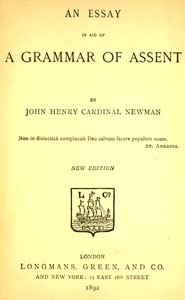
An Essay in Aid of a Grammar of Assent
John Henry Newman
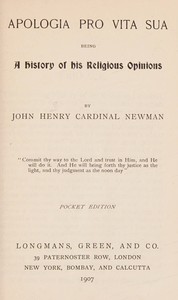
Apologia Pro Vita Sua
John Henry Newman
Meditations
Folio
Meditations
Marcus Aurelius
The Enchiridion
Epictetus
Thus Spake Zarathustra
Friedrich Nietzsche
Beyond Good and Evil
Folio
Beyond Good and Evil
Friedrich Nietzsche
The Genealogy of Morals
Folio
The Genealogy of Morals
Friedrich Nietzsche