length
134,980 words
a few pages a day
~8 min
finished in
72 days
full read
9h 22m
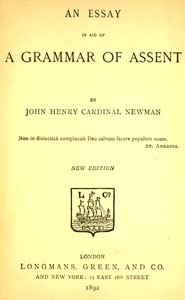
At Folio's default of ten pages a day, you finish An Essay in Aid of a Grammar of Assent in about 72 days — roughly 8 minutes of reading each morning.
The opening
the first pages of An Essay in Aid of a Grammar of Assent, free
1. Propositions (consisting of a subject and predicate united by the copula) may take a categorical, conditional, or interrogative form.
(1) An interrogative, when they ask a Question, (e. g. Does Free-trade benefit the poorer classes?) and imply the possibility of an affirmative or negative resolution of it.
(2) A conditional, when they express a Conclusion (e. g. Free-trade therefore benefits the poorer classes), and both imply, and imply their dependence on, other propositions.
(3) A categorical, when they simply make an Assertion (e. g. Free-trade does benefit), and imply the absence of any condition or reservation of any kind, looking neither before nor behind, as resting in themselves and being intrinsically complete.
These three modes of shaping a proposition, distinct as they are from each other, follow each other in natural sequence. A proposition, which starts with being a Question, may become a Conclusion, and then be changed into an Assertion; but it has of course ceased to be a question, so far forth as it has become a conclusion, and has rid itself of its argumentative form—that is, has ceased to be a conclusion,—so far forth as it has become an assertion. A question has not yet got so far as to be a conclusion, though it is the necessary preliminary of a conclusion; and an assertion has got beyond being a mere conclusion, though it is the natural issue of a conclusion. Their correlation is the measure of their distinction one from another.
No one is likely to deny that a question is distinct both from a conclusion and from an assertion; and an assertion will be found to be equally distinct from a conclusion. For, if we rest our affirmation on arguments, this shows that we are not asserting; and, when we assert, we do not argue. An assertion is as distinct from a conclusion, as a word of command is from a persuasion or recommendation. Command and assertion, as such, both of them, in their different ways, dispense with, discard, ignore, antecedents of any kind, though antecedents may have been a sine quâ non condition of their being elicited. They both carry with them the pretension of being personal acts.
In insisting on the intrinsic distinctness of these three modes of putting a proposition, I am not maintaining that they may not co-exist as regards one and the same subject. For what we have already concluded, we may, if we will, make a question of; and what we are asserting, we may of course conclude over again. We may assert, to one man, and conclude to another, and ask of a third; still, when we assert, we do not conclude, and, when we assert or conclude, we do not question.
2. The internal act of holding propositions is for the most part analogous to the external act of enunciating them; as there are three ways of enunciating, so are there three ways of holding them, each corresponding to each. These three mental acts are Doubt, Inference, and Assent. A question is the expression of a doubt; a conclusion is the expression of an act of inference; and an assertion is the expression of an act of assent. To doubt, for instance, is not to see one’s way to hold that Free-trade is or that it is not a benefit; to infer, is to hold on sufficient grounds that Free-trade may, must, or should be a benefit; to assent to the proposition, is to hold that Free-trade is a benefit.
Moreover, propositions, while they are the material of these three enunciations, are the objects of the three corresponding mental acts; and as without a proposition, there cannot be a question, conclusion, or assertion, so without a proposition there is nothing to doubt about, nothing to infer, nothing to assent to. Mental acts of whatever kind presuppose their objects.
Keep going from exactly here — Folio remembers your place and serves the next portion tomorrow.
continue reading An Essay in Aid of a Grammar of AssentAbout this free edition
An Essay in Aid of a Grammar of Assent by John Henry Newman (1801-1890) is free to read in full. Folio serves it in daily portions you can actually finish, tracks your streak and reading position across devices, and reads every page aloud with a built-in narrator. The text comes from Project Gutenberg.
More like An Essay in Aid of a Grammar of Assent
The Idea of a University
Folio
The Idea of a University
John Henry Newman
An Essay on the Development of Christian Doctrine
Folio
An Essay on the Development of Christian Doctrine
John Henry Newman
Apologia Pro Vita Sua
John Henry Newman
Meditations
Folio
Meditations
Marcus Aurelius
The Enchiridion
Epictetus
Thus Spake Zarathustra
Friedrich Nietzsche
Beyond Good and Evil
Folio
Beyond Good and Evil
Friedrich Nietzsche
The Genealogy of Morals
Folio
The Genealogy of Morals
Friedrich Nietzsche