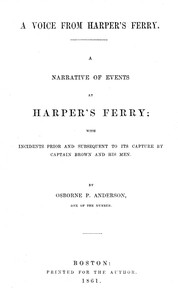
length
20,993 words
a few pages a day
~8 min
finished in
12 days
full read
1h 27m
At Folio's default of ten pages a day, you finish A Voice from Harper's Ferry in about 12 days — roughly 8 minutes of reading each morning.
The opening
the first pages of A Voice from Harper's Ferry, free
My sole purpose in publishing the following Narrative is to save from oblivion the facts connected with one of the most important movements of this age, with reference to the overthrow of American slavery. My own personal experience in it, under the orders of Capt. Brown, on the 16th and 17th of October, 1859, as the only man alive who was at Harper’s Ferry during the entire time--the unsuccessful groping after these facts, by individuals, impossible to be obtained, except from an actor in the scene--and the conviction that the cause of impartial liberty requires this duty at my hands--alone have been the motives for writing and circulating the little book herewith presented.
I will not, under such circumstances, insult nor burden the intelligent with excuses for defects in composition, nor for the attempt to give the facts. A plain, unadorned, truthful story is wanted, and that by one who knows what he says, who is known to have been at the great encounter, and to have labored in shaping the same. My identity as a member of Capt. Brown’s company cannot be questioned, successfully, by any who are bent upon suppressing the truth; neither will it be by any in Canada or the United States familiar with John Brown and his plans, as those know his men personally, or by reputation, who enjoyed his confidence sufficiently to know thoroughly his plans.
The readers of this narrative will therefore keep steadily in view the main point--that they are perusing a story of events which have happened under the eye of the great Captain, or are incidental thereto, and not a compendium of the “plans” of Capt. Brown; for as his plans were not consummated, and as their fulfilment is committed to the future, no one to whom they are known will recklessly expose all of them to the public gaze. Much has been given as true that never happened; much has been omitted that should have been made known; many things have been left unsaid, because, up to within a short time, but two could say them; one of them has been offered up, a sacrifice to the Moloch, Slavery; being that other one, I propose to perform the duty, trusting to that portion of the public who love the right for an appreciation of my endeavor.
O. P. A.
A VOICE FROM HARPER’S FERRY.
CHAPTER I.
THE IDEA AND ITS EXPONENTS--JOHN BROWN ANOTHER MOSES.
The idea underlying the outbreak at Harper’s Ferry is not peculiar to that movement, but dates back to a period very far beyond the memory of the “oldest inhabitant,” and emanated from a source much superior to the Wises and Hunters, the Buchanans and Masons of to-day. It was the appointed work for life of an ancient patriarch spoken of in Exodus, chap, ii., and who, true to his great commission, failed not to trouble the conscience and to disturb the repose of the Pharaohs of Egypt with that inexorable, “Thus saith the Lord: Let my people go!” until even they were urgent upon the people in its behalf. Coming down through the nations, and regardless of national boundaries or peculiarities, it has been proclaimed and enforced by the patriarch and the warrior of the Old World, by the enfranchised freeman and the humble slave of the New. Its nationality is universal; its language every where understood by the haters of tyranny; and those that accept its mission, every where understand each other. There is an unbroken chain of sentiment and purpose from Moses of the Jews to John Brown of America; from Kossuth, and the liberators of France and Italy, to the untutored Gabriel, and the Denmark Veseys, Nat Turners and Madison Washingtons of the Southern American States. The shaping and expressing of a thought for freedom takes the same consistence with the colored American--whether he be an independent citizen of the Haytian nation, a proscribed but humble nominally free colored man, a patient, toiling, but hopeful slave--as with the proudest or noblest representative of European or American civilization and Christianity. Lafayette, the exponent of French honor and political integrity, and John Brown, foremost among the men of the New World in high moral and religious principle and magnanimous bravery, embrace as brothers of the same mother, in harmony upon the grand mission of liberty; but, while the Frenchman entered the lists in obedience to a desire to aid, and by invitation from the Adamses and Hamiltons, and thus pushed on the political fortunes of those able to help themselves, John Brown, the liberator of Kansas, the projector and commander of the Harper’s Ferry expedition, saw in the most degraded slave a man and a brother, whose appeal for his God-ordained rights no one should disregard; in the toddling slave child, a captive whose release is as imperative, and whose prerogative is as weighty, as the most famous in the land. When the Egyptian pressed hard upon the Hebrew, Moses slew him; and when the spirit of slavery invaded the fair Territory of Kansas, causing the Free-State settlers to cry out because of persecution, old John Brown, famous among the men of God for ever, though then but little known to his fellow-men, called together his sons and went over, as did Abraham, to the unequal contest, but on the side of the oppressed white men of Kansas that were, and the black men that were to be. To-day, Kansas is free, and the verdict of impartial men is, that to John Brown, more than any other man, Kansas owes her present position.
Keep going from exactly here — Folio remembers your place and serves the next portion tomorrow.
continue reading A Voice from Harper's FerryAbout this free edition
A Voice from Harper's Ferry by Osborne P. Anderson (1830-1872) is free to read in full. Folio serves it in daily portions you can actually finish, tracks your streak and reading position across devices, and reads every page aloud with a built-in narrator. The text comes from Project Gutenberg.
More like A Voice from Harper's Ferry

The Autobiography of Benjamin Franklin
Benjamin Franklin
Narrative of the Life of Frederick Douglass
Folio
Narrative of the Life of Frederick Douglass
Frederick Douglass
My Bondage and My Freedom
Folio
My Bondage and My Freedom
Frederick Douglass
The Story of My Life
Folio
The Story of My Life
Helen Keller
Up from Slavery
Booker T. Washington
Incidents in the Life of a Slave Girl
Folio
Incidents in the Life of a Slave Girl
Harriet Jacobs
Twelve Years a Slave
Solomon Northup
The Narrative of Sojourner Truth
Folio
The Narrative of Sojourner Truth
Sojourner Truth