A Vindication of the Rights of Woman
Folio
A Vindication of the Rights of Woman
by Mary Wollstonecraft (1759-1797)
first published 1792 · free to read
length
86,276 words
a few pages a day
~8 min
finished in
46 days
full read
5h 59m
At Folio's default of ten pages a day, you finish A Vindication of the Rights of Woman in about 46 days — roughly 8 minutes of reading each morning.
The opening
the first pages of A Vindication of the Rights of Woman, free
M. Wollstonecraft was born in 1759. Her father was so great a wanderer, that the place of her birth is uncertain; she supposed, however, it was London, or Epping Forest: at the latter place she spent the first five years of her life. In early youth she exhibited traces of exquisite sensibility, soundness of understanding, and decision of character; but her father being a despot in his family, and her mother one of his subjects, Mary, derived little benefit from their parental training. She received no literary instructions but such as were to be had in ordinary day schools. Before her sixteenth year she became acquainted with Mr. Clare a clergyman, and Miss Frances Blood; the latter, two years older than herself; who possessing good taste and some knowledge of the fine arts, seems to have given the first impulse to the formation of her character. At the age of nineteen, she left her parents, and resided with a Mrs. Dawson for two years; when she returned to the parental roof to give attention to her mother, whose ill health made her presence necessary. On the death of her mother, Mary bade a final adieu to her father's house, and became the inmate of F. Blood; thus situated, their intimacy increased, and a strong attachment was reciprocated. In 1783 she commenced a day school at Newington green, in conjunction with her friend, F. Blood. At this place she became acquainted with Dr. Price, to whom she became strongly attached; the regard was mutual.
It is said that she became a teacher from motives of benevolence, or rather philanthropy, and during the time she continued in the profession, she gave proof of superior qualification for the performance of its arduous and important duties. Her friend and coadjutor married and removed to Lisbon, in Portugal, where she died of a pulmonary disease; the symptoms of which were visible before her marriage. So true was Mary's attachment to her, that she entrusted her school to the care of others, for the purpose of attending Frances in her closing scene. She aided, as did Dr. Young, in "Stealing Narcissa a grave." Her mind was expanded by this residence in a foreign country, and though clear of religious bigotry before, she took some instructive lessons on the evils of superstition, and intolerance.
On her return she found the school had suffered by her absence, and having previously decided to apply herself to literature, she now resolved to commence. In 1787 she made, or received, proposals from Johnson, a publisher in London, who was already acquainted with her talents as an author. During the three subsequent years, she was actively engaged, more in translating, condensing, and compiling, than in the production of original works. At this time she laboured under much depression of spirits, for the loss of her friend; this rather increased, perhaps, by the publication of "Mary, a novel," which was mostly composed of incidents and reflections connected with their intimacy.
The pecuniary concerns of her father becoming embarrassed, Mary practised a rigid economy in her expenditures, and with her savings was enabled to procure her sisters and brothers situations, to which without her aid, they could not have had access; her father was sustained at length from her funds; she even found means to take under her protection an orphan child.
She had acquired a facility in the arrangement and expression of thoughts, in her avocation of translator, and compiler, which was no doubt of great use to her afterward. It was not long until she had occasion for them. The eminent Burke produced his celebrated "Reflections on the Revolution in France." Mary full of sentiments of liberty, and indignant at what she thought subversive of it, seized her pen and produced the first attack upon that famous work. It succeeded well, for though intemperate and contemptuous, it was vehemently and impetuously eloquent; and though Burke was beloved by the enlightened friends of freedom, they were dissatisfied and disgusted with what they deemed an outrage upon it.
Keep going from exactly here — Folio remembers your place and serves the next portion tomorrow.
continue reading A Vindication of the Rights of WomanAbout this free edition
A Vindication of the Rights of Woman by Mary Wollstonecraft (1759-1797) is free to read in full. Folio serves it in daily portions you can actually finish, tracks your streak and reading position across devices, and reads every page aloud with a built-in narrator. The text comes from Project Gutenberg.
More like A Vindication of the Rights of Woman
The Love Letters of Mary Wollstonecraft to Gilbert Imlay
Folio
The Love Letters of Mary Wollstonecraft to Gilbert Imlay
Mary Wollstonecraft
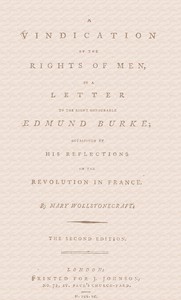
A Vindication of the Rights of Men
Mary Wollstonecraft
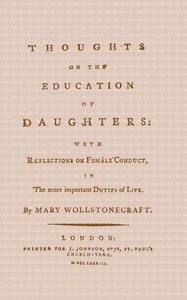
Thoughts on the Education of Daughters
Mary Wollstonecraft
Letters Written During a Short Residence in Sweden, Norway, and Denmark
Folio
Letters Written During a Short Residence in Sweden, Norway, and Denmark
Mary Wollstonecraft

The Autobiography of Benjamin Franklin
Benjamin Franklin
Narrative of the Life of Frederick Douglass
Folio
Narrative of the Life of Frederick Douglass
Frederick Douglass
My Bondage and My Freedom
Folio
My Bondage and My Freedom
Frederick Douglass
The Story of My Life
Folio
The Story of My Life
Helen Keller