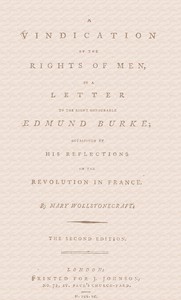
A Vindication of the Rights of Men
by Mary Wollstonecraft (1759-1797)
first published 1790 · free to read
length
24,613 words
a few pages a day
~8 min
finished in
13 days
full read
1h 43m
At Folio's default of ten pages a day, you finish A Vindication of the Rights of Men in about 13 days — roughly 8 minutes of reading each morning.
The opening
the first pages of A Vindication of the Rights of Men, free
Mr. Burke’s Reflections on the French Revolution first engaged my attention as the transient topic of the day; and reading it more for amusement than information, my indignation was roused by the sophistical arguments, that every moment crossed me, in the questionable shape of natural feelings and common sense.
Many pages of the following letter were the effusions of the moment; but, swelling imperceptibly to a considerable size, the idea was suggested of publishing a short vindication of the Rights of Men.
Not having leisure or patience to follow this desultory writer through all the devious tracks in which his fancy has started fresh game, I have confined my strictures, in a great measure, to the grand principles at which he has levelled many ingenious arguments in a very specious garb.
A LETTER TO THE Right Honourable EDMUND BURKE.
SIR,
It is not necessary, with courtly insincerity, to apologise to you for thus intruding on your precious time, not to profess that I think it an honour to discuss an important subject with a man whose literary abilities have raised him to notice in the state. I have not yet learned to twist my periods, nor, in the equivocal idiom of politeness, to disguise my sentiments, and imply what I should be afraid to utter: if, therefore, in the course of this epistle, I chance to express contempt, and even indignation, with some emphasis, I beseech you to believe that it is not a flight of fancy; for truth, in morals, has ever appeared to me the essence of the sublime; and, in taste, simplicity the only criterion of the beautiful. But I war not with an individual when I contend for the rights of men and the liberty of reason. You see I do not condescend to cull my words to avoid the invidious phrase, nor shall I be prevented from giving a manly definition of it, by the flimsy ridicule which a lively fancy has interwoven with the present acceptation of the term. Reverencing the rights of humanity, I shall dare to assert them; not intimidated by the horse laugh that you have raised, or waiting till time has wiped away the compassionate tears which you have elaborately laboured to excite.
From the many just sentiments interspersed through the letter before me, and from the whole tendency of it, I should believe you to be a good, though a vain man, if some circumstances in your conduct did not render the inflexibility of your integrity doubtful; and for this vanity a knowledge of human nature enables me to discover such extenuating circumstances, in the very texture of your mind, that I am ready to call it amiable, and separate the public from the private character.
I know that a lively imagination renders a man particularly calculated to shine in conversation and in those desultory productions where method is disregarded; and the instantaneous applause which his eloquence extorts is at once a reward and a spur. Once a wit and always a wit, is an aphorism that has received the sanction of experience; yet I am apt to conclude that the man who with scrupulous anxiety endeavours to support that shining character, can never nourish by reflection any profound, or, if you please, metaphysical passion. Ambition becomes only the tool of vanity, and his reason, the weather-cock of unrestrained feelings, is only employed to varnish over the faults which it ought to have corrected.
Keep going from exactly here — Folio remembers your place and serves the next portion tomorrow.
continue reading A Vindication of the Rights of MenAbout this free edition
A Vindication of the Rights of Men by Mary Wollstonecraft (1759-1797) is free to read in full. Folio serves it in daily portions you can actually finish, tracks your streak and reading position across devices, and reads every page aloud with a built-in narrator. The text comes from Project Gutenberg.
More like A Vindication of the Rights of Men
The Love Letters of Mary Wollstonecraft to Gilbert Imlay
Folio
The Love Letters of Mary Wollstonecraft to Gilbert Imlay
Mary Wollstonecraft
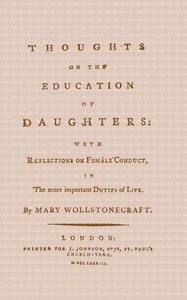
Thoughts on the Education of Daughters
Mary Wollstonecraft
A Vindication of the Rights of Woman
Folio
A Vindication of the Rights of Woman
Mary Wollstonecraft
Letters Written During a Short Residence in Sweden, Norway, and Denmark
Folio
Letters Written During a Short Residence in Sweden, Norway, and Denmark
Mary Wollstonecraft
Meditations
Folio
Meditations
Marcus Aurelius
The Enchiridion
Epictetus

Thus Spake Zarathustra
Friedrich Nietzsche
Beyond Good and Evil
Folio
Beyond Good and Evil
Friedrich Nietzsche