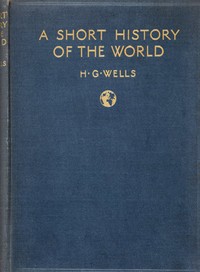
A Short History of the World
first published 1922 · free to read
length
118,077 words
a few pages a day
~8 min
finished in
63 days
full read
8h 12m
At Folio's default of ten pages a day, you finish A Short History of the World in about 63 days — roughly 8 minutes of reading each morning.
The opening
the first pages of A Short History of the World, free
The story of our world is a story that is still very imperfectly known. A couple of hundred years ago men possessed the history of little more than the last three thousand years. What happened before that time was a matter of legend and speculation. Over a large part of the civilized world it was believed and taught that the world had been created suddenly in 4004 B.C., though authorities differed as to whether this had occurred in the spring or autumn of that year. This fantastically precise misconception was based upon a too literal interpretation of the Hebrew Bible, and upon rather arbitrary theological assumptions connected therewith. Such ideas have long since been abandoned by religious teachers, and it is universally recognized that the universe in which we live has to all appearances existed for an enormous period of time and possibly for endless time. Of course there may be deception in these appearances, as a room may be made to seem endless by putting mirrors facing each other at either end. But that the universe in which we live has existed only for six or seven thousand years may be regarded as an altogether exploded idea.
The earth, as everybody knows nowadays, is a spheroid, a sphere slightly compressed, orange fashion, with a diameter of nearly 8,000 miles. Its spherical shape has been known at least to a limited number of intelligent people for nearly 2,500 years, but before that time it was supposed to be flat, and various ideas which now seem fantastic were entertained about its relations to the sky and the stars and planets. We know now that it rotates upon its axis (which is about 24 miles shorter than its equatorial diameter) every twenty-four hours, and that this is the cause of the alternations of day and night, that it circles about the sun in a slightly distorted and slowly variable oval path in a year. Its distance from the sun varies between ninety-one and a half millions at its nearest and ninety-four and a half million miles.
LUMINOUS SPIRAL CLOUDS OF MATTER “LUMINOUS SPIRAL CLOUDS OF MATTER”
(Nebula photographed 1910)
Photo: G. W. Ritchey
About the earth circles a smaller sphere, the moon, at an average distance of 239,000 miles. Earth and moon are not the only bodies to travel round the sun. There are also the planets, Mercury and Venus, at distances of thirty-six and sixty-seven millions of miles; and beyond the circle of the earth and disregarding a belt of numerous smaller bodies, the planetoids, there are Mars, Jupiter, Saturn, Uranus and Neptune at mean distances of 141, 483, 886, 1,782, and 1,793 millions of miles respectively. These figures in millions of miles are very difficult for the mind to grasp. It may help the reader’s imagination if we reduce the sun and planets to a smaller, more conceivable scale.
THE NEBULA SEEN EDGE ON THE NEBULA SEEN EDGE-ON
Note the central core which, through millions of years, is cooling to solidity
Photo: G. W. Ritchey
If, then, we represent our earth as a little ball of one inch diameter, the sun would be a big globe nine feet across and 323 yards away, that is about a fifth of a mile, four or five minutes’ walking. The moon would be a small pea two feet and a half from the world. Between earth and sun there would be the two inner planets, Mercury and Venus, at distances of one hundred and twenty-five and two hundred and fifty yards from the sun. All round and about these bodies there would be emptiness until you came to Mars, a hundred and seventy-five feet beyond the earth; Jupiter nearly a mile away, a foot in diameter; Saturn, a little smaller, two miles off; Uranus four miles off and Neptune six miles off. Then nothingness and nothingness except for small particles and drifting scraps of attenuated vapour for thousands of miles. The nearest star to earth on this scale would be 40,000 miles away.
These figures will serve perhaps to give one some conception of the immense emptiness of space in which the drama of life goes on.
Keep going from exactly here — Folio remembers your place and serves the next portion tomorrow.
continue reading A Short History of the WorldAbout this free edition
A Short History of the World by H. G. Wells (1866-1946) is free to read in full. Folio serves it in daily portions you can actually finish, tracks your streak and reading position across devices, and reads every page aloud with a built-in narrator. The text comes from Project Gutenberg.
More like A Short History of the World

The Wheels of Chance: A Bicycling Idyll
H. G. Wells
The Time Machine
H. G. Wells

The War of the Worlds
H. G. Wells
The Invisible Man
H. G. Wells
The Island of Doctor Moreau
H. G. Wells
The First Men in the Moon
H. G. Wells
The Sleeper Awakes
Folio
The Sleeper Awakes
H. G. Wells
The Food of the Gods and How It Came to Earth
Folio
The Food of the Gods and How It Came to Earth
H. G. Wells