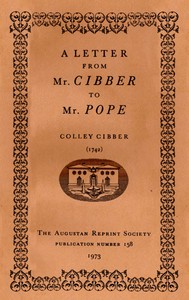
A Letter from Mr. Cibber to Mr. Pope
free to read
length
17,737 words
a few pages a day
~8 min
finished in
10 days
full read
1h 14m
At Folio's default of ten pages a day, you finish A Letter from Mr. Cibber to Mr. Pope in about 10 days — roughly 8 minutes of reading each morning.
The opening
the first pages of A Letter from Mr. Cibber to Mr. Pope, free
In the twentieth century, Colley Cibber's name has become synonymous with "fool." Pope's Dunciad, the culmination of their long quarrel, has done its work well, and Cibber, now too often regarded merely as a pretentious dunce, has been relegated to an undeserved obscurity.
The history of this feud is replete with inconsistencies.[1] The image Cibber presents of himself as a charming, good-natured, thick-skinned featherbrain is as true as Pope's of himself as a patient, humorous, objective moralist. Each picture is somewhat manipulated by its creator. The reasons behind the manipulation are less matters of outright untruth than of complex personalities disclosing only what they regard as pertinent. Cibber, the actor, always tries to charm his audience; Pope, the satirist, proffers those aspects best suited to his moral purpose.
Although the fact of their differences is evident in Pope's writings after 1730, explanations of the cause, continuation and climax tend to be muddled. The cause generally cited is Cibber's story in the Letter concerning Three Hours after Marriage and The Rehearsal. This is not only a one-sided version, it is not even strongly substantiated. As Norman Ault pointed out, it was not reported in any of the periodicals at a time when such incidents were seized upon by journalists hungry for gossip.[2] The only confirmation aside from Cibber is Montagu Bacon's letter to his cousin James Montagu, which gives a slightly less vivacious account:
'I don't know whether you heard, before you went out of town, that The Rehearsal was revived ... and Cibber interlarded it with several things in ridicule of the last play, upon which Pope went up to him and told him he was a rascal, and if he were able he would cane him; that his friend Gay was a proper fellow, and if he went on in his sauciness he might expect such a reception from him. The next night Gay came accordingly, and, treating him as Pope had done the night before, Cibber very fairly gave him a fillip on the nose, which made them both roar. The Guards came and parted them, and carried away Gay, and so ended this poetical scuffle.'[3]
A more likely cause is the second story in the Letter, the visit to the bawdy house. If, as Ault goes on to suggest, there is even a shadow of truth in it, Pope's attitude, as well as his reluctance to reveal its cause, is understandable. The question then becomes: why did he continually provoke Cibber, knowing the latter had such a story at hand? This, however, might not be so illogical as it appears. Pope's work in the thirties abounds in sneers at the actor, but none of them is equal in scale to the full attack launched against Theobald. In comparison with the 1735 portraits of Atticus and Sporus, the comments on Cibber are minor barbs that could be ignored by a man whose reputation was secure in its own right. Cibber evidently believed he was in such a position, for he offered no defense before 1740, and took no offensive action before 1742.
The "wicked wasp of Twickenham" is supposed to have meditated long and fiendishly before bursting forth against his enemies, yet the Dunciad of 1728 reveals no evidence of long fermentation. The choice of Theobald as king of the Dunces obviously derives from Shakespeare Restored; or a Specimen of the many errors as well committed as unamended by Mr. Pope, in his late edition of that Poet (1726). Theobald's remarks on Pope's slipshod editing of Shakespeare are not couched in diplomatic terms, and would be especially galling if Warburton's note is true:
During two whole years while Mr. Pope was preparing his Edition of Shakespear, he publish'd Advertisements, requesting assistance, and promising satisfaction to any who could contribute to its greater perfection. But this Restorer, who was at that time solliciting favours of him by letters, did wholly conceal his design, till after its publication: (which he was since not asham'd to own, in a Daily Journal, of Nov. 26, 1728.)[4]
Pedantic, unimaginative and presumptuous, Theobald was the logical choice for a Dunce King in 1728. Dennis, Ducket, Burnet, Gildon et cie., had assailed him for years, and the prompt responses by Scriblerus merely increased their fury. Pope bore as many undeserved blows as Cibber, and he was no model of patience; the intense hostilities waged against him in the twenties were ample cause for an epic answer.[5]
Keep going from exactly here — Folio remembers your place and serves the next portion tomorrow.
continue reading A Letter from Mr. Cibber to Mr. PopeAbout this free edition
A Letter from Mr. Cibber to Mr. Pope by Colley Cibber (1671-1757) is free to read in full. Folio serves it in daily portions you can actually finish, tracks your streak and reading position across devices, and reads every page aloud with a built-in narrator. The text comes from Project Gutenberg.
More like A Letter from Mr. Cibber to Mr. Pope
The Autobiography of Benjamin Franklin
Benjamin Franklin
Narrative of the Life of Frederick Douglass
Folio
Narrative of the Life of Frederick Douglass
Frederick Douglass
My Bondage and My Freedom
Folio
My Bondage and My Freedom
Frederick Douglass
The Story of My Life
Folio
The Story of My Life
Helen Keller
Up from Slavery
Booker T. Washington
Incidents in the Life of a Slave Girl
Folio
Incidents in the Life of a Slave Girl
Harriet Jacobs
Twelve Years a Slave
Solomon Northup
The Narrative of Sojourner Truth
Folio
The Narrative of Sojourner Truth
Sojourner Truth