length
70,224 words
a few pages a day
~8 min
finished in
37 days
full read
4h 53m
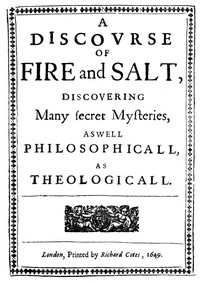
At Folio's default of ten pages a day, you finish A Discovrse of Fire and Salt in about 37 days — roughly 8 minutes of reading each morning.
The opening
the first pages of A Discovrse of Fire and Salt, free
PYTHAGORAS who of all Pagans was undoubtedly, by common consent and approbation, held to have made more profound search, and with less incertainty penetrated into the secrets as well of Divinity, as of Nature, having quaffed full draughts from the living source of Mosaicall Traditions, amid’st his darke sentences, where, according to the Letter, he touched one thing, and mystically understood and comprised another; (wherein he imitates the Ægyptians and Chaldæans, or rather, the Hebrewes, from whence all theirs proceeded) he here sets downe these two: Not to speake of God without Light; and to apply Salt in all his Sacrifices and Offerings; which he borrowed word for word from Moses, as we shall hereafter declare. For our intention is here to Treat of Fire and of Salt.
And that upon the 9. of Saint Marke, ver. 49. Every man shall be salted with Fire, and every Sacrifice shall be salted with Salt. Wherein foure things come to be specified, Man, and Sacrifice, Fire, and Salt; which yet are reduced to two, comprehending under them, the other two; Man and Sacrifice, Fire and Salt; in respect of the conformitie they beare each to other.
In the beginning God created Heaven and Earth; this said Moses on the entrance upon Genesis. Whereupon the Jew Aristobulus, and some Ethniques willing to shew that Pythagoras and Plato had read Moses bookes, and from thence drawne the greatest part of their most secret Philosophy, alledged that which Moses should have said, that the heaven and the earth were first created; Plato in his Timæus, after, Timæus Locrien said that God first assembled Fire and Earth, to build an universe thereof; (we will shew it more sensibly of Zohar in the Weik of a Candle lighted, for all consists of light, being the first of all Creatures.) These Philosophers presupposing that the World consisted (as indeed it doth) of the foure Elements, which are as well in heaven, and yet higher, as in the earth, and lower, but in a diverse manner.
The two highest, Aire and Fire, being comprised under the name of Heaven and of the Æthereall Region: for the word ἄιθηρ, comes from the verbe ἄιθω to shine, and to enflame, the two proprieties of these Elements. And under the word Earth, the two lower, Earth and Water, incorporated into one Globe. But although Moses set Heaven before Earth; (and observe here that in all Genesis he toucheth at nothing but things sensible, but not of intelligible things; which is a point apart) for concerning this, there is no good agreement between Jewes and Christians; Saint Chrysostome in his first Homily. Observe a little with what dignity the Divine Nature comes to shine in his manner of proceeding to the creation of things; For God contrary to Artists in building his Edifice, stretched out first the heavens round about, afterwards planted the earth below.
Hee wrought first at the head, and afterwards came to the foundation. But it is the Hebrewes custome, that when they speake most of a thing, they ordinarily put the last in order, which they pretend to touch first: And the same is here practised, where Heaven is alledged before Earth, which he comes to discry immediately after.
In the beginning God created Heaven and Earth, and the Earth was without Forme and void; Saint Matthew useth the same, upon the entrance to his Gospell, The Booke of the Generation of Jesus Christ the son of David, the son of Abraham, Abraham begat Isaac, &c. For it is well knowne, that Abraham was a long time before David: Otherwise it seemes, that Moses would particularly demonstrate, that the Earth was made before the Heaven, by the Creation of man, that is, the Image and pourtrait of the great World, for that in the second of Genesis, God formed man of the slime of the earth, (that is to say,) his body which it represents; and afterwards breathed in his face the spirit, or breath of life: that carrieth him backe to heaven; whereunto suits that which is written in the 1 to the Cor. 15. The first man from the earth is earthly, and the second man from heaven is heavenly: the first man Adam was made a living soule; and the last Adam, a quickning spirit. Whereto the Generation of the Creature relates, who six weeks after the Conception, is nothing but a masse of informed flesh, till the soule that is infused from above, doth vivifie it.
Keep going from exactly here — Folio remembers your place and serves the next portion tomorrow.
continue reading A Discovrse of Fire and SaltAbout this free edition
A Discovrse of Fire and Salt by Blaise de Vigenère (1523-1596) is free to read in full. Folio serves it in daily portions you can actually finish, tracks your streak and reading position across devices, and reads every page aloud with a built-in narrator. The text comes from Project Gutenberg.
More like A Discovrse of Fire and Salt
The Upanishads
Folio
The Upanishads
Swami Paramananda
The Yoga Sutras of Patanjali
Folio
The Yoga Sutras of Patanjali
Patañjali
The Persian Mystics: Jami
Folio
The Persian Mystics: Jami
Jami
A Letter to a Hindu
Folio
A Letter to a Hindu
Leo Tolstoy
Lives of the Necromancers
Folio
Lives of the Necromancers
William Godwin
The Witch-Cult in Western Europe
Folio
The Witch-Cult in Western Europe
Margaret Alice Murray
Witch, Warlock, and Magician
Folio
Witch, Warlock, and Magician
W. H. Davenport Adams
The Wonderfull Discoverie of Witches in the Countie of Lancaster
Folio
The Wonderfull Discoverie of Witches in the Countie of Lancaster
Thomas, active 1612-1618 Potts