length
119,225 words
a few pages a day
~8 min
finished in
63 days
full read
8h 17m
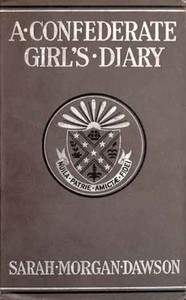
At Folio's default of ten pages a day, you finish A Confederate Girl's Diary in about 63 days — roughly 8 minutes of reading each morning.
The opening
the first pages of A Confederate Girl's Diary, free
Built by General A. G. Carter in 1848, now the home of his grandson, Howell Morgan. This was a Spanish grant and has always remained in the family.
THE ANTE-BELLUM HOME OF JUDGE THOMAS GIBBES MORGAN 308
On Church Street, Baton Rouge, La., now the property of St. Joseph Academy, and used as an annex.
JUDGE THOMAS GIBBES MORGAN 346
INTRODUCTION
It is perhaps due to a chance conversation, held some seventeen years ago in New York, that this Diary of the Civil War was saved from destruction.
A Philadelphian had been talking with my mother of North and South, and had alluded to the engagement between the Essex and the Arkansas, on the Mississippi, as a brilliant victory for the Federal navy. My mother protested, at once; said that she and her sister Miriam, and several friends, had been witnesses, from the levee, to the fact that the Confederates had fired and abandoned their own ship when the machinery broke down, after two shots had been exchanged: the Federals, cautiously turning the point, had then captured but a smoking hulk. The Philadelphian gravely corrected her; history, it appeared, had consecrated, on the strength of an official report, the version more agreeable to Northern pride.
"But I wrote a description of the whole, just a few hours after it occurred!" my mother insisted. "Early in the war I began to keep a diary, and continued until the very end; I had to find some vent for my feelings, and I would not make an exhibition of myself by talking, as so many women did. I have written while resting to recover breath in the midst of a stampede; I have even written with shells bursting over the house in which I sat, ready to flee but waiting for my mother and sisters to finish their preparations."
"If that record still existed, it would be invaluable," said the Philadelphian. "We Northerners are sincerely anxious to know what Southern women did and thought at that time, but the difficulty is to find authentic contemporaneous evidence. All that I, for one, have seen, has been marred by improvement in the light of subsequent events."
"You may read my evidence as it was written from March 1862 until April 1865," my mother declared impulsively.
At our home in Charleston, on her return, she unstitched with trembling hands a linen-bound parcel always kept in her tall, cedar-lined wardrobe of curled walnut. On it was scratched in ink "To be burned unread after my death"; it contained, she had once told me, a record of no interest save to her who had written it and lacked the courage to re-read it; a narrative of days she had lived, of joys she had lost; of griefs accepted, of vain hopes cherished.
From the linen, as the stitches were cut, fell five blank books of different sizes. Two, of convenient dimensions, might have been intended for diaries; the other three, somewhat unwieldy, were partly used ledgers from Judge P. H. Morgan's office. They were closely written in a clear, firm hand; the ink, of poor quality, had faded in many places to a pale brown scarcely darker than the deep yellow to which time had burned the paper. The effort to read under such conditions, and the tears shed over the scenes evoked, might well have cost my mother her sight; but she toiled for many weeks, copying out the essential portions of the voluminous record for the benefit of the Northerner who really wished to know.
Her transcription finished, she sent it to Philadelphia. It was in due course returned, with cold regrets that the temptation to rearrange it had not been resisted. No Southerner at that time could possibly have had opinions so just or foresight so clear as those here attributed to a young girl. Explanation was not asked, nor justification allowed: the case, tried by one party alone, with evidence seen from one standpoint alone, had been judged without appeal.
Keep going from exactly here — Folio remembers your place and serves the next portion tomorrow.
continue reading A Confederate Girl's DiaryAbout this free edition
A Confederate Girl's Diary by Sarah Morgan Dawson (1842-1909) is free to read in full. Folio serves it in daily portions you can actually finish, tracks your streak and reading position across devices, and reads every page aloud with a built-in narrator. The text comes from Project Gutenberg.
More like A Confederate Girl's Diary
The Autobiography of Benjamin Franklin
Benjamin Franklin
Narrative of the Life of Frederick Douglass
Folio
Narrative of the Life of Frederick Douglass
Frederick Douglass
My Bondage and My Freedom
Folio
My Bondage and My Freedom
Frederick Douglass
The Story of My Life
Folio
The Story of My Life
Helen Keller
Up from Slavery
Booker T. Washington
Incidents in the Life of a Slave Girl
Folio
Incidents in the Life of a Slave Girl
Harriet Jacobs
Twelve Years a Slave
Solomon Northup
The Narrative of Sojourner Truth
Folio
The Narrative of Sojourner Truth
Sojourner Truth