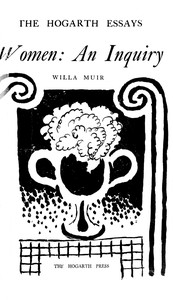
Women: An Inquiry
first published 1925 · free to read
length
10,803 words
a few pages a day
~8 min
finished in
6 days
full read
45 min
At Folio's default of ten pages a day, you finish Women: An Inquiry in about 6 days — roughly 8 minutes of reading each morning.
The opening
the first pages of Women: An Inquiry, free
MEN and women are latecomers to this planet, but they have existed for a very long time, judged by human standards. One might reasonably expect the difference between them, if it is an essential difference, to be now capable of formulation. An essential difference would be a difference distinctively human, that is, spiritual as well as physical, and at the same time distinctively sexual.
External differences, such as the presence or absence of beards and other secondary sexual characteristics, do not satisfy the first part of this definition, and are to be disregarded. Many so-called differences in social behaviour are also not essential differences. A valuable book written by the Vaertings[1] has made this clear. In a State where men are dominant, as in most of our civilised States for the past two thousand years, certain attributes are considered to be characteristic of women which are equally characteristic of men in a State where women are dominant, as it is said they were for some time in ancient Egypt. The subordinate sex in each case is excluded from complete development, and is considered to be less intelligent, less courageous, and more domesticated than the dominant sex. In fact, men and women share jointly in what is called human nature, and are alike capable of courage, fear, cruelty, tenderness, intelligence, and stupidity. When exhilarated by power and responsibility they display the more dominating qualities, and in subordinate positions they manifest a “slave psychology.” Therefore men and women are not to be differentiated as brave or timid, intelligent or stupid, strong or weak, because a classification of this kind is too broadly human and not distinctively sexual.
It is not asserted that secondary physiological differences between the sexes or social differences in behaviour have no significance. Possibly sexual differentiation is so fundamental that it modifies the least reactions of men and women; but to begin an investigation of these would require exhaustive scientific information outside the scope of this essay, which is an attempt to discover if the division of the human race into men and women involves a division of spiritual as well as of sexual functions, so that the creative work of women is different in kind from the creative work of men. From this point of view the differences mentioned are significant as effects rather than causes, and a consideration of them must be dismissed as unfruitful. The aim of this essay, then, is to find a conception of womanhood as something essentially different from manhood. An essential difference would persist through all the variations of behaviour caused by the dominance of either sex: consequently the validity of this inquiry is not impaired by the restriction of its material to the activities of men and women in our present one-sided civilisation. The knowledge that it is one-sided, because men have for so long been dominant over women, is valuable in helping to distinguish what is essential from what is accidental. The subordination of women makes it difficult but not impossible to recognise the essential quality of womanhood. In a masculine civilisation the creative work of women may be belittled, misinterpreted, or denied: but if it is a reality, its existence will be proved at least by the emotional colour of the denial.
Keep going from exactly here — Folio remembers your place and serves the next portion tomorrow.
continue reading Women: An InquiryAbout this free edition
Women: An Inquiry by Willa Muir (1890-1970) is free to read in full. Folio serves it in daily portions you can actually finish, tracks your streak and reading position across devices, and reads every page aloud with a built-in narrator. The text comes from Project Gutenberg.
More like Women: An Inquiry
Meditations
Folio
Meditations
Marcus Aurelius
The Enchiridion
Epictetus
Thus Spake Zarathustra
Friedrich Nietzsche
Beyond Good and Evil
Folio
Beyond Good and Evil
Friedrich Nietzsche
The Genealogy of Morals
Folio
The Genealogy of Morals
Friedrich Nietzsche
The Republic
Folio
The Republic
Plato
Apology
Folio
Apology
Plato
Crito
Folio
Crito
Plato