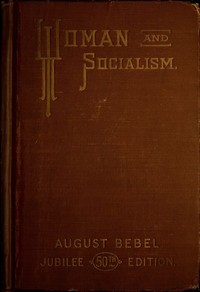
Woman and Socialism
first published 1879 · free to read
length
182,186 words
a few pages a day
~8 min
finished in
96 days
full read
12h 39m
At Folio's default of ten pages a day, you finish Woman and Socialism in about 96 days — roughly 8 minutes of reading each morning.
The opening
the first pages of Woman and Socialism, free
We are living in an age of great social transformations that are steadily progressing. In all strata of society we perceive an unsettled state of mind and an increasing restlessness, denoting a marked tendency toward profound and radical changes. Many questions have arisen and are being discussed with growing interest in ever widening circles. One of the most important of these questions and one that is constantly coming into greater prominence, is the woman question.
The woman question deals with the position that woman should hold in our social organism, and seeks to determine how she can best develop her powers and her abilities, in order to become a useful member of human society, endowed with equal rights and serving society according to her best capacity. From our point of view this question coincides with that other question: In what manner should society be organized to abolish oppression, exploitation, misery and need, and to bring about the physical and mental welfare of individuals and of society as a whole? To us then, the woman question is only one phase of the general social question that at present occupies all intelligent minds; its final solution can only be attained by removing social extremes and the evils which are a result of such extremes.
Nevertheless, the woman question demands our special consideration. What the position of woman has been in ancient society, what her position is to-day and what it will be in the coming social order, are questions that deeply concern at least one half of humanity. Indeed, in Europe they concern a majority of organized society, because women constitute a majority of the population. Moreover, the prevailing conceptions concerning the development of woman’s social position during successive stages of history are so faulty, that enlightenment on this subject has become a necessity. Ignorance concerning the position of woman, chiefly accounts for the prejudice that the woman’s movement has to contend with among all classes of people, by no means least among the women themselves. Many even venture to assert that there is no woman question at all, since woman’s position has always been the same and will remain the same in the future, because nature has destined her to be a wife and a mother and to confine her activities to the home. Everything that is beyond the four narrow walls of her home and is not closely connected with her domestic duties, is not supposed to concern her.
In the woman question then we find two contending parties, just as in the labor question, which relates to the position of the workingman in human society. Those who wish to maintain everything as it is, are quick to relegate woman to her so-called “natural profession,” believing that they have thereby settled the whole matter. They do not recognize that millions of women are not placed in a position enabling them to fulfill their natural function of wifehood and motherhood, owing to reasons that we shall discuss at length later on. They furthermore do not recognize that to millions of other women their “natural profession” is a failure, because to them marriage has become a yoke and a condition of slavery, and they are obliged to drag on their lives in misery and despair. But these wiseacres are no more concerned by these facts than by the fact that in various trades and professions millions of women are exploited far beyond their strength, and must slave away their lives for a meagre subsistence. They remain deaf and blind to these disagreeable truths, as they remain deaf and blind to the misery of the proletariat, consoling themselves and others by the false assertion that it has always been thus and will always continue to be so. That woman is entitled, as well as man, to enjoy all the achievements of civilization, to lighten her burdens, to improve her condition, and to develop all her physical and mental qualities, they refuse to admit. When, furthermore, told that woman--to enjoy full physical and mental freedom--should also be economically independent, should no longer depend for subsistence upon the good will and favor of the other sex, the limit of their patience will be reached. Indignantly they will pour forth a bitter endictment of the “madness of the age” and its “crazy attempts at emancipation.” These are the old ladies of both sexes who cannot overcome the narrow circle of their prejudices. They are the human owls that dwell wherever darkness prevails, and cry out in terror whenever a ray of light is cast into their agreeable gloom.
Keep going from exactly here — Folio remembers your place and serves the next portion tomorrow.
continue reading Woman and SocialismAbout this free edition
Woman and Socialism by August Bebel (1840-1913) is free to read in full. Folio serves it in daily portions you can actually finish, tracks your streak and reading position across devices, and reads every page aloud with a built-in narrator. The text comes from Project Gutenberg.
More like Woman and Socialism
Woman under socialism
August Bebel
Meditations
Folio
Meditations
Marcus Aurelius

The Enchiridion
Epictetus

Thus Spake Zarathustra
Friedrich Nietzsche
Beyond Good and Evil
Folio
Beyond Good and Evil
Friedrich Nietzsche
The Genealogy of Morals
Folio
The Genealogy of Morals
Friedrich Nietzsche
The Republic
Folio
The Republic
Plato
Apology
Folio
Apology
Plato