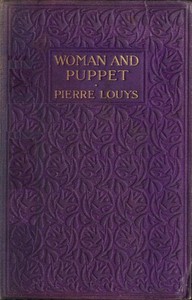
Woman and Puppet, Etc.
free to read
length
33,284 words
a few pages a day
~8 min
finished in
18 days
full read
2h 19m
At Folio's default of ten pages a day, you finish Woman and Puppet, Etc. in about 18 days — roughly 8 minutes of reading each morning.
The opening
the first pages of Woman and Puppet, Etc., free
_About twelve years ago Oscar Wilde dedicated his beautiful SALOME thus: “À mon Ami Pierre Louÿs.” At that time not many gentlemen in England knew the name of the writer who was to become famous throughout the Land of the Mind as author of APHRODITE. His earliest fame here was to be enshrined in that dedication. Afterwards, in THE SPIRIT LAMP, he had the honour and pleasure of putting into a French sonnet one of the prose poems that Wilde used to put into the post as letters. Suddenly, about ten years ago, every one in the republic of French letters was praising a new and wonderful book, APHRODITE. It was the most amazing study of antiquity since the SALAMBO of Flaubert or the Mary Magdalen of Edgar Saltus. The beautiful girl in the romance by Louÿs captivated a continent. She was, indeed, mystérieuse et victorieuse. But he did not stop. His waiting world soon had from him the CHANSONS DE BILITIS. An English wit, one of the few, said they were CHANCES OF DEBILITY. His phrase saves trouble, but one can say that these prose chansons were a picture of Sapphic life and love of a very febrile sort. There is quite a lot of that in modern French literature. It is a mode of the moment. Louÿs then passed to the writing of the superb little books LÊDA, BYBLIS, THE ARTIST TRIUMPHANT, and A NEW PLEASURE. They are here translated. The narrative Louÿs called THE ADVENTURES OF KING PAUSOLUS was of the whimsy story type. It brought to the minds of well-read men such things as Uchard’s tale MON ONCLE BARBASSOU. It also clearly informed the reader that Louÿs was French, and that even in the telling of a harmless romance the strip of water between England and France is a strip that also flows between two antipolar view-points. But Louÿs at last came to the writing of WOMAN AND PUPPET, and wrote something of deepest human intent. A version of it follows. The very curious story entitled THE HILL OF HORSEL shows the fusing of fact and fiction, antiquity and to-day. It is a most interesting effort, and achievement, in a form of story that Poe, Gautier and D’Aurevilly also perfected._
G. F. MONKSHOOD.
WOMAN AND PUPPET
CHAPTER I
In Spain the Carnival does not finish, as in France, at eight o’clock on the morning of Ash Wednesday. Over the wonderful gaiety of Seville the memory that “dust we are,” etc., spreads its odour of sepulture for four days only, and the first Sunday of Lent all the Carnival reawakens.
It is the Domingo de Pinatas, or the Sunday of Marmites, the Grand Fête. All the populous town has changed its costume, and one sees in the streets rags and tatters of red, blue, green, yellow or rose, that have been mosquito-nets, curtains or women’s garments, all waving in the sunlight and carried by a small body of ragamuffins. The youngsters, noisy, many-coloured and masked, push their way through the crowd of great personages.
At the windows one sees pressed forward innumerable brunette heads. Nearly all the young girls of the countryside are in Seville on such a day as this. Paper confetti fall as a coloured rain, fans shade and protect pretty powdered faces, there are cries, appeals and laughter in the narrow streets. A few thousands of people make more noise on this day of Carnival than would the whole of Paris.
But, on the twenty-third of February in eighteen hundred and ninety-six, André Stévenol saw the end of the Carnival approaching with a slight feeling of vexation, for the week, although essentially one of love-affairs, had not brought him any new adventure. Some previous sojourning in Spain had taught him with what quickness and freedom of the heart the knots of friendship were tied and untied in this still primitive land. He was depressed at the thought that chance and circumstance had not favoured him. He had had a long paper battle with one young girl. They had fought and teased each other with the serpentine strips of Carnival time, he in the street, she at a window. She ran down and gave him a little red bouquet with “Many thanks, sir.” But, alas! she had fled quickly, and at closer view illusions fled also. André put the flower in his coat, but did not put the giver in his memory.
Four o’clock sounded from many clocks. He went by way of the Calle Rodrigo and gained the Delicias, Champs-Elysées of shading trees along the immense Guadalquivir thronged with vessels. It was there that unrolled the Carnival of the elegant.
Keep going from exactly here — Folio remembers your place and serves the next portion tomorrow.
continue reading Woman and Puppet, Etc.About this free edition
Woman and Puppet, Etc. by Pierre Louÿs (1870-1925) is free to read in full. Folio serves it in daily portions you can actually finish, tracks your streak and reading position across devices, and reads every page aloud with a built-in narrator. The text comes from Project Gutenberg.
More like Woman and Puppet, Etc.
Pride and Prejudice
Jane Austen
Sense and Sensibility
Jane Austen
Emma
Folio
Emma
Jane Austen
Persuasion
Folio
Persuasion
Jane Austen
Mansfield Park
Folio
Mansfield Park
Jane Austen
Jane Eyre
Charlotte Brontë
The Tenant of Wildfell Hall
Folio
The Tenant of Wildfell Hall
Anne Brontë
Agnes Grey
Folio
Agnes Grey
Anne Brontë