length
29,268 words
a few pages a day
~8 min
finished in
16 days
full read
2h 2m
At Folio's default of ten pages a day, you finish Why We Love Music in about 16 days — roughly 8 minutes of reading each morning.
The opening
the first pages of Why We Love Music, free
This version of the text cannot represent certain typographical effects. Italics are delimited with the '' character as italic_.
The few minor errors, attributable to the printer, have been corrected. Please see the transcriber's note at the end of this text for details regarding the handling of any textual issues encountered during its preparation.
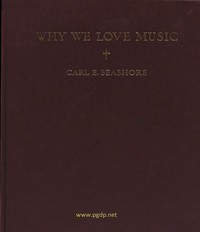
Why We Love Music
BY CARL E. SEASHORE
Professor of Psychology and Dean Emeritus of the Graduate College The State University of Iowa
OLIVER DITSON COMPANY THEODORE PRESSER CO., DISTRIBUTORS BRYN MAWR, PENNSYLVANIA
Copyright MCMXLI by Oliver Ditson Company International Copyright Secured
Printed in the United States of America
PREFACE
The magazine, Time, commenting on my new book, The Psychology of Music[A], spoke approvingly of the scientific contributions to music, but gibed that, "psychologists have not explained why we love music." As a reply to that I wrote a note, Why Do We Love Music?[B] This seemed to call for a wider excursion implementing the views there taken, as in the present Chapter I. That, in turn, led to the writing of the remainder of this volume, in which each chapter deals with some of the salient factors involved in the development of feeling for music.
These ventures digress from my habitual style of writing, as a technical psychologist, in that I frequently indulge in generalizations and predictions in a practical and popular vein. The attempt to interpret and evaluate present tendencies in the region of forward movements in music naturally takes me into unexplored territory and will stimulate questioning on the part of promoters of various interest in the field. I hold no brief for infallibility of the positions taken, except to say that they are my convictions at the present moment. While they are not direct reports of scientific experiments in the laboratory or the studio, they may be regarded as an extension or interpretation based upon scientific experiments and observations. It is hoped that they may serve as hypotheses or at least a challenge for investigation and practical trial. The reader must judge what is new and what is true from his point of view. Many of the things I advocate are in an experimental stage and in advance of current prevailing practice. This is the reason for presenting them. My aim has been to tease out those elements in the musical situation which help to make music function in our lives and be appreciated.
The following chapters have appeared in magazines: Ch. I, The Etude (brief summary); Ch. II, The Parents' Magazine; Ch. III, National Parent Teacher, under the title, "On Their Musical Way"; Ch. IV, The School Review; Ch. VI, The Scientific Monthly. For permission to bring these chapters into this volume I herewith express my appreciation to the publishers.
CARL E. SEASHORE, Iowa City, Iowa, March 1, 1940.
-----
Footnote A:
McGraw-Hill, 1938
Footnote B:
Music Educators Journal, Sept. 1938
CONTENTS
Chapter Page
I Why Do We Love Music? 1
The Musical Medium 2
Organic response, 2; Sounds in themselves, 3; Music proper, 3; Music with words and action, 3; Symbolism, 4.
The Musical Motives 4
Musical knowledge, 5; Musical feeling, 5; Musical action, 6; Music as play, 7; Musical imagination, 8; Who loves music?, 8.
Thought Review 10
II Music Before the Age of Six 12
From smile to music, 12; Music in play, 14; Environment, 15; Music and speech, 16; Musical talent, 17; Musical education, 18.
Thought Review 19
III Music Between the Ages of Six and Ten 21
Keep going from exactly here — Folio remembers your place and serves the next portion tomorrow.
continue reading Why We Love MusicAbout this free edition
Why We Love Music by Carl E. Seashore (1866-1949) is free to read in full. Folio serves it in daily portions you can actually finish, tracks your streak and reading position across devices, and reads every page aloud with a built-in narrator. The text comes from Project Gutenberg.
More like Why We Love Music
Meditations
Folio
Meditations
Marcus Aurelius
The Enchiridion
Epictetus

Thus Spake Zarathustra
Friedrich Nietzsche
Beyond Good and Evil
Folio
Beyond Good and Evil
Friedrich Nietzsche
The Genealogy of Morals
Folio
The Genealogy of Morals
Friedrich Nietzsche
The Republic
Folio
The Republic
Plato
Apology
Folio
Apology
Plato
Crito
Folio
Crito
Plato