We Philologists
Folio
length
19,255 words
a few pages a day
~8 min
finished in
11 days
full read
1h 20m
At Folio's default of ten pages a day, you finish We Philologists in about 11 days — roughly 8 minutes of reading each morning.
The opening
the first pages of We Philologists, free
The mussel is crooked inside and rough outside . it is only when we hear its deep note after blowing into it that we can begin to esteem it at its true value.--(Ind. Spruche, ed Bothlingk, 1 335)
An ugly-looking-wind instrument . but we must first blow into it.
TRANSLATOR'S INTRODUCTION
The subject of education was one to which Nietzsche, especially during his residence in Basel, paid considerable attention, and his insight into it was very much deeper than that of, say, Herbert Spencer or even Johann Friedrich Herbart, the latter of whom has in late years exercised considerable influence in scholastic circles. Nietzsche clearly saw that the "philologists" (using the word chiefly in reference to the teachers of the classics in German colleges and universities) were absolutely unfitted for their high task, since they were one and all incapable of entering into the spirit of antiquity. Although at the first reading, therefore, this book may seem to be rather fragmentary, there are two main lines of thought running through it: an incisive criticism of German professors, and a number of constructive ideas as to what classical culture really should be.
These scattered aphorisms, indeed, are significant as showing how far Nietzsche had travelled along the road over which humanity had been travelling from remote ages, and how greatly he was imbued with the pagan spirit which he recognised in Goethe and valued in Burckhardt. Even at this early period of his life Nietzsche was convinced that Christianity was the real danger to culture; and not merely modern Christianity, but also the Alexandrian culture, the last gasp of Greek antiquity, which had helped to bring Christianity about. When, in the later aphorisms of "We Philologists," Nietzsche appears to be throwing over the Greeks, it should be remembered that he does not refer to the Greeks of the era of Homer or AEschylus, or even of Aristotle, but to the much later Greeks of the era of Longinus.
Classical antiquity, however, was conveyed to the public through university professors and their intellectual offspring, and these professors, influenced (quite unconsciously, of course) by religious and "liberal" principles, presented to their scholars a kind of emasculated antiquity. It was only on these conditions that the State allowed the pagan teaching to be propagated in the schools; and if, where classical scholars were concerned, it was more tolerant than the Church had been, it must be borne in mind that the Church had already done all the rough work of emasculating its enemies, and had handed down to the State a body of very innocuous and harmless investigators. A totally erroneous conception of what constituted classical culture was thus brought about. Where any distinction was actually made, for example, later Greek thought was enormously over-rated, and early Greek thought equally undervalued. Aphorism 44, together with the first half-dozen or so in the book, may be taken as typical specimens of Nietzsche's protest against this state of things.
It must be added, unfortunately, that Nietzsche's observations in this book apply as much to England as to Germany. Classical teachers here may not be rated so high as they are in Germany, but their influence would appear to be equally powerful, and their theories of education and of classical antiquity equally chaotic. In England as in Germany they are "theologians in disguise." The danger of modern "values" to true culture may be readily gathered from a perusal of aphorisms that follow: and, if these aphorisms enable even one scholar in a hundred to enter more thoroughly into the spirit of a great past they will not have been penned in vain.
J. M. KENNEDY.
LONDON, July 1911.
I
To what a great extent men are ruled by pure hazard, and how little reason itself enters into the question, is sufficiently shown by observing how few people have any real capacity for their professions and callings, and how many square pegs there are in round holes: happy and well chosen instances are quite exceptional, like happy marriages, and even these latter are not brought about by reason. A man chooses his calling before he is fitted to exercise his faculty of choice. He does not know the number of different callings and professions that exist; he does not know himself; and then he wastes his years of activity in this calling, applies all his mind to it, and becomes experienced and practical. When, afterwards, his understanding has become fully developed, it is generally too late to start something new; for wisdom on earth has almost always had something of the weakness of old age and lack of vigour about it.
Keep going from exactly here — Folio remembers your place and serves the next portion tomorrow.
continue reading We PhilologistsAbout this free edition
We Philologists by Friedrich Wilhelm Nietzsche (1844-1900) is free to read in full. Folio serves it in daily portions you can actually finish, tracks your streak and reading position across devices, and reads every page aloud with a built-in narrator. The text comes from Project Gutenberg.
More like We Philologists
The Birth of Tragedy
Folio
The Birth of Tragedy
Friedrich Wilhelm Nietzsche
On the Future of Our Educational Institutions
Folio
On the Future of Our Educational Institutions
Friedrich Wilhelm Nietzsche
The Joyful Wisdom ("La Gaya Scienza")
Folio
The Joyful Wisdom ("La Gaya Scienza")
Friedrich Wilhelm Nietzsche
Homer and Classical Philology
Folio
Homer and Classical Philology
Friedrich Wilhelm Nietzsche
The Dawn of Day
Folio
The Dawn of Day
Friedrich Wilhelm Nietzsche
Early Greek Philosophy & Other Essays
Friedrich Wilhelm Nietzsche
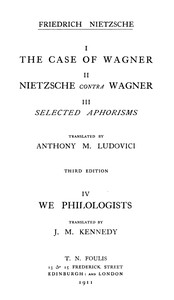
The Case of Wagner
Friedrich Wilhelm Nietzsche
Ecce Homo
Folio
Ecce Homo
Friedrich Wilhelm Nietzsche