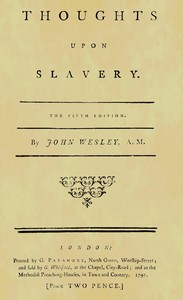
Thoughts upon slavery
free to read
length
8,905 words
a few pages a day
~8 min
finished in
5 days
full read
37 min
At Folio's default of ten pages a day, you finish Thoughts upon slavery in about 5 days — roughly 8 minutes of reading each morning.
The opening
the first pages of Thoughts upon slavery, free
I. 1. By Slavery I mean Domestic Slavery, or that of a servant to a master. A late ingenious Writer well observes, “The variety of forms in which Slavery appears, makes it almost impossible to convey a just notion of it, by way of definition. There are however certain properties which have accompanied Slavery in most places, whereby it is easily distinguished from that mild domestic service which obtains in our country.”[1]
[1] See Mr. Hargrave’s Plea for Somerset the Negro.
2. Slavery imports an obligation of perpetual service, an obligation which only the consent of the master can dissolve. Neither in some countries can the master himself dissolve it, without the consent of judges appointed by the law. It generally gives the master an arbitrary power of any correction, not affecting life or limb. Sometimes even these are exposed to his will: or protected only by a fine, or some slight punishment, too inconsiderable to restrain a master of a harsh temper. It creates an incapacity of acquiring any thing, except for the master’s benefit. It allows the master to alienate the Slave, in the same manner as his cows and horses. Lastly it descends in its full extent from parent to child, even to the last generation.
3. The beginning of this may be dated from the remotest period, of which we have an account in history. It commenced in the barbarous State of Society, and in process of time spread into all nations. It prevailed particularly among the Jews, the Greeks, the Romans, and the ancient Germans: and was transmitted by them to the various kingdoms and states, which arose out of the Roman empire. But after christianity prevailed, it gradually fell into decline in almost all parts of Europe. This great change began in Spain, about the end of the eighth century: and was become general in most other kingdoms of Europe, before the middle of the fourteenth.
4. From this time Slavery was nearly extinct, till the commencement of the sixteenth century, when the discovery of America, and of the Western and Eastern coasts of Africa, gave occasion to the revival of it. It took its rise from the Portuguese, who to supply the Spaniards with men, to cultivate their new possessions in America, procured Negroes from Africa, whom they sold for Slaves to the American Spaniards. This began in the year 1508, when they imported the first Negroes into Hispaniola. In 1540, Charles the fifth, then King of Spain, determined to put an end to Negro-Slavery: giving positive orders, That all the Negro-Slaves in the Spanish dominions should be set free. And this was accordingly done by Lagasca, whom he sent and impowered to free them all, on condition of continuing to labour for their masters. But soon after Lagasca returned to Spain, Slavery returned and flourished as before. Afterwards other nations, as they acquired possessions in America, followed the examples of the Spaniards; and Slavery has taken deep root in most of our American colonies.
II. Such is the nature of Slavery: such the beginning of Negro-Slavery in America. But some may desire to know, what country it is, from which the Negroes are brought? What sort of men, of what temper and behaviour are they in their own country? And in what manner they are generally procured, carried to, and treated in America?
1. And first, What kind of country is that from whence they are brought? Is it so remarkably horrid, dreary and barren, that it is a kindness to deliver them out of it? I believe many have apprehended so: but it is an entire mistake, if we may give credit to those who have lived many years therein, and could have no motive to misrepresent it.
2. That part of Africa whence the Negroes are brought, commonly known by the name of Guinea, extends along the coast, in the whole, between three and four thousand miles. From the river Senegal, (seventeen degrees North of the line) to Cape Sierra Leona, it contains seven hundred miles. Thence it runs Eastward about fifteen hundred miles, including the Grain-coast, the Ivory-coast, the Gold-coast, and the Slave-coast, with the large kingdom of Benin. From thence it runs Southward, about twelve hundred miles, and contains the kingdoms of Congo and Angola.
Keep going from exactly here — Folio remembers your place and serves the next portion tomorrow.
continue reading Thoughts upon slaveryAbout this free edition
Thoughts upon slavery by John Wesley (1703-1791) is free to read in full. Folio serves it in daily portions you can actually finish, tracks your streak and reading position across devices, and reads every page aloud with a built-in narrator. The text comes from Project Gutenberg.
More like Thoughts upon slavery
Meditations
Folio
Meditations
Marcus Aurelius

The Enchiridion
Epictetus

Thus Spake Zarathustra
Friedrich Nietzsche
Beyond Good and Evil
Folio
Beyond Good and Evil
Friedrich Nietzsche
The Genealogy of Morals
Folio
The Genealogy of Morals
Friedrich Nietzsche
The Republic
Folio
The Republic
Plato
Apology
Folio
Apology
Plato
Crito
Folio
Crito
Plato