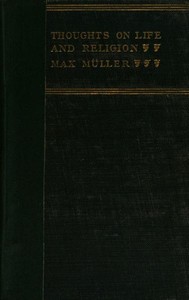
Thoughts on Life and Religion
free to read
length
46,933 words
a few pages a day
~8 min
finished in
25 days
full read
3h 16m
At Folio's default of ten pages a day, you finish Thoughts on Life and Religion in about 25 days — roughly 8 minutes of reading each morning.
The opening
the first pages of Thoughts on Life and Religion, free
This book has been prepared in accordance with a wish expressed by many known and unknown admirers of my husband's writings, who desire to possess in a portable form the passages that have specially appealed to them in his different works, and in the Life and Letters.
I have taken this opportunity of adding extracts from private letters, and from the writings he left unfinished, which would not otherwise have become known to any but his own family or a few intimate friends.
Those who have read the Life and Letters, do not need to be told that Max Müller lived from his earliest years in the firm conviction that all is wisely ordered in this life, and 'all for our real good, though we do not always see it, and though we cannot venture to fathom the wisdom guiding our steps through life.'
To others his unswerving trust and faith as shown in these extracts may be a revelation, for he seldom talked on such subjects. This trust and faith gave him strength through the bitter struggles of his early life, taught him resignation during the years when the dearest wish of his heart seemed unattainable, supported him later when those he tenderly loved were snatched from him by death, and upheld him in his last long and depressing illness.
My earnest desire is that this little book may prove a help and comfort to many exposed to like trials, and strengthen those whose path now stretches before them as a sunny avenue, to meet the sorrows that almost surely await them as life advances.
GEORGINA MAX MÜLLER.
June 11, 1905.
CONTENTS
PAGE
The Art of Life, 1
The Beautiful, 4
The Bible, 6
Children, 12
Christ, the Logos, 13
Christianity, 21
Death, 34
The Deity, 44
The Divine, 57
Doubts, 60
Evolution of Religion, 66
Faith, 70
The Fatherhood of God, 73
Future Life, 74
The Infinite, 87
Knowledge, 96
Language, 99
Life, 103
Love, 121
Mankind, 129
Mind or Thought, 132
Miracles, 135
Music, 138
Nature, 139
Obscurity, 142
Old Age, 143
Religion and Religions, 145
Revelation, 184
The Rig-Veda, 189
Science, 190
The Self, 192
Sorrow and Suffering, 198
The Soul, 208
Theosophy, 215
Truth, 217
The Will of God, 222
Wonder, 226
Words, 228
Work, 230
The World, 233
THE ART OF LIFE
To learn to understand one another is the great art of life, and to 'agree to differ' is the best lesson of the comparative science of religion.
Silesian Horseherd.
There is a higher kind of music which we all have to learn, if our life is to be harmonious, beautiful, and useful. There are certain intervals between the young and the old which must be there, which are meant to be there, without which life would be monotonous; but out of these intervals and varieties the true art of life knows how to build up perfect harmonies.... Even great sorrow may be a blessing, by drawing some of our affections away from this life to a better life ... of which, it is true, we know nothing, but from which, when we see the wisdom and love that underlie this life, we may hope everything. We are meant to hope and to trust, and that is often much harder than to see and to know.... The greatest of all arts is the art of life, and the best of all music the harmony of spirits. There are many little rules to be learnt for giving harmony and melody to our life, but the thorough bass must be--love.
Life.
One thing is necessary above all things in order to live peaceably with people, that is, in Latin, Humanitas, German, Menschlichkeit. It is difficult to describe, but it is to claim as little as possible from others, neither an obliging temper nor gratitude, and yet to do all one can to please others, yet without expecting them always to find it out. As men are made up of contradictions they are the more grateful and friendly the less they see that we expect gratitude and friendliness. Even the least cultivated people have their good points, and it is not only far better but far more interesting if one takes trouble to find out the best side and motives of people, rather than the worst and most selfish.... Life is an art, and more difficult than Sanscrit or anything else.
Keep going from exactly here — Folio remembers your place and serves the next portion tomorrow.
continue reading Thoughts on Life and ReligionAbout this free edition
Thoughts on Life and Religion by F. Max Müller (1823-1900) is free to read in full. Folio serves it in daily portions you can actually finish, tracks your streak and reading position across devices, and reads every page aloud with a built-in narrator. The text comes from Project Gutenberg.
More like Thoughts on Life and Religion
The Dhammapada
Folio
The Dhammapada
F. Max Müller
Meditations
Folio
Meditations
Marcus Aurelius
The Enchiridion
Epictetus
Thus Spake Zarathustra
Friedrich Nietzsche
Beyond Good and Evil
Folio
Beyond Good and Evil
Friedrich Nietzsche
The Genealogy of Morals
Folio
The Genealogy of Morals
Friedrich Nietzsche
The Republic
Folio
The Republic
Plato
Apology
Folio
Apology
Plato