length
7,722 words
a few pages a day
~8 min
finished in
5 days
full read
32 min
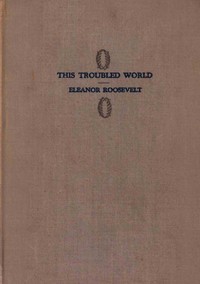
At Folio's default of ten pages a day, you finish This Troubled World in about 5 days — roughly 8 minutes of reading each morning.
The opening
the first pages of This Troubled World, free
The newspapers these days are becoming more and more painful. I was reading my morning papers on the train not so long ago, and looked up with a feeling of desperation. Up and down the car people were reading, yet no one seemed excited.
To me the whole situation seems intolerable. We face today a world filled with suspicion and hatred. We look at Europe and see a civil war going on, with other nations participating not only as individual volunteers, but obviously with the help and approval of their governments. We look at the Far East and see two nations, technically not at war, killing each other in great numbers.
Every nation is watching the others on its borders, analyzing its own needs and striving to attain its ends with little consideration for the needs of its neighbors. Few people are sitting down dispassionately to go over the whole situation in an attempt to determine what present conditions are, or how they should be met.
We know, for instance, that certain nations today need to expand because their populations have increased. Certain people will tell you that the solution of this whole question lies in the acceptance or rejection of birth control. That may be the solution for the future, but we can do nothing in that way about the populations that now exist. They are on this earth, and modern science has left us only a few places where famine or flood or disease can wipe out large numbers of superfluous people in one fell swoop. For this reason certain nations need additional territory to which part of their present populations may be moved; other nations need more land on which to grow necessary raw materials; or perhaps they may need mineral deposits which are not to be found in their own country. You will say that these can be had by trade. Yes, but the nations possessing them will frequently make the cost too high to the nations which need them.
It is not a question today of the “free” interchange of goods. If standards of living were approximately the same, throughout the world, competition would be on an equal basis and then there might be no need for tariffs. However, standards of living vary. The nations with higher standards have set up protective barriers which served them well when they were self-contained, but not so well when they reached a point where they either wished to import or export.
When you take all these things into consideration, the size of this problem is apt to make you feel that even an attempt to solve it in the future by education is futile. Faint heart, however, ne’er won fair lady, nor did it ever solve world problems!
Peace plan after peace plan has been presented to me; most of them, I find, are impractical, or not very carefully thought out. In nearly all of them some one can find a flaw. I have come to look at them now without the slightest hope of finding one full-fledged plan, but I keep on looking in the hope of finding here and there some small suggestion that may be acceptable to enough people to insure an honest effort being made to study it and evaluate its possible benefits.
For instance, one lady of my acquaintance brought me a plan this past spring which sounded extremely plausible. Her premises are: We never again wish to send our men overseas; we wish to have adequate defense; we do not need a navy if we do not intend to go beyond our own shores; submarines and airplanes can defend our shores, with guns along our coasts as an added protection. Therefore, we do not need an army, for our men are going to stay at home. With our coast defenses strong, nobody will land here, so why go to the expense of an army? We do not need battleships or, in fact, any navy beyond submarines because we do not intend to own any outlying possessions.
In this way, said the lady, we will save vast sums of money which can be applied to all the social needs of the day--better housing, better schools, old age pensions, workmen’s compensation, care of the blind and crippled and other dependents. There is no limit to what we might do with this money which we now spend on preparation for destruction.
Keep going from exactly here — Folio remembers your place and serves the next portion tomorrow.
continue reading This Troubled WorldAbout this free edition
This Troubled World by Eleanor Roosevelt (1884-1962) is free to read in full. Folio serves it in daily portions you can actually finish, tracks your streak and reading position across devices, and reads every page aloud with a built-in narrator. The text comes from Project Gutenberg.
More like This Troubled World
Meditations
Folio
Meditations
Marcus Aurelius

The Enchiridion
Epictetus

Thus Spake Zarathustra
Friedrich Nietzsche
Beyond Good and Evil
Folio
Beyond Good and Evil
Friedrich Nietzsche
The Genealogy of Morals
Folio
The Genealogy of Morals
Friedrich Nietzsche
The Republic
Folio
The Republic
Plato
Apology
Folio
Apology
Plato
Crito
Folio
Crito
Plato