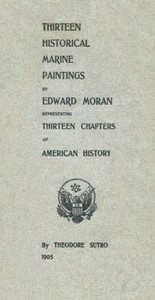
Thirteen Chapters of American History
free to read
length
18,699 words
a few pages a day
~8 min
finished in
10 days
full read
1h 18m
At Folio's default of ten pages a day, you finish Thirteen Chapters of American History in about 10 days — roughly 8 minutes of reading each morning.
The opening
the first pages of Thirteen Chapters of American History, free
The Thirteen Paintings, to a history and description of which (and incidentally to a brief memoir of their creator, Edward Moran) these pages are devoted, are monumental in their character and importance. Mr. Moran designated them as representing the "Marine History of the United States." I have somewhat changed this title; for even the untraversed "Ocean" and the landing of Columbus in the new world represent periods which necessarily affect the whole American Continent.
The conception of these pictures was in itself a mark of genius, for no more fitting subjects could have been chosen by the greatest marine painter in the United States than the heroic and romantic incidents connected with the sea, which are so splendidly depicted in these thirteen grand paintings. That their execution required over fifteen years of ceaseless labor and the closest historical study is not surprising. The localities, the ships, the armament, the personages, the costumes, the weapons and all the incidents connected with each epoch are minutely and correctly represented, in so far as existing records rendered that possible. And yet, interwoven with each canvas, is a tone so poetic and imaginative that stamps it at once as the offspring of genius and lifts it far above the merely photographic and realistic. The series is the result of a life of prolific production, careful study, unceasing industry and great experience.
Mr. Moran himself regarded these pictures as his crowning work, and in token of his many happy years of married life presented them, several years before his death, to his wife, Annette Moran, herself an artist of great merit, and whom he always mentioned as his best critic and the inspirer of his greatest achievements. This loving act, strange to say, gave rise to a protracted legal controversy, by reason of an adverse claim to these paintings made by the executor of the estate of Edward Moran, the final decision of which in favor of the widow, after three years of litigation, lends additional interest to these remarkable works of art. Proceedings to recover the pictures from the executor of the estate, who had them in his possession and refused to deliver them to her, were commenced on February 5, 1902, and after a trial in the Supreme Court in the City of New York lasting several days, a jury decided that the pictures were the property of the widow as claimed. On a technical point of law raised by the executor this finding of the jury was temporarily rendered ineffective, but, on an appeal to the Appellate Division of the Supreme Court, this technicality was overruled and an absolute judgment awarded in favor of the widow.[A] This was on January 23, 1903. Still not content, the executor appealed to the highest court in the State, the Court of Appeals at Albany, which, on January 26, 1904, finally and absolutely affirmed the decision of the Appellate Division.[B] But even then the widow was kept out of her property on further applications made by the executor to the court. Also in this he failed, and at last, on April 28, 1904, the judgment in her favor was satisfied through the delivery of the pictures to her, as her absolute property, beyond dispute, cavil or further question.
I have deemed it proper to make this explanation, as it is through my connection as counsel for Mrs. Moran throughout this litigation that the occasion has presented itself for this publication, and of giving to the public the opportunity to examine and enjoy, to the fullest extent, these great pictures at the Metropolitan Museum of Art.
It may be added that although these paintings have occasionally been viewed by artists, they have never before been publicly exhibited as a series except for a very short period in the year 1900 in Philadelphia and in Washington. During this time they received the highest encomiums from critics and the press, and were pronounced the most notable series of historic pictures ever painted in this country. While each one of the series is a master work, it is as a group that the greatest interest attaches to them, and it was Mr. Moran's desire, and it is also that of the present owner, that they should, if possible, never be separated.
With reference to the exhibition of these paintings at the Metropolitan Museum of Art, I quote from a full page illustrated article which appeared in the New York Herald on Sunday, November 6, 1904, as follows:
Keep going from exactly here — Folio remembers your place and serves the next portion tomorrow.
continue reading Thirteen Chapters of American HistoryAbout this free edition
Thirteen Chapters of American History by Theodore Sutro (1845-1927) is free to read in full. Folio serves it in daily portions you can actually finish, tracks your streak and reading position across devices, and reads every page aloud with a built-in narrator. The text comes from Project Gutenberg.
More like Thirteen Chapters of American History
The History of the Peloponnesian War
Folio
The History of the Peloponnesian War
Thucydides
The History of Herodotus
Folio
The History of Herodotus
Herodotus
The Gallic Wars
Folio
The Gallic Wars
Julius Caesar
Anabasis
Folio
Anabasis
Xenophon
The Lives of the Twelve Caesars
Folio
The Lives of the Twelve Caesars
Suetonius
Germania
Folio
Germania
Tacitus

The History of the Decline and Fall of the Roman Empire
Edward Gibbon

The Travels of Marco Polo
Marco Polo