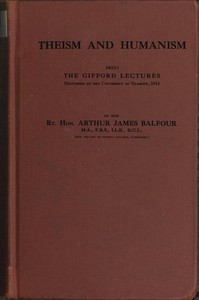
length
53,286 words
a few pages a day
~8 min
finished in
29 days
full read
3h 42m
At Folio's default of ten pages a day, you finish Theism and Humanism in about 29 days — roughly 8 minutes of reading each morning.
The opening
the first pages of Theism and Humanism, free
This volume contains the substance of the Gifford Lectures delivered at the University of Glasgow in January and February 1914. I say the substance of the lectures, lest any of those who formed part of my most kindly audience should expect a verbal reproduction of what they then heard. No such reproduction would have been either expedient or possible. The lectures were not read: they were spoken (with the aid of brief notes) in such terms as suggested themselves at the moment; and their duration was rigidly fixed, to suit my academic audience, so as just to occupy the customary hour. Although, therefore, they were largely (though not wholly) based upon written drafts, none of the language, and not all the ideas and illustrations contained in the original could be reproduced in the spoken lectures, nor did everything in the spoken lectures represent passages in the written originals.
It is not, in these circumstances, surprising that the work has had, in large measure, to be rewritten, though the argument itself, and the order in which its various parts are presented for consideration, remains substantially unchanged.
I should not have troubled the reader with this very unimportant narrative except for the purpose of explaining the long interval that has elapsed between the delivery of the lectures and their publication. Literary composition I have always found laborious and slow, even in favourable conditions. But the conditions have not been favourable. My anxiety to make the argument easy to read for persons who take little interest in, and have small knowledge of, philosophical controversies did not make it easy to write; while external circumstances were singularly unfavourable to rapid composition. No one who took any part in public affairs between March 1914 and the outbreak of the war, or between the outbreak of the war and the present moment, is likely to regard these months as providing convenient occasion for quiet thought and careful writing. I say this, however, not as an excuse for poor workmanship, but only as an explanation of long delay.
It may be desirable to warn the intending reader before he embarks on these lectures, that though the basis of the argument is wide, its conclusion is narrow: and though that conclusion is religious, the discussions leading up to it are secular. I make no dialectical use of the religious sentiment; nor do I attempt any analysis of its essential character. Still less do I deal with any doctrines outside what is called “natural” religion; for to “natural” religion the Gifford Lecturer is expressly confined. But even themes which might well be deemed to fall within these limits are scarcely referred to. For example, God, freedom, and immortality have been treated by at least one eminent writer as the great realities beyond the world of sense. I believe in them all. But I only discuss the first—and that only from a limited point of view.
One other caution I must give, though it is hardly necessary. No one, I suppose, is likely to consult this small volume in the hope of finding an historic survey, properly “documented,” of the great theistic controversy. But, if so misguided an individual exists, he is doomed to the severest disappointment. There have been, and will be, Gifford Lecturers well equipped for so great an undertaking; but most assuredly I am not among them.
My warm thanks are due to my brother, Mr. Gerald Balfour; my sister, Mrs. Sidgwick, and my brother-in-law, Lord Rayleigh, for the trouble they have taken in reading the proofs, and for the aid they have given me in correcting them.
In connection with a passage in the ninth lecture, Sir Oliver Lodge has been good enough to give me an interesting note on “energy,” which appears in its proper place.
4 CARLTON GARDENS May 24, 1915.
CONTENTS
PART I
INTRODUCTORY
LECTURE I
PAGE
I. INTRODUCTORY: METAPHYSICS AND THE “PLAIN MAN” 3
II. “INEVITABLE” BELIEFS AND COMMON SENSE 13
III. THE MATERIAL OF THE PRESENT ARGUMENT FOR THEISM: THE CHARACTER OF THE THEISM TO BE ESTABLISHED 17
IV. WHAT THE ARGUMENT IS NOT. SOME OF ITS LIMITATIONS 23
LECTURE II
Keep going from exactly here — Folio remembers your place and serves the next portion tomorrow.
continue reading Theism and HumanismAbout this free edition
Theism and Humanism by Arthur James Balfour (1848-1930) is free to read in full. Folio serves it in daily portions you can actually finish, tracks your streak and reading position across devices, and reads every page aloud with a built-in narrator. The text comes from Project Gutenberg.
More like Theism and Humanism
Decadence
Arthur James Balfour
Meditations
Folio
Meditations
Marcus Aurelius
The Enchiridion
Epictetus
Thus Spake Zarathustra
Friedrich Nietzsche
Beyond Good and Evil
Folio
Beyond Good and Evil
Friedrich Nietzsche
The Genealogy of Morals
Folio
The Genealogy of Morals
Friedrich Nietzsche
The Republic
Folio
The Republic
Plato
Apology
Folio
Apology
Plato