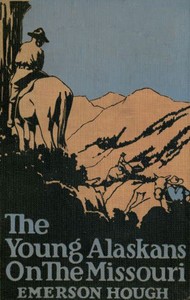
The Young Alaskans on the Missouri
free to read
length
77,643 words
a few pages a day
~8 min
finished in
41 days
full read
5h 24m
At Folio's default of ten pages a day, you finish The Young Alaskans on the Missouri in about 41 days — roughly 8 minutes of reading each morning.
The opening
the first pages of The Young Alaskans on the Missouri, free
"Well, it didn't. Of course, Rob got in, even if he had to run away and smouch a little about how old he was. But he wasn't through his training. And as for the other boys, Frank was solemn as an owl because the desk sergeant laughed at him and told him to go back to the Boy Scouts; and Jesse was almost in tears over it."
"All our boys!"
"Yes! All our boys. The whole country'd have been in it if it had gone on. America doesn't play any game to lose it."
"Yes, and look at you!"
Uncle Dick moved his leg. "Cheap!" said he. "Cheap! But we don't talk of that. What I was talking about, or was going to talk about, was something by way of teaching these boys what a country this America is and always has been; how it never has played any game to lose it, and never is going to."
"Well, Richard, what is it this time?" His sister began to fold up her work, sighing, and to smooth it out over her knee. "We've just got settled down here in our own country, and I was looking for a little rest and peace."
"You need it, after your Red Cross work, and you shall have it. You shall rest. While you do, I'll take the boys on the trail, the Peace Trail--the greatest trail of progress and peace all the world ever knew."
"Whatever can you mean?"
"And made by two young chaps, officers of our Army, not much more than boys they were, neither over thirty. They found America for us, or a big part of it. I call them the two absolutely splendidest and perfectly bulliest boys in history."
"Oh, I know! You mean Lewis and Clark! You're always talking of them to the boys. Ever since we came to St. Louis----"
"Yes, ever since we came to this old city, where those two boys started out West, before anybody knew what the West was or even where it was. I've been talking to our boys about those boys! Rather I should say, those two young gentlemen of our Army, over a hundred years ago--Captain Meriwether Lewis and Captain William Clark."
His sister nodded gravely, "I know."
"What water has run by here, since 1804, in these two rivers, the Mississippi and the Missouri! How the country has grown! How the world has changed! And how we have forgotten!
"That's why I want to take them, even now, my dear sister, these young Americans, over that very same old trail--not so long and hard and full of danger now. Why? Lest we forget! Lest our young Americans forget! And we all are forgetting. Not right.
"You see? Because this old town of St. Louis was then only a village, and we just had bought our unknown country of France, and this town was on the eastern edge of it, the gate of it--the gate to the West, it used to be, before steam came, while everything went by keel boat; oar or paddle and pole and sail and cordelle. Ah, Sis, those were the days!"
"Think of the time it must have taken!"
"Think of the times they must have been!"
"But now one never hears of Lewis and Clark. We go by rail, so much faster. As for going up-river by steamboat, I never heard of such a thing!"
"But the boys have. I caught Jesse, even, pondering over my Catlin, looking at the buffalo and Indian pictures."
"I never heard of Catlin."
"Of course not. Well, he came much later than my captains, and was an artist. But my captains had found the way. Rob and Frank know. They've read the worked-over Journals of Lewis and Clark. Me, I've even seen the originals. I swear those curious pages make my heart jump to this very day, even after our travels on the soil of France just now--France, the country that practically gave us our country, or almost all of it west of the Missouri, more than a hundred years ago. She didn't know, and we didn't know. Well, we helped pay the rest of the price, if there was anything left back, at Château Thierry and in the Argonne."
Keep going from exactly here — Folio remembers your place and serves the next portion tomorrow.
continue reading The Young Alaskans on the MissouriAbout this free edition
The Young Alaskans on the Missouri by Emerson Hough (1857-1923) is free to read in full. Folio serves it in daily portions you can actually finish, tracks your streak and reading position across devices, and reads every page aloud with a built-in narrator. The text comes from Project Gutenberg.
More like The Young Alaskans on the Missouri
The Mississippi Bubble
Folio
The Mississippi Bubble
Emerson Hough
The Covered Wagon
Folio
The Covered Wagon
Emerson Hough
The Way of a Man
Folio
The Way of a Man
Emerson Hough
The Girl at the Halfway House
Folio
The Girl at the Halfway House
Emerson Hough
The Lady and the Pirate
Folio
The Lady and the Pirate
Emerson Hough
The Young Alaskans
Emerson Hough
The Passing of the Frontier: A Chronicle of the Old West
Folio
The Passing of the Frontier: A Chronicle of the Old West
Emerson Hough
Treasure Island
Robert Louis Stevenson