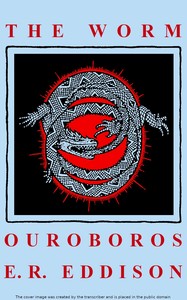
length
169,948 words
a few pages a day
~8 min
finished in
90 days
full read
11h 48m
At Folio's default of ten pages a day, you finish The Worm Ouroboros in about 90 days — roughly 8 minutes of reading each morning.
The opening
the first pages of The Worm Ouroboros, free
True Thomas lay on Huntlie bank, A ferlie he spied wi his ee; And there he saw a Lady bright Come riding down by the Eildon Tree.
Her skirt was o the grass-green silk, Her mantle o the velvet fyne, At ilka tett of her horse’s mane Hung fifty siller bells and nine.
True Thomas he pulld aff his cap, And louted low down on his knee: “Hail to thee, Mary, Queen of Heaven! For thy peer on earth could never be.”
“O no, O no, Thomas,” she says, “That name does not belang to me; I’m but the Queen of fair Elfland, That am hither come to visit thee.
“Harp and carp, Thomas,” she says, “Harp and carp alang wi me. And if ye dare to kiss my lips, Sure of your bodie I will be.”
“Betide me weal, betide me woe, That weird shall never daunton me.” Syne he has kissed her rosy lips, All underneath the Eildon Tree.
THOMAS THE RHYMER.
To W. G. E. and to my friends K. H. and G. C. L. M. I dedicate this book
It is neither allegory nor fable but a Story to be read for its own sake.
The proper names I have tried to spell simply. The e in Carcë is long, like that in Phryne, the o in Krothering short and the accent on that syllable: Corund is accented on the first syllable, Prezmyra on the second, Brandoch Daha on the first and fourth, Gorice on the last syllable, rhyming with thrice: Corinius rhymes with Flaminius, Galing with sailing, La Fireez with desire ease: ch is always guttural, as in loch.
9th January 1922 E. R. E.
THE INDUCTION
There was a man named Lessingham dwelt in an old low house in Wastdale, set in a gray old garden where yew-trees flourished that had seen Vikings in Copeland in their seedling time. Lily and rose and larkspur bloomed in the borders, and begonias with blossoms big as saucers, red and white and pink and lemon-colour, in the beds before the porch. Climbing roses, honeysuckle, clematis, and the scarlet flame-flower scrambled up the walls. Thick woods were on every side without the garden, with a gap north-eastward opening on the desolate lake and the great fells beyond it: Gable rearing his crag-bound head against the sky from behind the straight clean outline of the Screes.
Cool long shadows stole across the tennis lawn. The air was golden. Doves murmured in the trees; two chaffinches played on the near post of the net; a little water-wagtail scurried along the path. A French window stood open to the garden, showing darkly a dining-room panelled with old oak, its Jacobean table bright with flowers and silver and cut glass and Wedgwood dishes heaped with fruit: greengages, peaches, and green muscat grapes. Lessingham lay back in a hammock-chair watching through the blue smoke of an after-dinner cigar the warm light on the Gloire de Dijon roses that clustered about the bedroom window overhead. He had her hand in his. This was their House.
“Should we finish that chapter of Njal?” she said.
She took the heavy volume with its faded green cover, and read: “He went out on the night of the Lord’s day, when nine weeks were still to winter; he heard a great crash, so that he thought both heaven and earth shook. Then he looked into the west airt, and he thought he saw thereabouts a ring of fiery hue, and within the ring a man on a gray horse. He passed quickly by him, and rode hard. He had a flaming firebrand in his hand, and he rode so close to him that he could see him plainly. He was black as pitch, and he sung this song with a mighty voice—
Here I ride swift steed, His flank flecked with rime, Rain from his mane drips, Horse mighty for harm; Flames flare at each end, Gall glows in the midst, So fares it with Flosi’s redes As this flaming brand flies; And so fares it with Flosi’s redes As this flaming brand flies.
“Then he thought he hurled the firebrand east towards the fells before him, and such a blaze of fire leapt up to meet it that he could not see the fells for the blaze. It seemed as though that man rode east among the flames and vanished there.
Keep going from exactly here — Folio remembers your place and serves the next portion tomorrow.
continue reading The Worm OuroborosAbout this free edition
The Worm Ouroboros by Eric Rücker Eddison (1882-1945) is free to read in full. Folio serves it in daily portions you can actually finish, tracks your streak and reading position across devices, and reads every page aloud with a built-in narrator. The text comes from Project Gutenberg.
More like The Worm Ouroboros
The Time Machine
H. G. Wells

The War of the Worlds
H. G. Wells
The Invisible Man
H. G. Wells

The Island of Doctor Moreau
H. G. Wells
The First Men in the Moon
H. G. Wells
The Sleeper Awakes
Folio
The Sleeper Awakes
H. G. Wells
The Food of the Gods and How It Came to Earth
Folio
The Food of the Gods and How It Came to Earth
H. G. Wells

Frankenstein
Mary Shelley