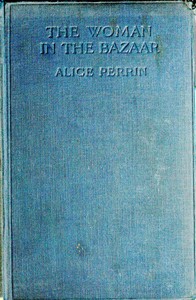
The Woman in the Bazaar
free to read
length
46,037 words
a few pages a day
~8 min
finished in
25 days
full read
3h 12m
At Folio's default of ten pages a day, you finish The Woman in the Bazaar in about 25 days — roughly 8 minutes of reading each morning.
The opening
the first pages of The Woman in the Bazaar, free
Note: Project Gutenberg also has an HTML version of this file which includes the original illustration. See 61272-h.htm or 61272-h.zip: (https://www.gutenberg.org/cache/epub/61272/pg61272-images.html) or (https://www.gutenberg.org/files/61272/61272-h.zip)
Images of the original pages are available through Internet Archive. See https://archive.org/details/womaninbazaar00perriala
Transcriber's note:
Text enclosed by underscores is in italics (italics).
Small capitals were replaced with ALL CAPITALS.
THE WOMAN IN THE BAZAAR
* * * * * *
BY THE SAME AUTHOR
The Happy Hunting Ground The Anglo-Indians The Charm Idolatry A Free Solitude The Waters of Destruction Red Records East of Suez Late in Life The Spell of the Jungle
* * * * * *
[Illustration: "Coventry guessed that this was 'the woman in the bazaar'" (see page 194).]
THE WOMAN IN THE BAZAAR
by
ALICE PERRIN
With a Frontispiece by J. Dewar Mills
Cassell and Company, Ltd London, New York, Toronto and Melbourne
First Published in 1914
CONTENTS
CHAPTER PAGE
1. THE VICAR'S DAUGHTER . . . . . . . . 1
2. IN THE GARDEN . . . . . . . . . . 15
3. SUCCESS . . . . . . . . . . . 24
4. MRS. GREAVES . . . . . . . . . . 36
5. THE LIE . . . . . . . . . . . 55
6. THE BACHELORS' BALL . . . . . . . . 76
7. TRIXIE . . . . . . . . . . . 95
8. INDIA . . . . . . . . . . . 116
9. DOUBT . . . . . . . . . . . 129
10. THE RIVER . . . . . . . . . . 143
11. THE JUNGLE . . . . . . . . . . 163
12. IN THE BAZAAR . . . . . . . . . 183
13. THE OUTCOME . . . . . . . . . . 202
THE WOMAN IN THE BAZAAR
CHAPTER I
THE VICAR'S DAUGHTER
Summer-time at Under-edge compensated, in a measure, for the trials and severities of winter--for winter could be grim and cruel in the isolated little Cotswold village approached by roads that were almost perpendicular. Why such a spot should ever have been fixed upon for human habitation seemed difficult to comprehend, save that in old and dangerous days its very inaccessibility may have been its chief attraction; most of the villagers were descendants of gypsies, outlaws, and highwaymen. Now, at the close of the nineteenth century, no one, unless held by custom and tradition, or by lack of means, remained permanently at Under-edge; for communication with the world in the valley below was still conducted by carrier, postal arrangements were awkward and uncertain, water very often scarce, and existence during winter-time a long-drawn period of bleak and hard monotony.
But when the vast fields, bounded by rough stone walls, grew green and luscious, and the oaks put forth new foliage the colour of a young pea-pod, and the elm trunks sprouted feathery sprays that likened the trees to gigantic Houdan fowls, life in Under-edge became at least endurable. Even the dilapidated vicarage looked charming, wistaria draping the old walls in mauve cascades, and white montana creeper heaped above the porch; roses and passion flower climbed and clung to broken trellis-work, and outside the dining-room window the magnolia tree, planted by a former vicar many years ago, filled the air with lemon scent from waxen cups. Though the garden was unkempt, the grass so seldom mown, and the path unweeded, hardy perennials brightened the neglected flower-beds, and lilac, syringa, laburnum, flourished in sweet luxuriance. It was a paradise for birds, whose trilling echoed clear from dawn to sunset in this safe retreat.
Rafella Forte, the vicar's daughter, came out of the house this summer morning in a blue cotton frock that matched her eyes, wearing no hat on her yellow head. A coarse market basket was slung on her arm, and she carried a light pronged fork, since her object was not to cut flowers for the drawing-room vases, as would seem natural for a young lady, but to dig potatoes for the midday meal. The potato patch was perhaps the most useful portion of the vicarage garden, and it meant real disaster if the crop was scanty, since the living of Under-edge, though not quite so miserable as some, was yet poor enough to render the garden produce of infinite value, in support of one joint a week, an occasional hen that had ceased laying, and sometimes a rabbit presented by a farmer.
Keep going from exactly here — Folio remembers your place and serves the next portion tomorrow.
continue reading The Woman in the BazaarAbout this free edition
The Woman in the Bazaar by Alice Perrin (1867-1934) is free to read in full. Folio serves it in daily portions you can actually finish, tracks your streak and reading position across devices, and reads every page aloud with a built-in narrator. The text comes from Project Gutenberg.
More like The Woman in the Bazaar
Pride and Prejudice
Jane Austen
Sense and Sensibility
Jane Austen
Emma
Folio
Emma
Jane Austen
Persuasion
Folio
Persuasion
Jane Austen
Mansfield Park
Folio
Mansfield Park
Jane Austen

Jane Eyre
Charlotte Brontë
The Tenant of Wildfell Hall
Folio
The Tenant of Wildfell Hall
Anne Brontë
Agnes Grey
Folio
Agnes Grey
Anne Brontë