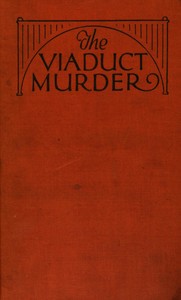
length
59,434 words
a few pages a day
~8 min
finished in
32 days
full read
4h 8m
At Folio's default of ten pages a day, you finish The Viaduct Murder in about 32 days — roughly 8 minutes of reading each morning.
The opening
the first pages of The Viaduct Murder, free
[Frontispiece: A map showing the railway line between Paston Oatvile station and Paston Whitchurch station, and the viaduct where the railroad crosses the river and the golf links. The Dormy House is situated nearer to Paston Oatvile, while the Hatcheries is close by Paston Whitchurch. Below the map is a railway timetable.]
LONDON .. .. .. .. .. | 3. 0 | 3.47 | .. Weighford .. .. .. .. | 3.31 | 4.29 | .. Paston Oatvile (arr.) .. | .. | 4.43 | .. |--------|========|======== Paston Oatvile (dep.) .. | .. | .. | 4.50 Paston Whitchurch .. .. | .. | .. | 4.58 BINVER .. .. .. .. | 3.59 | .. | 5. 9
Dedicated by command to Tony Wilson
“In the matter of information, above all regard with suspicion that which seems probable. Begin always by believing what seems incredible.” Gaboriau, Monsieur Lecoq.
Contents
I. The Paston Oatvile Dormy-house II. In the Rough III. Piecing it Together IV. Endless Clues V. On the Railway VI. The Movements of Mr. Davenant VII. Carmichael’s Account of it VIII. The Inquest, and a Fresh Clue IX. The Animated Picture X. In which a Book is more communicative than a Lady XI. A Funeral and a Vigil XII. A Search with Piano Accompaniment XIII. The Man in the Passage XIV. A Chase, ending with a Surprise XV. Gordon takes the Opportunity to Philosophize XVI. Reeves promises to do his Best XVII. By which Train? XVIII. The Holmes Method XIX. Mordaunt Reeves talks to Himself XX. Proof at Last XXI. The Test XXII. In the Fog XXIII. Marryatt breaks the Pledge XXIV. Gordon offers the Consolation of Philosophy XXV. The Dull Facts
Chapter I
The Paston Oatvile Dormy-house
Nothing is ever wasted. The death of the animal fertilizes the vegetable world: bees swarm in the disused pillar-box; sooner or later, somebody will find a use for the munition-factories. And the old country-seats of feudal England, that bask among their figured terraces, frowning at the ignoble tourist down secular avenues and thrusting back the high-road he travels by into respectful detours—these too, although the family have long since decided that it is too expensive to live there, and the agents smile at the idea of letting them like one humouring a child, have their place in the hero-tenanted England of to-day. The house itself may be condemned to the scrap-heap, but you can always make a golf-course out of the Park. Acres, that for centuries have scorned the weight of the plough, have their stubborn glebe broken with the niblick, and over-populated greens recall the softness and the trimness of earlier lawns. Ghosts of an earlier day will walk there, perhaps, but you can always play through them.
Paston Oatvile (distrust the author whose second paragraph does not come to ground in the particular) seemed to have been specially adapted by an inscrutable Providence for such a niche in the scheme of things. The huge Italianate building which the fifteenth Lord Oatvile raised as a monument to his greatness (he sold judiciously early out of the South Sea Company) took fire in the nineties of last century and burned for a whole night; the help given by the local fire brigade was energetic rather than considerate, and Achelous completed the havoc which Vulcan had begun. It stands even now, an indecent skeleton, papered rooms and carved mantelpieces confronting you shamefacedly, like the inside of a doll’s house whose curtain-wall has swung back on the hinge. What secrets that ball-room, those powder-closets must have witnessed in the days of an earlier gallantry, when the stuccoed façade still performed its discreet office! Poor rooms, they will never know any more secrets now. The garden, too, became involved in the contagion of decay: weeds have overgrown its paved walks, and neglected balustrades have crumbled; a few of the hardier flowers still spring there, but half-smothered in rank grass, shabby-genteel survivors of an ancien régime. For the family never attempted to rebuild; they prudently retired to the old Manor at the other end of the park, a little brick and timber paradise which had served the family for a century and a half as dower-house. In time, even this reduced splendour was judged too expensive, and the family sold.
Keep going from exactly here — Folio remembers your place and serves the next portion tomorrow.
continue reading The Viaduct MurderAbout this free edition
The Viaduct Murder by Ronald Arbuthnott Knox (1888-1957) is free to read in full. Folio serves it in daily portions you can actually finish, tracks your streak and reading position across devices, and reads every page aloud with a built-in narrator. The text comes from Project Gutenberg.
More like The Viaduct Murder

The three taps
Ronald Arbuthnott Knox
The Adventures of Sherlock Holmes
Arthur Conan Doyle
The Hound of the Baskervilles
Arthur Conan Doyle
A Study in Scarlet
Folio
A Study in Scarlet
Arthur Conan Doyle

The Sign of the Four
Arthur Conan Doyle

The Memoirs of Sherlock Holmes
Arthur Conan Doyle

The Return of Sherlock Holmes
Arthur Conan Doyle

His Last Bow
Arthur Conan Doyle