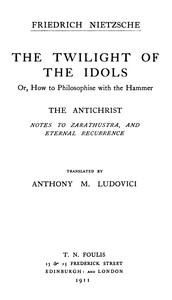
length
70,391 words
a few pages a day
~8 min
finished in
38 days
full read
4h 53m
At Folio's default of ten pages a day, you finish The Twilight of the Idols in about 38 days — roughly 8 minutes of reading each morning.
The opening
the first pages of The Twilight of the Idols, free
The Twilight of the Idols was written towards the end of the summer of 1888, its composition seems to have occupied only a few days,—so few indeed that, in Ecce Homo (p. 118), Nietzsche says he hesitates to give their number; but, in any case, we know it was completed on the 3rd of September in Sils Maria. The manuscript which was dispatched to the printers on the 7th of September bore the title: “Idle Hours of a Psychologist”; this, however, was abandoned in favour of the present title, while the work was going through the press. During September and the early part of October 1888, Nietzsche added to the original contents of the book by inserting the whole section entitled “Things the Germans Lack,” and aphorisms 32-43 of “Skirmishes in a War with the Age”; and the book, as it now stands, represents exactly the form in which Nietzsche intended to publish it in the course of the year 1889. Unfortunately its author was already stricken down with illness when the work first appeared at the end of January 1889, and he was denied the joy of seeing it run into nine editions, of one thousand each, before his death in 1900.
Of The Twilight of the Idols, Nietzsche says in Ecce Homo (p. 118):—“If anyone should desire to obtain a rapid sketch of how everything before my time was standing on its head, he should begin reading me in this book. That which is called ‘Idols’ on the title-page is simply the old truth that has been believed in hitherto. In plain English, The Twilight of the Idols means that the old truth is on its last legs.”
Certain it is that, for a rapid survey of the whole of Nietzsche’s doctrine, no book, save perhaps the section entitled “Of Old and New Tables” in Thus Spake Zarathustra, could be of more real value than The Twilight of the Idols. Here Nietzsche is quite at his best. He is ripe for the marvellous feat of the transvaluation of all values. Nowhere is his language—that marvellous weapon which in his hand became at once so supple and so murderous—more forcible and more condensed. Nowhere are his thoughts more profound. But all this does not by any means imply that this book is the easiest of Nietzsche’s works. On the contrary, I very much fear that, unless the reader is well prepared, not only in Nietzscheism, but also in the habit of grappling with uncommon and elusive problems, a good deal of the contents of this work will tend rather to confuse than to enlighten him in regard to what Nietzsche actually wishes to make clear in these pages.
How much prejudice, for instance, how many traditional and deep-seated opinions, must be uprooted, if we are to see even so much as an important note of interrogation in the section entitled “The Problem of Socrates”—not to speak of such sections as “Morality as the Enemy of Nature,” “The Four Great Errors,” &c. The errors exposed in these sections have a tradition of two thousand years behind them; and only a fantastic dreamer could expect them to be eradicated by a mere casual study of these pages. Indeed, Nietzsche himself looked forward only to a gradual change in the general view of the questions he discussed; he knew only too well what the conversion of “light heads” was worth, and what kind of man would probably be the first to rush into his arms; and, grand psychologist that he was, he guarded himself beforehand against bad company by means of his famous warning:—“The first adherents of a creed do not prove anything against it.”
To the aspiring student of Nietzsche, however, it ought not to be necessary to become an immediate convert in order to be interested in the treasure of thought which Nietzsche here lavishes upon us. For such a man it will be quite difficult enough to regard the questions raised in this work as actual problems. Once, however, he has succeeded in doing this, and has given his imagination time to play round these questions as problems, the particular turn or twist that Nietzsche gives to their elucidation, may then perhaps strike him, not only as valuable, but as absolutely necessary.
Keep going from exactly here — Folio remembers your place and serves the next portion tomorrow.
continue reading The Twilight of the IdolsAbout this free edition
The Twilight of the Idols by Friedrich Nietzsche (1844-1900) is free to read in full. Folio serves it in daily portions you can actually finish, tracks your streak and reading position across devices, and reads every page aloud with a built-in narrator. The text comes from Project Gutenberg.
More like The Twilight of the Idols
Thus Spake Zarathustra
Friedrich Nietzsche
Beyond Good and Evil
Folio
Beyond Good and Evil
Friedrich Nietzsche
The Genealogy of Morals
Folio
The Genealogy of Morals
Friedrich Nietzsche
The Antichrist
Folio
The Antichrist
Friedrich Nietzsche
Human, All Too Human
Folio
Human, All Too Human
Friedrich Nietzsche
Meditations
Folio
Meditations
Marcus Aurelius
The Enchiridion
Epictetus
The Republic
Folio
The Republic
Plato