length
73,931 words
a few pages a day
~8 min
finished in
39 days
full read
5h 8m
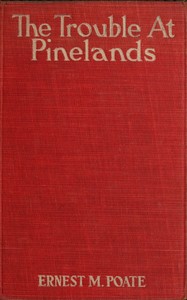
At Folio's default of ten pages a day, you finish The trouble at Pinelands in about 39 days — roughly 8 minutes of reading each morning.
The opening
the first pages of The trouble at Pinelands, free
I could not sleep. I am an old man now and of settled habit; a “confirmed bachelor,” the young folks call me. Even the smallest change of routine irks me; and so, on this night, I found it very hard to be comfortable in a strange bed.
Peter McGregor had gone north. He was in Baltimore to order flowers, consult the caterer, and make the final arrangements for the wedding breakfast. Only women were left in the old stone mansion; the McGregors called it “Fort House,” because it had something of the grim, forbidding look of an old fort. Dorothy, Peter’s sister, her invalid aunt, and the nurse, Miss Christie, were all here.
Miss Christie was too indifferent to care, I think; she was a very dormouse for contentment, and she slept so determinedly that I used to wonder when she found time to care for her patient. But Dorothy was timid, as most young girls are; and her Aunt Mary, who was paralyzed, was highly nervous at the best and declared that she’d never close an eye without a man in the house. And, indeed, I could not blame them much, for Fort House was a gloomy, eerie place, with its big, silent rooms and long, dark halls, wainscoted in time-stained oak and full of unexpected nooks and corners. Also, though well within the village, it stood far back from the street in a little grove of high, solemn pines; leafy shrubs grew thick about its gray walls, and honeysuckle vines climbed over its narrow windows and shaded them still further.
A man must be had to protect these lone women, and there was I--not a very efficient protector, I fear, since I am turned sixty-five and sadly crippled with rheumatism, but the best available. For my nephew, Lewis, Doctor C. Lewis Parker, Johns Hopkins Medical College, class of ’17, though willing enough, was scarcely the man to come, since he was to marry Dorothy in two days; whereas I was of discreet age and with none to miss me at home. In spite of his assurances I knew well enough that I was a nuisance and no help in my nephew’s house; he kept me with him simply because I was his only surviving kinsman, as he was mine, and because his kind heart would not leave me to end my days in some home for the aged. Yes, I knew that I was but a burden upon his goodness--knew it sadly, but without bitterness; a long old age tempers one’s pride.
But here I was, the guardian of my nephew’s bride to be; and I tossed upon my bed and could not sleep for long, sad thoughts. I rejoiced in the boy’s happiness; truly I rejoiced, for Dorothy McGregor was the sweetest of girls and as tender to a useless old man as if I had been her own kin. Yes, it was best, oh, surely it was best, that these two kindly, handsome young folk should marry and make their own home. I looked back through a vista of long, lonely years at my own friendless life, a life that might have been so different if my Dorothy had lived.
They would marry and be happy in each other. But--I am a very selfish old man, I fear--but what of me? I had no other home; and, were she never so tender of heart, what bride desires that her honeymoon should have such a worthless, worn-out satellite as I? No, these two must build their own nest; and it would have no place for me. Then I thought briefly of Aunt Mary McGregor, paralyzed from the waist down, these fourteen years, and bearing her troubles with such saintly patience; where would she go, and how would she live after the wedding? We two might marry also, I thought, and laughed mirthlessly at the idea. Old maid and old bachelor, we might join our troubles and spend the evening of our days together, enlivening each other with comparisons of our various aches and pains. For I must admit that Aunt Mary, for all her sweet patience, was overfond of discussing her symptoms.
The old house was very quiet, except for those strange creakings and rustlings which one hears at night in these old places. Faint, eerie noises, these, which made the silence more profound; I fancied that Fort House whispered to itself of days gone by.
Keep going from exactly here — Folio remembers your place and serves the next portion tomorrow.
continue reading The trouble at PinelandsAbout this free edition
The trouble at Pinelands by Ernest M. Poate (1885?-1935) is free to read in full. Folio serves it in daily portions you can actually finish, tracks your streak and reading position across devices, and reads every page aloud with a built-in narrator. The text comes from Project Gutenberg.
More like The trouble at Pinelands
The Adventures of Sherlock Holmes
Arthur Conan Doyle
The Hound of the Baskervilles
Arthur Conan Doyle
A Study in Scarlet
Folio
A Study in Scarlet
Arthur Conan Doyle
The Sign of the Four
Arthur Conan Doyle
The Memoirs of Sherlock Holmes
Arthur Conan Doyle
The Return of Sherlock Holmes
Arthur Conan Doyle
His Last Bow
Arthur Conan Doyle
The Valley of Fear
Arthur Conan Doyle