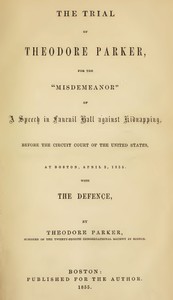
length
119,178 words
a few pages a day
~8 min
finished in
63 days
full read
8h 17m
At Folio's default of ten pages a day, you finish The Trial of Theodore Parker in about 63 days — roughly 8 minutes of reading each morning.
The opening
the first pages of The Trial of Theodore Parker, free
If it were a merely personal matter for which I was arraigned before the United States Court, after the trial was over I should trouble the public no further with that matter; and hitherto indeed, though often attacked, nay, almost continually for the last fourteen years, I have never returned a word in defence. But now, as this case is one of such vast and far-reaching importance, involving the great Human Right to Freedom of Speech, and as the actual question before the court was never brought to trial, I cannot let the occasion pass by without making further use of it.
When Judge Curtis delivered his charge to the Grand-Jury, June 7th, 1854, I made ready for trial, and in three or four days my line of defence was marked out--the fortifications sketched, the place of the batteries determined; I began to collect arms, and was soon ready for his attack. When that Grand-Jury, summoned with no special reference to me, refused to find a bill and were discharged, I took public notice of the conduct of Judge Curtis, in a Sermon for the Fourth of July.[1] But I knew the friends of the fugitive slave bill at Boston and Washington too well to think they would let the matter sleep; I knew what arts could be used to pack a jury and procure a bill. So I was not at all surprised when I heard of the efforts making by the Slave Power in Boston to obtain an indictment by another grand-jury summoned for that purpose. It need not be supposed that I was wholly ignorant of their doings from day to day. The arrest was no astonishment to me. I knew how much the reputation of this Court and of its Attorney depended on the success of this prosecution. I knew what private malignity was at work.
[Footnote 1: 2 Parker's Additional Speeches, 178-283.]
After my arraignment I made elaborate preparation for my defence. I procured able counsel, men needing no commendation, to manage the technical details which I knew nothing about and so could not meddle with, while I took charge of other matters lying more level to my own capacity. I thought it best to take an active part in my own defence,--for the matter at issue belonged to my previous studies and general business; my personal friends and the People in general, seemed to expect me to defend myself as well as I could.
A great political revolution took place between the Judge's charge and my arraignment, June 7th, and November 29th, 1854, and I thought the Court would not allow the case to come to open argument. For certainly, it would not be a very pleasant thing for Judge Sprague and Judge Curtis, who have taken such pains to establish slavery in Massachusetts, to sit there--each like a travestied Prometheus, chained up in a silk gown because they had brought to earth fire from the quarter opposite to Heaven--and listen to Mr. Hale, and Mr. Phillips and other anti-slavery lawyers, day after day: there were facts, sure to come to light, not honorable to the Court and not pleasant to look at in the presence of a New England community then getting indignant at the outrages of the Slave Power. I never thought the case would come to the jury. I looked over the indictment, and to my unlearned eye it seemed so looped and windowed with breaches that a skilful lawyer might drive a cart and six oxen through it in various directions; and so the Court might easily quash the indictment and leave all the blame of the failure on the poor Attorney--whom they seemed to despise, though using him for their purposes--while they themselves should escape with a whole reputation, and ears which had not tingled under manly speech.
Keep going from exactly here — Folio remembers your place and serves the next portion tomorrow.
continue reading The Trial of Theodore ParkerAbout this free edition
The Trial of Theodore Parker by Theodore Parker (1810-1860) is free to read in full. Folio serves it in daily portions you can actually finish, tracks your streak and reading position across devices, and reads every page aloud with a built-in narrator. The text comes from Project Gutenberg.
More like The Trial of Theodore Parker
The History of the Peloponnesian War
Folio
The History of the Peloponnesian War
Thucydides
The History of Herodotus
Folio
The History of Herodotus
Herodotus
The Gallic Wars
Folio
The Gallic Wars
Julius Caesar
Anabasis
Folio
Anabasis
Xenophon
The Lives of the Twelve Caesars
Folio
The Lives of the Twelve Caesars
Suetonius
Germania
Folio
Germania
Tacitus
The History of the Decline and Fall of the Roman Empire
Edward Gibbon
The Travels of Marco Polo
Marco Polo