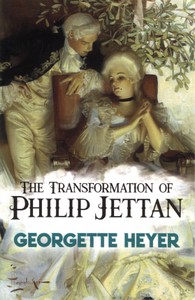
The Transformation of Philip Jettan
by Georgette Heyer (1902-1974)
first published 1923 · free to read
length
47,129 words
a few pages a day
~8 min
finished in
25 days
full read
3h 16m
At Folio's default of ten pages a day, you finish The Transformation of Philip Jettan in about 25 days — roughly 8 minutes of reading each morning.
The opening
the first pages of The Transformation of Philip Jettan, free
The original edition was published with the subtitle A Comedy of Manners, and the author used the pseudonym Stella Martin. The book was later published as Powder and Patch, with Chapter Twenty deleted.
One
The House of Jettan
If you searched among the Downs in Sussex, somewhere between Midhurst and Brighthelmstone, inland a little, and nestling in modest seclusion between two waves of hills, you would find Little Fittledean, a village round which three gentlemen had built their homes. One chose the north side, half a mile away, and on the slope of the Downs. He was Mr. Winton, a dull man with no wife, but two children, James and Jennifer. The second built his house west of the village, not far from the London Road and Great Fittledean. He was one Sir Thomas Jettan. He chose his site carefully, beside a wood, and laid out gardens after the Dutch style. That was way back in the last century when Charles the Second was King, and what had then been a glaring white erection, stark-naked and blatant in its sylvan setting, was now, some seventy years later, a fair place, creeper-hung, and made kindly by the passing of the years. The Jettan who built it became inordinately proud of the house. Never a day passed but he would strut round the grounds, looking at the nude structure from a hundred different points of vantage. It was to be the country seat of the Jettans in their old age; they were to think of it almost as they would think of their children. It was never to be sold; it was to pass from father to son and from son to grandson through countless ages. Nor must it accrue to a female heir, be she never so direct, for old Tom determined that the name of Jettan should always be associated with the house.
Old Tom propounded these notions to the whole countryside. All his friends and his acquaintances were shown the white house and told the tale of its owner's past misdemeanours and his present virtue--a virtue due, he assured them, to the possession of so fair an estate. No more would he pursue the butterfly existence that all his ancestors had pursued before him. This house was his anchor and his interest; he would rear his two sons to reverence it, and it might even be that the tradition which held every Jettan to be a wild fellow at heart should be broken at last.
The neighbours laughed behind their hands at old Tom's childishness. They dubbed the hitherto unnamed house "Tom's Pride," in good-humoured raillery.
Tom Jettan was busy thinking out a suitable name for his home when the countryside's nickname came to his ears. He was not without humour in spite of his vanity, and when the sobriquet had sunk into his brain, he chuckled deep in his chest, and slapped his knee in appreciation. Not a month later the neighbours were horrified to find, cunningly inserted in the wrought-iron gates of the white house, a gilded scroll bearing the legend, "Jettan's Pride." No little apprehension was felt amongst them at having their secret joke thus discovered and utilised, and those who next waited on Tom did so with an air of ashamed nervousness. But Tom soon made it clear that, far from being offended, he was grateful to them for finding an appropriate name for his home.
Keep going from exactly here — Folio remembers your place and serves the next portion tomorrow.
continue reading The Transformation of Philip JettanAbout this free edition
The Transformation of Philip Jettan by Georgette Heyer (1902-1974) is free to read in full. Folio serves it in daily portions you can actually finish, tracks your streak and reading position across devices, and reads every page aloud with a built-in narrator. The text comes from Project Gutenberg.