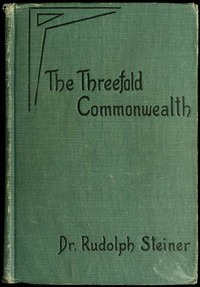
The Threefold Commonwealth
free to read
length
41,210 words
a few pages a day
~8 min
finished in
22 days
full read
2h 52m
At Folio's default of ten pages a day, you finish The Threefold Commonwealth in about 22 days — roughly 8 minutes of reading each morning.
The opening
the first pages of The Threefold Commonwealth, free
The social life of the present day presents grave and far-reaching problems. We are confronted by demands for social reconstruction, which shew that the solution of these problems must be sought along paths unthought-of hitherto. Borne out by the actual events of the hour, the time has perhaps come for someone to gain a hearing, who is forced by life's experience to maintain, that the neglect to turn our thoughts into the paths that are now needed has stranded us in confusion and perplexity. It is under that conviction that this book is written. Its purpose is to discuss what needs doing, in order that those demands, which are being urged by a large part of mankind to-day, may be turned in the direction of a determinate social will and purpose.
Personal likes and dislikes should enter but little into the formation of a social purpose. The demands, welcome or unwelcome, are there; and they must be reckoned with as facts of social life. This should be borne in mind by those who, from their personal situation in life, may be inclined to be annoyed at the author's way of discussing the demands of the working-class, because in their opinion he lays too one-sided a stress on these demands, as on something that must be reckoned with when determining on a social purpose. But what the author wants, is to present life as it exists to-day in all its full reality, in so far as he is able from his knowledge of it. He has ever before his eyes the fatal consequences that must ensue, if people refuse to see facts, which are actually there, which have arisen out of the life of modern mankind,--and if they accordingly persist in ignoring a social will and purpose in which these facts find their place.
Those people again will not be pleased with the author's remarks, who regard themselves as experts in practical life,--or in what, under the influence of fond habit, has come to be regarded as practical life. They will be of opinion, that whoever wrote this book was not a practical person. These are just the people, who, in the author's opinion, have everything to unlearn and re-learn. Their practice of life seems to him the very thing, which is demonstrated by the actual facts from which mankind are suffering to be an utter mistake,--that very mistake that has led to boundless and immeasurable fatalities. These people will be obliged to recognise the practicability of much that has seemed to them absurd idealism. And although they may condemn this book at the outset, because its opening pages say less about the economic than about the spiritual life of modern mankind, yet the author's own acquaintance with life forces him to the conviction, that, unless people can bring themselves to pay due and accurate attention to the spiritual life of modern mankind, they will only go on adding fresh mistakes to the old ones.
Neither will what is said in these pages altogether please those, who are for ever repeating with endless variations the phrases: that man must rise above absorption in purely material interests,--that he must turn to "ideals," to the things of the "spirit." For the author does not attach much importance to mere references to the "spirit" or to talk about a vague spiritual world. The only spirituality he can acknowledge, is that which forms the substance of man's own life and manifests its power no less in mastering the practical problems of life than in constructing a philosophy of life and of the universe, which can satisfy the needs of man's soul. The important point, is not the knowledge,--or supposed knowledge,--of a spiritual life, but that such a spiritual life shews itself in a practical grip of realities, and is not a special preserve for the inner life of the soul, a backwater alongside the full tide of realities.
And so, what is said in these pages will seem to the "spiritually-minded" too unspiritual, to "practical persons" too remote from practice. But the author's view is, that he may have his own special use at the present time, for the very reason, that he neither tends towards that aloofness from life, which is to be found in many a man who thinks himself practical, nor yet can hold in any way with the kind of talk about the spirit, which conjures up a mirage out of words.
Keep going from exactly here — Folio remembers your place and serves the next portion tomorrow.
continue reading The Threefold CommonwealthAbout this free edition
The Threefold Commonwealth by Rudolf Steiner (1861-1925) is free to read in full. Folio serves it in daily portions you can actually finish, tracks your streak and reading position across devices, and reads every page aloud with a built-in narrator. The text comes from Project Gutenberg.
More like The Threefold Commonwealth
An Outline of Occult Science
Folio
An Outline of Occult Science
Rudolf Steiner
The Philosophy of Spiritual Activity
Rudolf Steiner
The Education of Children from the Standpoint of Theosophy
Folio
The Education of Children from the Standpoint of Theosophy
Rudolf Steiner
The Spiritual Guidance of Man and of Mankind
Folio
The Spiritual Guidance of Man and of Mankind
Rudolf Steiner
The Way of Initiation; or, How to Attain Knowledge of the Higher Worlds
Folio
The Way of Initiation; or, How to Attain Knowledge of the Higher Worlds
Rudolf Steiner
Mystics of the Renaissance and their relation to modern thought, including Meister Eckhart, Tauler, Paracelsus, Jacob Boehme, Giordano Bruno, and others
Folio
Mystics of the Renaissance and their relation to modern thought, including Meister Eckhart, Tauler, Paracelsus, Jacob Boehme, Giordano Bruno, and others
Rudolf Steiner
Christianity as Mystical Fact, and the Mysteries of Antiquity
Folio
Christianity as Mystical Fact, and the Mysteries of Antiquity
Rudolf Steiner
The Upanishads
Folio
The Upanishads
Swami Paramananda