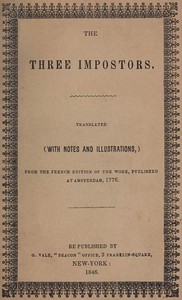
length
28,625 words
a few pages a day
~8 min
finished in
16 days
full read
1h 59m
At Folio's default of ten pages a day, you finish The Three Impostors in about 16 days — roughly 8 minutes of reading each morning.
The opening
the first pages of The Three Impostors, free
The following little book I present to the reader without any remarks on the different opinions relative to its antiquity; as the subject is amply discussed in the body of the work, and constitutes one of its most interesting and attractive features. The Edition from which the present is translated was brought me from Paris by a distinguished defender of Civil and Religious Liberty: and as my friend had an anxiety from a thorough conviction of its interest and value, to see it published in the English Language, I have from like feelings brought it before the public; and I am convinced that it is an excellent antidote to Superstition and Intolerance, and eminently calculated to promote the cause of Freedom, Justice, and Morality.
J. MYLES.
PREFACE BY THE TRANSLATOR.
The Translator of the following little treatise deems it necessary to say a few words as to the object of its publication. It is given to the world, neither with a view to advocate Scepticism, nor to spread infidelity, but simply to vindicate the right of private judgment. No human being is in a position to look into the heart, or to decide correctly as to the creed or conduct of his fellow mortals; and the attributes of the Deity are so far beyond the grasp of limited reason, that man must become a God himself before he can comprehend them. Such being the case, surely all harsh censure of each other's opinions and actions ought to be abandoned; and every one should so train himself as to be enabled to declare with the humane and manly philosopher
"Homo sum, nihil humania me alienum puto."
Dundee, September 1844.
CONTENTS OF THE PRELIMINARY DISSERTATION.
DISQUISITIONS on the book entitled "The Three Impostors."
ANSWER to the dissertation of M. de la Monnoye on the work entitled "The Three Impostors."
COPY of Part 2d, Vol. 1., Article ix. of "Literary Memoirs," published at the Hague by Henry du Sauzet, 1716.
DISQUISITIONS ON THE BOOK ENTITLED THE THREE IMPOSTORS.
It has long been a disputed point if there was at anytime a book printed and bearing the title of "The Three Impostors."
M. de la Monnoye, having been informed that a learned German [1] intended to publish a dissertation the object of which was to prove that this work had really been printed, wrote a letter, in refutation, to one of his friends; this letter was given by M. Bayle to M. Basnage de Bauval, who in February 1694, gave an extract from it in his "History of the works of celebrated and learned men." At a later period M. de la Monnoye entered more fully into the subject, in a letter dated at Paris 16th of June, 1712, and addressed to President Bouhier, in which letter, he says, will be found an abridged but complete account of this remarkable book.
He condemns at once the opinion of those who attribute the work to the Emperor Frederick. The false charge, he says, took its rise from a passage in the appendix to a discourse concerning Antichrist, and published by Grotius, wherein he speaks as follows [2]: "Far be it from me to attribute the book called 'The Three Impostors,' either to the Pope, or to the opponents of the Pope; long ago the enemies of the Emperor Frederick Barbarossa set abroad the report of such a book, as having been written by his command; but from that period nobody has seen it; for which reason I consider it apocryphal."
Colomiez quotes this, page 28 of his "Historical Miscellanies;" but he adds that there are some blunders--that it was not Frederick I. (Barbarossa,) on whom they intended to fix the authorship, but Frederick II. his grandson. This he says, is apparent from the letters of Pierre des Vignes, the secretary and chancellor of the second Frederick, and from Matthew Paris; inasmuch as they record, that this monarch was blamed for having said that the world had been led aside by "Three Impostors;" but by no means that he had written a book having such a title. The Emperor denied in the strongest terms, that he ever made use of any expression to that effect. He detested the blasphemy with which they charged him, and declared that it was an atrocious calumny; more shame to Lipsius and other writers who have condemned him without sufficiently looking into the evidences.
Keep going from exactly here — Folio remembers your place and serves the next portion tomorrow.
continue reading The Three ImpostorsAbout this free edition
The Three Impostors by Jean Maximilien Lucas (-1697) is free to read in full. Folio serves it in daily portions you can actually finish, tracks your streak and reading position across devices, and reads every page aloud with a built-in narrator. The text comes from Project Gutenberg.
More like The Three Impostors
Meditations
Folio
Meditations
Marcus Aurelius
The Enchiridion
Epictetus

Thus Spake Zarathustra
Friedrich Nietzsche
Beyond Good and Evil
Folio
Beyond Good and Evil
Friedrich Nietzsche
The Genealogy of Morals
Folio
The Genealogy of Morals
Friedrich Nietzsche
The Republic
Folio
The Republic
Plato
Apology
Folio
Apology
Plato
Crito
Folio
Crito
Plato