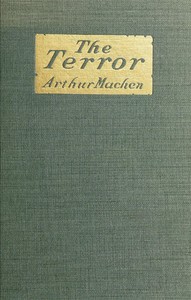
The Terror
first published 1917 · free to read
length
37,540 words
a few pages a day
~8 min
finished in
20 days
full read
2h 36m
At Folio's default of ten pages a day, you finish The Terror in about 20 days — roughly 8 minutes of reading each morning.
The opening
the first pages of The Terror, free
After two years we are turning once more to the morning’s news with a sense of appetite and glad expectation. There were thrills at the beginning of the war; the thrill of horror and of a doom that seemed at once incredible and certain; this was when Namur fell and the German host swelled like a flood over the French fields, and drew very near to the walls of Paris. Then we felt the thrill of exultation when the good news came that the awful tide had been turned back, that Paris and the world were safe; for awhile at all events.
Then for days we hoped for more news as good as this or better. Has Von Kluck been surrounded? Not to-day, but perhaps he will be surrounded to-morrow. But the days became weeks, the weeks drew out to months; the battle in the West seemed frozen. Now and again things were done that seemed hopeful, with promise of events still better. But Neuve Chapelle and Loos dwindled into disappointments as their tale was told fully; the lines in the West remained, for all practical purposes of victory, immobile. Nothing seemed to happen; there was nothing to read save the record of operations that were clearly trifling and insignificant. People speculated as to the reason of this inaction; the hopeful said that Joffre had a plan, that he was “nibbling,” others declared that we were short of munitions, others again that the new levies were not yet ripe for battle. So the months went by, and almost two years of war had been completed before the motionless English line began to stir and quiver as if it awoke from a long sleep, and began to roll onward, overwhelming the enemy.
The secret of the long inaction of the British Armies has been well kept. On the one hand it was rigorously protected by the censorship, which severe, and sometimes severe to the point of absurdity—“the captains and the ... depart,” for instance—became in this particular matter ferocious. As soon as the real significance of that which was happening, or beginning to happen, was perceived by the authorities, an underlined circular was issued to the newspaper proprietors of Great Britain and Ireland. It warned each proprietor that he might impart the contents of this circular to one other person only, such person being the responsible editor of his paper, who was to keep the communication secret under the severest penalties. The circular forbade any mention of certain events that had taken place, that might take place; it forbade any kind of allusion to these events or any hint of their existence, or of the possibility of their existence, not only in the Press, but in any form whatever. The subject was not to be alluded to in conversation, it was not to be hinted at, however obscurely, in letters; the very existence of the circular, its subject apart, was to be a dead secret.
These measures were successful. A wealthy newspaper proprietor of the North, warmed a little at the end of the Throwsters’ Feast (which was held as usual, it will be remembered), ventured to say to the man next to him: “How awful it would be, wouldn’t it, if....” His words were repeated, as proof, one regrets to say, that it was time for “old Arnold” to “pull himself together”; and he was fined a thousand pounds. Then, there was the case of an obscure weekly paper published in the county town of an agricultural district in Wales. The Meiros Observer (we will call it) was issued from a stationer’s back premises, and filled its four pages with accounts of local flower shows, fancy fairs at vicarages, reports of parish councils, and rare bathing fatalities. It also issued a visitors’ list, which has been known to contain six names.
This enlightened organ printed a paragraph, which nobody noticed, which was very like paragraphs that small country newspapers have long been in the habit of printing, which could hardly give so much as a hint to any one—to any one, that is, who was not fully instructed in the secret. As a matter of fact, this piece of intelligence got into the paper because the proprietor, who was also the editor, incautiously left the last processes of this particular issue to the staff, who was the Lord-High-Everything-Else of the establishment; and the staff put in a bit of gossip he had heard in the market to fill up two inches on the back page. But the result was that the Meiros Observer ceased to appear, owing to “untoward circumstances” as the proprietor said; and he would say no more. No more, that is, by way of explanation, but a great deal more by way of execration of “damned, prying busybodies.”
Keep going from exactly here — Folio remembers your place and serves the next portion tomorrow.
continue reading The TerrorAbout this free edition
The Terror by Arthur Machen (1863-1947) is free to read in full. Folio serves it in daily portions you can actually finish, tracks your streak and reading position across devices, and reads every page aloud with a built-in narrator. The text comes from Project Gutenberg.
More like The Terror
The Great God Pan
Folio
The Great God Pan
Arthur Machen
The Hill of Dreams
Folio
The Hill of Dreams
Arthur Machen
The Three Impostors
Arthur Machen
The House of Souls
Folio
The House of Souls
Arthur Machen
The Angels of Mons: The Bowmen and Other Legends of the War
Arthur Machen

Things near & far
Arthur Machen
Hieroglyphics
Arthur Machen
Dracula
Bram Stoker