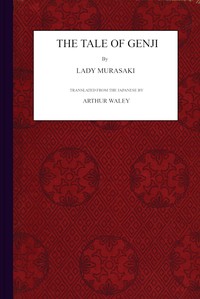
The tale of Genji
free to read
length
98,193 words
a few pages a day
~8 min
finished in
52 days
full read
6h 49m
At Folio's default of ten pages a day, you finish The tale of Genji in about 52 days — roughly 8 minutes of reading each morning.
The opening
the first pages of The tale of Genji, free
Readers of the Diaries of Court Ladies of Old Japan, translated by Madame Omori and Professor Doi, will remember that the second of the three diaries is that of a certain Murasaki Shikibu. The little that is known of this lady’s life has been set forth by Miss Amy Lowell in her Introduction to that book. A few dates, most of them very insecure, will be found in Appendix I of this volume. It is, however, certain that Murasaki was born in the last quarter of the tenth century, that she lost her husband in 1001, and that a few years later she became lady-in-waiting to the Empress Akiko. We know that she was chosen for this post on account of her proficiency in Chinese, a subject which the young Empress was anxious to study. Akiko was then about sixteen, so that Murasaki’s position in the house was what, in our parlance, we should call that of ‘governess’ rather than of lady-in-waiting. Akiko, though officially espoused to the Emperor, was still living at home, and her father soon began to pay somewhat embarrassing attentions to the new governess. From the Diary we know that on one occasion at any rate his solicitations were refused. Was the Tale of Genji or any part of it already written when Murasaki came to Court? We only know that in a passage of the Diary which apparently refers to the year 1008 she speaks of her novel having been read out loud to the Emperor. His majesty’s comment (‘This is a learned lady; she must have been reading the Chronicle of Japan’) shows that what was read to him must have been the opening chapter of the tale. For in the whole work there is only one sentence which could possibly remind any one of the Nihongi (‘Chronicle of Japan’), and that is the conclusion of Chapter I. So though we may be certain that the first few books were already written in 1008, it is quite possible that the whole fifty-four were not finished till long afterwards. But from the Sarashina Diary, the first of the three contained in the Court Ladies of Old Japan, we know that the Tale of Genji in its complete form was already a classic in the year 1022. The unknown authoress of this diary spent her childhood in a remote province. Her great pleasure was to read romances; but except at the Capital they were hard to come by. She prays fervently to Buddha to bring her quickly to Kyoto, and let her read ‘dozens and dozens of stories.’ In 1022 she at last arrives at Court and her wildest dreams are fulfilled. Packed in a big box her aunt sends round ‘the fifty-odd chapters of Genji’ and a whole library of shorter fairy-tales and romances. ‘Are there really such people as this in the world? Were Genji my lover, though he should come to me but once in the whole year, how happy I should be! Or were I Lady Ukifune in her mountain home, gazing as the months go by at flowers, red autumn leaves, moonlight and snow; happy, despite loneliness and misfortune, in the thought that at any moment the wonderful letter might come....’
Such were the rêveries of one who read the Tale of Genji more than nine hundred years ago. I think that, could they but read it in the original, few readers would feel that in all those centuries the charm of the book had in any way evaporated. The task of translation in such a case is bound to be arduous and discouraging; but I have all the time been spurred by the belief that I am translating by far the greatest novel of the East, and one which, even if compared with the fiction of Europe, takes its place as one of the dozen greatest masterpieces of the world.
CONTENTS
PAGE PREFACE 7 LIST OF MOST IMPORTANT PERSONS 11 GENEALOGICAL TABLES 13 CHAPTER I. KIRITSUBO 17 II. THE BROOM-TREE 39 III. UTSUSEMI 81 IV. YŪGAO 92 V. MURASAKI 135 VI. THE SAFFRON-FLOWER 180 VII. THE FESTIVAL OF RED LEAVES 211 VIII. THE FLOWER FEAST 239 IX. AOI 250 APPENDICES 297
LIST OF MOST IMPORTANT PERSONS
(ALPHABETICAL)
Aoi, Princess Genji’s wife.
Asagao, Princess Daughter of Prince Momozono. Courted in vain by Genji from his 17th year onward.
Emperor, The Genji’s father.
Fujitsubo The Emperor’s consort. Loved by Genji. Sister of Prince Hyōbukyō; aunt of Murasaki.
Genji, Prince Son of the Emperor and his concubine Kiritsubo.
Hyōbukyō, Prince Brother of Fujitsubo; father of Murasaki.
Iyo no Suke Husband of Utsusemi.
Ki no Kami Son of Iyo no Kami, also called Iyo no Suke.
Kiritsubo Concubine of the Emperor; Genji’s mother.
Kōkiden The Emperor’s original consort; later supplanted by Kiritsubo and Fujitsubo successively.
Koremitsu Genji’s retainer.
Left, Minister of the Father of Aoi.
Momozono, Prince Father of Princess Asagao.
Murasaki Child of Prince Hyōbukyō. Adopted by Genji. Becomes his second wife.
Myōbu A young Court lady who introduces Genji to Princess Suyetsumuhana.
Nokiba no Ogi Ki no Kami’s sister.
Oborozukiyo, Princess Sister of Kōkiden.
Ōmyōbu Fujitsubo’s maid.
Right, Minister of the Father of Kōkiden.
Rokujō, Princess Widow of the Emperor’s brother, Prince Zembō. Genji’s mistress from his 17th year onward.
Shōnagon Murasaki’s nurse.
Suyetsumuhana, Princess Daughter of Prince Hitachi. A timid and eccentric lady.
Tō no Chūjō Genji’s brother-in-law and great friend.
Ukon Yūgao’s maid.
Utsusemi Wife of the provincial governor, Iyo no Suke. Courted by Genji.
Keep going from exactly here — Folio remembers your place and serves the next portion tomorrow.
continue reading The tale of GenjiAbout this free edition
The tale of Genji by Murasaki Shikibu (978?-) is free to read in full. Folio serves it in daily portions you can actually finish, tracks your streak and reading position across devices, and reads every page aloud with a built-in narrator. The text comes from Project Gutenberg.