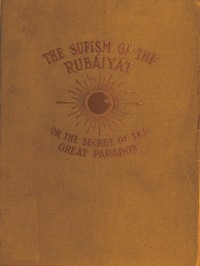
The Sufism of the Rubaiyat
free to read
length
10,558 words
a few pages a day
~8 min
finished in
6 days
full read
44 min
At Folio's default of ten pages a day, you finish The Sufism of the Rubaiyat in about 6 days — roughly 8 minutes of reading each morning.
The opening
the first pages of The Sufism of the Rubaiyat, free
In placing this volume before the public I only hope that I may be able to convey to my readers the higher and deeper truths of this most famous of Persian Poets, who so ably attempted to portray to his countrymen the benevolent God the subtle life within the grosser of our material forms.
Also the mysterious force within the grape, which renders possible fermentation, thereby changing its character from matter to spirit. Therefore, I sincerely trust that this may be a means to enlighten many seekers after truth, and to my Critics will but add this line, "that they in me can find no opponent for them," for what little I have done has been to bless, to illuminate, not destroy the works of others, to whom myself with the rest of the world's readers owe our many thanks. Hoping that all may realize the spirit in which I here present it, and may it comfort and bless those who read to learn of its sublime truths, is the sincere wish of thy brother man.
THE AUTHOR.
NOTES
RUBÁIYÁT. A reading between the lines, a meaning, within a meaning, a paradox.
OMÁR KHAYYÁM. The Tent Maker, an ancient Persian manner of expression signifying the Supreme Creator, for a tent to their minds represented the universe, the earth formed its level or floor, and the heavens its canopy. Again, the expression Astronomer Poet was another title for the Creator. He who laid out the heavens as a garden and placed the stars in design or order. He was also the Controller of the seasons, the Lord of the Vernal Equinox and the Prince of Horsemen.
IRAM. The nameless center of the universe, the womb from whence all things are born; the heavenly garden where Jamshyd the King of Splendor (or wisdom) sits enthroned, and reads from out the seven orbited cup (the inverted heaven) wherein the orbits of the seven planets circle around within its sphere, and there divines the astronomical mysteries of the seasons, years and all hidden things.
RUSTUM and ZÁL. The personification of the universal positive and negative creative energies, the elements of causation, the great opposites, summer and winter, youth and age, etc.
HÁTIM TAI. The personification of charity, benevolence and generosity.
TAKHT-I-JAMSHYD. The throne of wisdom, the mid-heaven, whereon Jamshyd the King of Splendor (or wisdom) symbolized by the sun when he reaches his zenith at high noon. The ancient Persians like the more modern Parsee do not worship the Sun as God, but to them it is the symbol of God, the All Seeing Eye, the Surveyor of the worlds, etc.
BAHRÁM GÙR. This character symbolizes the sun in the astronomical sign of Sagittarius wherein he represents the ass or old year, which will soon be lost in the swamps of winter or the sign of Capricorn, the extreme point of the southern ecliptic.
SATURN. Lord of the Seventh Heaven, the symbol of old age or ripeness.
MÁH to MÁHI. From fish to moon, an expression denoting the period from conception to birth, the state of transition between matter and spirit and between life and death, or as we use the same expression in the words "it is neither fish nor fowl."
PARWÌN. The Pleiades, the symbol of spirituality, gentleness, kindness, etc.
MUSHTARÌ. The Planet Jupiter, the symbol of benevolence, religion, toleration and big heartedness.
Keep going from exactly here — Folio remembers your place and serves the next portion tomorrow.
continue reading The Sufism of the RubaiyatAbout this free edition
The Sufism of the Rubaiyat by Omar Khayyam (1048-1122) is free to read in full. Folio serves it in daily portions you can actually finish, tracks your streak and reading position across devices, and reads every page aloud with a built-in narrator. The text comes from Project Gutenberg.
More like The Sufism of the Rubaiyat
The Rubaiyat of Omar Khayyam
Folio
The Rubaiyat of Omar Khayyam
Omar Khayyam
Meditations
Folio
Meditations
Marcus Aurelius
The Enchiridion
Epictetus
Thus Spake Zarathustra
Friedrich Nietzsche
Beyond Good and Evil
Folio
Beyond Good and Evil
Friedrich Nietzsche
The Genealogy of Morals
Folio
The Genealogy of Morals
Friedrich Nietzsche
The Republic
Folio
The Republic
Plato
Apology
Folio
Apology
Plato