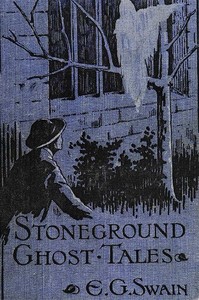
The Stoneground Ghost Tales
first published 1912 · free to read
length
38,914 words
a few pages a day
~8 min
finished in
21 days
full read
2h 42m
At Folio's default of ten pages a day, you finish The Stoneground Ghost Tales in about 21 days — roughly 8 minutes of reading each morning.
The opening
the first pages of The Stoneground Ghost Tales, free
On the edge of that vast tract of East Anglia, which retains its ancient name of the Fens, there may be found, by those who know where to seek it, a certain village called Stoneground. It was once a picturesque village. To-day it is not to be called either a village, or picturesque. Man dwells not in one "house of clay," but in two, and the material of the second is drawn from the earth upon which this and the neighbouring villages stood. The unlovely signs of the industry have changed the place alike in aspect and in population. Many who have seen the fossil skeletons of great saurians brought out of the clay in which they have lain from pre-historic times, have thought that the inhabitants of the place have not since changed for the better. The chief habitations, however, have their foundations not upon clay, but upon a bed of gravel which anciently gave to the place its name, and upon the highest part of this gravel stands, and has stood for many centuries, the Parish Church, dominating the landscape for miles around.
Stoneground, however, is no longer the inaccessible village, which in the middle ages stood out above a waste of waters. Occasional floods serve to indicate what was once its ordinary outlook, but in more recent times the construction of roads and railways, and the drainage of the Fens, have given it freedom of communication with the world from which it was formerly isolated.
The Vicarage of Stoneground stands hard by the Church, and is renowned for its spacious garden, part of which, and that (as might be expected) the part nearest the house, is of ancient date. To the original plot successive Vicars have added adjacent lands, so that the garden has gradually acquired the state in which it now appears.
The Vicars have been many in number. Since Henry de Greville was instituted in the year 1140 there have been 30, all of whom have lived, and most of whom have died, in successive vicarage houses upon the present site.
The present incumbent, Mr. Batchel, is a solitary man of somewhat studious habits, but is not too much enamoured of his solitude to receive visits, from time to time, from schoolboys and such. In the summer of the year 1906 he entertained two, who are the occasion of this narrative, though still unconscious of their part in it, for one of the two, celebrating his 15th birthday during his visit to Stoneground, was presented by Mr. Batchel with a new camera, with which he proceeded to photograph, with considerable skill, the surroundings of the house.
One of these photographs Mr. Batchel thought particularly pleasing. It was a view of the house with the lawn in the foreground. A few small copies, such as the boy's camera was capable of producing, were sent to him by his young friend, some weeks after the visit, and again Mr. Batchel was so much pleased with the picture, that he begged for the negative, with the intention of having the view enlarged.
The boy met the request with what seemed a needlessly modest plea. There were two negatives, he replied, but each of them had, in the same part of the picture, a small blur for which there was no accounting otherwise than by carelessness. His desire, therefore, was to discard these films, and to produce something more worthy of enlargement, upon a subsequent visit.
Mr. Batchel, however, persisted in his request, and upon receipt of the negative, examined it with a lens. He was just able to detect the blur alluded to; an examination under a powerful glass, in fact revealed something more than he had at first detected. The blur was like the nucleus of a comet as one sees it represented in pictures, and seemed to be connected with a faint streak which extended across the negative. It was, however, so inconsiderable a defect that Mr. Batchel resolved to disregard it. He had a neighbour whose favourite pastime was photography, one who was notably skilled in everything that pertained to the art, and to him he sent the negative, with the request for an enlargement, reminding him of a long-standing promise to do any such service, when as had now happened, his friend might see fit to ask it.
Keep going from exactly here — Folio remembers your place and serves the next portion tomorrow.
continue reading The Stoneground Ghost TalesAbout this free edition
The Stoneground Ghost Tales by E. G. Swain (1861-1938) is free to read in full. Folio serves it in daily portions you can actually finish, tracks your streak and reading position across devices, and reads every page aloud with a built-in narrator. The text comes from Project Gutenberg.
More like The Stoneground Ghost Tales

Dracula
Bram Stoker
The Strange Case of Dr. Jekyll and Mr. Hyde
Robert Louis Stevenson
The Turn of the Screw
Folio
The Turn of the Screw
Henry James

The Picture of Dorian Gray
Oscar Wilde
The Fall of the House of Usher
Folio
The Fall of the House of Usher
Edgar Allan Poe
Carmilla
Joseph Sheridan Le Fanu
Uncle Silas
Folio
Uncle Silas
Joseph Sheridan Le Fanu
The Castle of Otranto
Folio
The Castle of Otranto
Horace Walpole