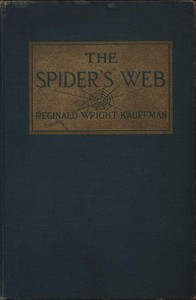
length
87,102 words
a few pages a day
~8 min
finished in
46 days
full read
6h 3m
At Folio's default of ten pages a day, you finish The Spider's Web in about 46 days — roughly 8 minutes of reading each morning.
The opening
the first pages of The Spider's Web, free
That's the shout, the shout we shall utter When, with rifles and spades, We stand, with the old Red Flag aflutter On the barricades! --FRANCIS ADAMS.
Thou orb of many orbs! Thou seething principle! Thou well-kept, latent germ! Thou center! Around the idea of thee the strange sad war revolving, With all its angry and vehement play of causes, (With yet unknown results to come, for thrice a thousand years).... --WHITMAN.
While three men hold together, The kingdoms are less by three. --SWINBURNE.
*LIST OF ILLUSTRATIONS*
"Betty," he said, "do you understand what your father is asking me to do?" . . . (Outside cover) (missing from book)
Betty stood at the window in the full light of the street-lamp . . . . . . . . . Frontispiece
He found it necessary to be emphatic
The mob was using the coal from the dismantled wagon
*EXPLANATION*
In order to warn off trespassers, I have begun my novel with four chapters that an expert bookmaker--indeed, my own book-maker--has pronounced dull: I knew that only those to whom the book belonged would persevere. By the same token, being aware that the story which is prefaced by an apology is ended with suspicion, I preface this story with an apology: I want to apologize to my friends for using them and to my enemies for not giving them what they have expected; I want to create in the minds of the former the suspicion that I am darker than I have been painted, and in the minds of the latter the suspicion that I am not a whited sepulcher but a blackened altar.
In 1909 I projected, vaguely it is true, a cycle of four novels, each to be independent of the others in plot and character, but all carrying forward a definite view of life. As, however, the announcement of a cycle is the surest means of alienating readers, not to mention publishers, I held my tongue about the general plan and concerned myself, in public, only with its separate parts. These were "The House of Bondage," "The Sentence of Silence," "Running Sands" and "The Spider's Web."
Privately, the first question demanding answer was that of method. In what I had to say I believed burningly, as I still believe deeply, and the great thing with me was not to say it in the manner that most people would call Art, but to say it in the manner that would convert as many readers as possible to my way of thinking. I did not want to produce the effect of a work of Art; I wanted to produce conviction of truth. On the one hand, I must avoid even the appearance of a personal interest in my characters, because that would divert my readers into the charge of sentimentality; and on the other, I must not hesitate to marshal my events in their largest force, even though the reviewers called this melodrama.
Here is a choice that is sure to come sooner or later to every writer of fiction: the choice between what he has considered Art for Art's sake and what he considers art for Man's sake. He has kept in mind the day when his books will be judged solely by their own merits, when the causes with which he sympathizes have been defeated and forgotten or established and beyond the need of sympathy; when new evils demand new remedies and old wounds are healed. He knows, as few of his contemporary readers can know, that then he will be heavily handicapped by all that is immediate or local in what he writes; that by nothing save adherence to the eternal standards of Art can he endure. He may be certain, in his own mind, that any true art is the expression, in the manner best calculated to secure a desired effect, of the ideas essential to the effect, but he will be equally sure that the world will not so consider. If he sets any propaganda above Art, the future will forget his work, the present meet it with prejudice, probably with opposition; and against all this he has to set only his own faith in the righteousness of the thing he has to say.
Keep going from exactly here — Folio remembers your place and serves the next portion tomorrow.
continue reading The Spider's WebAbout this free edition
The Spider's Web by Reginald Wright Kauffman (1877-1959) is free to read in full. Folio serves it in daily portions you can actually finish, tracks your streak and reading position across devices, and reads every page aloud with a built-in narrator. The text comes from Project Gutenberg.
More like The Spider's Web
Running Sands
Folio
Running Sands
Reginald Wright Kauffman

The Adventures of Sherlock Holmes
Arthur Conan Doyle
The Hound of the Baskervilles
Arthur Conan Doyle
A Study in Scarlet
Folio
A Study in Scarlet
Arthur Conan Doyle

The Sign of the Four
Arthur Conan Doyle

The Memoirs of Sherlock Holmes
Arthur Conan Doyle

The Return of Sherlock Holmes
Arthur Conan Doyle

His Last Bow
Arthur Conan Doyle