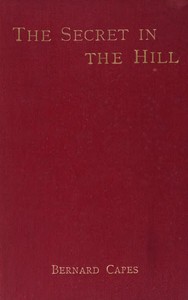
The secret in the hill
free to read
length
73,945 words
a few pages a day
~8 min
finished in
39 days
full read
5h 8m
At Folio's default of ten pages a day, you finish The secret in the hill in about 39 days — roughly 8 minutes of reading each morning.
The opening
the first pages of The secret in the hill, free
When I was a very little boy my mother died. I was too young to feel her loss long, though I missed her badly at first; but the compensation was that it brought my father nearer to me. He was a barrister, a prodigal love of a man, dear bless him! And he felt his bereavement so cruelly that for a time he seemed incapable of rallying from the blow. But presently he plucked up heart, and went, for my sake, to his business again.
He was more liked than lucky, I believe. I had evidence enough, at least of the former; for after my mother’s death, not bearing that we should be parted, he carried me with him on the last circuit he was ever to go. Those were the days when Bench and Bar dined well, and sat up late telling tales. Sometimes my father would slip me into his pocket, so to speak, and from its shelter--when, to be candid, I had been much better in bed--I heard fine stories related by the gentlemen who put off gravity with the horsehair they wore all day. They were a merry and irresponsible lot, rather like a strolling company of actors; and, indeed, it was no less their business to play many parts. There were types among them which I came to associate with certain qualities: such as the lean vivacious ones, who ate and drank hungrily, and presently grew incoherent and quarrelsome; such as the rosy bald-headed ones, who always seemed to make most laughter; such as the large, heavy-browed ones, who sulked when they were bettered in argument. But my friend amongst them all, next to my father, was Mr. Quayle, Q.C.
I fancied I had discovered, after much consideration, why he was called Q.C. He was a little man, quite bald and round all over his head and face except for a tuft of hair on his chin, and there was the Q; and he wore a pouter-pigeon ruff under his chin like this, Q/C, and there was the Q.C. I may have been wrong; but anyhow I had precedent to justify me, for many of these jolly souls bore such characteristic nicknames. There was Plain John, for instance, who had so christened himself for ever during a dispute about the uses or abuses of multiple titles. “Plain John” had been enough for him, he had said. Again, there was Blind Fogle, so called from his favourite cross-examination phrase. “I don’t quite see.” They were all boys together when off duty, chaffing and horse-playing, and my father was the merriest and most irrepressible of the crew.
There was one treat, however, of which he was persistent in baulking me. Pray him as I might, he would never let me see or hear him in his character of Counsel. The Court where he would be working by day was forbidden ground to me, and for that very reason I longed, like Bluebeard’s wife, to peep into it. This was not right, even in thought, for I knew his wishes. But worse is to be confessed. I once took an opportunity, which ought never to have been given me, to disobey him; and dreadful were the consequences, as you shall hear.
We were travelling on what is called the Home Circuit, and one day we came to Ipswich, a town to mark itself red in the annals of my young life. On the second morning after our arrival I was playing at horses with George, my father’s man, when Mr. Quayle looked in at our hotel, and, dismissing George, took and sat me upon his knee.
“Dad gone to Court?” said he.
“Yes,” I answered; “just.”
He grunted, and rubbed his bald head, with a look half comical, half aggravated. His eyes were rather blinky and red, and he seemed confused in manner and at a loss for words.
“Dicky,” he said, suddenly, “did you live very well, very rich-like, when mamma was alive?”
“Yes,” I answered; “’cept when mamma said we must retrench, and cried; and by’m-by papa laughed, and threw the rice pudding into the fire, and took us to dine at a palace.”
“And that was--very long before--hey?”
“It was a very little while before mamma went away for good,” I murmured, and hung my head, inclined to whimper.
Mr. Quayle twitched at me compunctious.
Keep going from exactly here — Folio remembers your place and serves the next portion tomorrow.
continue reading The secret in the hillAbout this free edition
The secret in the hill by Bernard Capes (1854-1918) is free to read in full. Folio serves it in daily portions you can actually finish, tracks your streak and reading position across devices, and reads every page aloud with a built-in narrator. The text comes from Project Gutenberg.
More like The secret in the hill
The skeleton key
Bernard Capes

The great Skene mystery
Bernard Capes
Gilead Balm, knight errant
Bernard Capes
The pot of basil
Bernard Capes
The Adventures of Sherlock Holmes
Arthur Conan Doyle
The Hound of the Baskervilles
Arthur Conan Doyle
A Study in Scarlet
Folio
A Study in Scarlet
Arthur Conan Doyle
The Sign of the Four
Arthur Conan Doyle