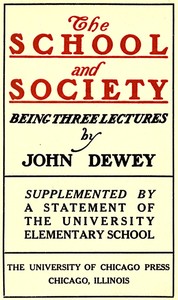
The School and Society
free to read
length
22,656 words
a few pages a day
~8 min
finished in
12 days
full read
1h 34m
At Folio's default of ten pages a day, you finish The School and Society in about 12 days — roughly 8 minutes of reading each morning.
The opening
the first pages of The School and Society, free
The three lectures presented in the following pages were delivered before an audience of parents and others interested in the University Elementary School, in the month of April of the year 1899. Mr. Dewey revised them in part from a stenographic report, and unimportant changes and the slight adaptations necessary for the press have been made in his absence. The lectures retain therefore the unstudied character as well as the power of the spoken word. As they imply more or less familiarity with the work of the Elementary School, Mr. Dewey’s supplementary statement of this has been added.
------------------------------------------------------------------------
AUTHOR’S NOTE
A second edition affords a grateful opportunity for recalling that this little book is a sign of the coöperating thoughts and sympathies of many persons. Its indebtedness to Mrs. Emmons Blaine is partly indicated in the dedication. From my friends, Mr. and Mrs. George Herbert Mead, came that interest, unflagging attention to detail, and artistic taste which, in my absence, remade colloquial remarks until they were fit to print, and then saw the results through the press with the present attractive result—a mode of authorship made easy, which I recommend to others fortunate enough to possess such friends.
It would be an extended paragraph which should list all the friends whose timely and persisting generosity has made possible the school which inspired and defined the ideas of these pages. These friends, I am sure, would be the first to recognize the peculiar appropriateness of especial mention of the names of Mrs. Charles R. Crane and Mrs. William R. Linn.
And the school itself in its educational work is a joint undertaking. Many have engaged in shaping it. The clear and experienced intelligence of my wife is wrought everywhere into its texture. The wisdom, tact and devotion of its instructors have brought about a transformation of its original amorphous plans into articulate form and substance with life and movement of their own. Whatever the issue of the ideas presented in this book, the satisfaction coming from the coöperation of the diverse thoughts and deeds of many persons in undertaking to enlarge the life of the child will abide.
January 5, 1900
------------------------------------------------------------------------
I THE SCHOOL AND SOCIAL PROGRESS
We are apt to look at the school from an individualistic standpoint, as something between teacher and pupil, or between teacher and parent. That which interests us most is naturally the progress made by the individual child of our acquaintance, his normal physical development, his advance in ability to read, write, and figure, his growth in the knowledge of geography and history, improvement in manners, habits of promptness, order, and industry—it is from such standards as these that we judge the work of the school. And rightly so. Yet the range of the outlook needs to be enlarged. What the best and wisest parent wants for his own child, that must the community want for all of its children. Any other ideal for our schools is narrow and unlovely; acted upon, it destroys our democracy. All that society has accomplished for itself is put, through the agency of the school, at the disposal of its future members. All its better thoughts of itself it hopes to realize through the new possibilities thus opened to its future self. Here individualism and socialism are at one. Only by being true to the full growth of all the individuals who make it up, can society by any chance be true to itself. And in the self-direction thus given, nothing counts as much as the school, for, as Horace Mann said, “Where anything is growing, one former is worth a thousand re-formers,”
Keep going from exactly here — Folio remembers your place and serves the next portion tomorrow.
continue reading The School and SocietyAbout this free edition
The School and Society by John Dewey (1859-1952) is free to read in full. Folio serves it in daily portions you can actually finish, tracks your streak and reading position across devices, and reads every page aloud with a built-in narrator. The text comes from Project Gutenberg.
More like The School and Society
How We Think
Folio
How We Think
John Dewey

Reconstruction in Philosophy
John Dewey
Democracy and Education
Folio
Democracy and Education
John Dewey
German Philosophy and Politics
Folio
German Philosophy and Politics
John Dewey

Ethics
John Dewey
Moral Principles in Education
Folio
Moral Principles in Education
John Dewey
China, Japan and the U.S.A.
Folio
China, Japan and the U.S.A.
John Dewey
The Child and the Curriculum
Folio
The Child and the Curriculum
John Dewey